
Respiratory System & 9 Air Sacs
Unidirectional Flow Mechanics & Cross-Current Gas Exchange
Scientific Overview & Physiological Context
Birds have the most efficient breathing system of any land animal on Earth. While mammals breathe in and out through dead-end lung sacs (leaving stale air trapped inside), chickens breathe with an unbroken, one-way stream of fresh oxygen powered by nine bellows-like air sacs.
The 9 Bellows: How Avian Air Sacs Work
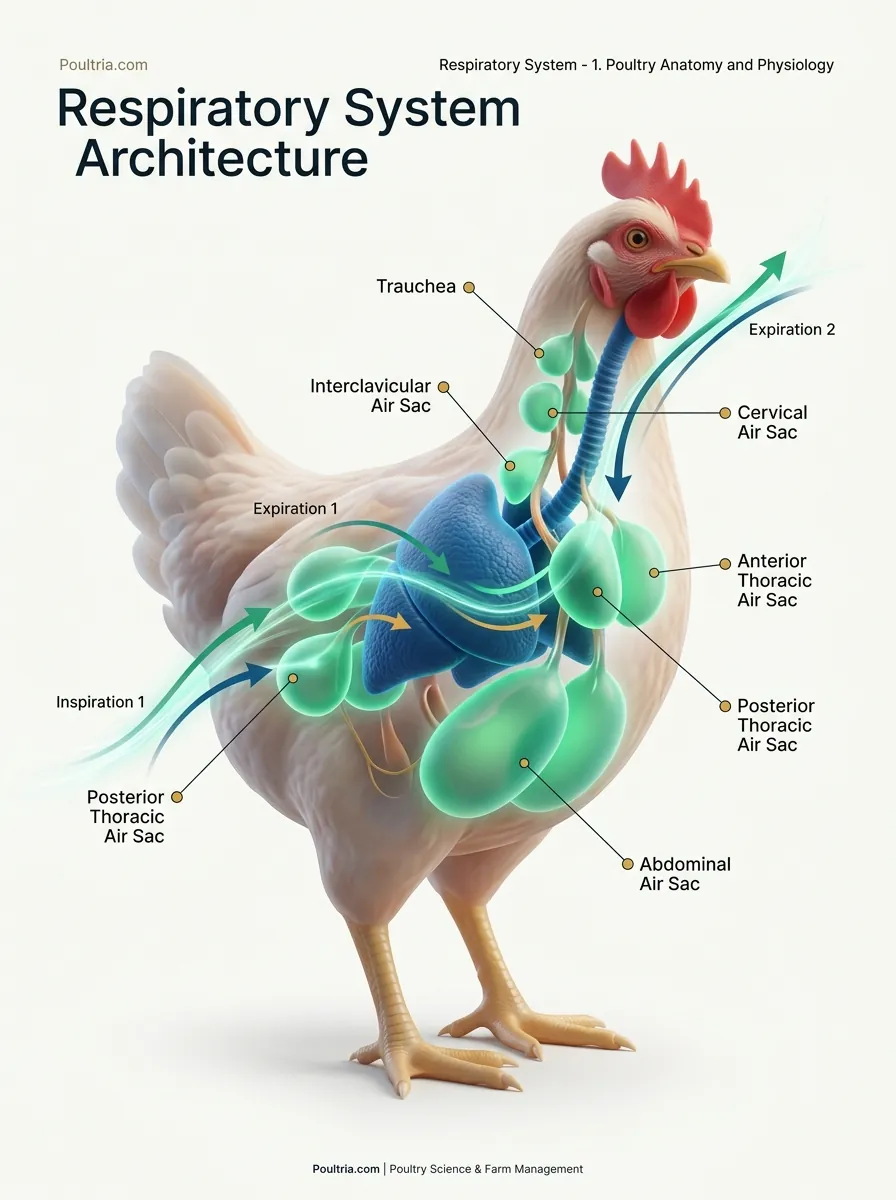
A chicken's lungs do not expand and deflate like human lungs. Instead, their lungs are small, rigid sponge-like structures embedded against the ribs. Connected to the lungs are nine delicate, transparent air sacs: one interclavicular sac, two cervical sacs in the neck, two anterior thoracic sacs, two posterior thoracic sacs, and two large abdominal sacs. These air sacs expand and contract like rubber bellows, pushing air continuously through the lungs in a steady, unbroken circuit.
It Takes Two Breaths for One Air Circuit
The magic of avian breathing is the two-breath cycle. When a bird takes Breath 1 In, fresh air bypasses the lungs and fills the posterior air sacs. On Breath 1 Out, those rear sacs squeeze, pushing that fresh air forward across the lungs for gas exchange. On Breath 2 In, the spent air is pulled into the front (anterior) sacs. Finally, on Breath 2 Out, the front sacs squeeze, venting the carbon dioxide out into the atmosphere. Fresh oxygen is always flowing in one constant direction.
Cross-Current Blood Exchange & The Ammonia Threat
Inside the lungs, tiny blood capillaries run at right angles across microscopic air tubes (parabronchi). This 'cross-current' flow makes oxygen transfer nearly 10 times more efficient than in mammals. However, because air sacs have very few protective immune cells, dirty air is dangerous. When shed ammonia rises above 15 to 20 ppm, it paralyzes the tiny cleaning hairs (cilia) in the windpipe, allowing inhaled dust and E. coli bacteria to settle directly into the sterile air sacs.
Core Biological & Management Mechanisms
Air requires two continuous inhalations and exhalations to complete its full journey from beak to exhaust.
Blood capillaries cross air parabronchi at 90-degree angles, extracting maximum oxygen from every breath.
Lungs stay rigid while flexible air sacs act as mechanical pumps driving continuous one-way air movement.
Because air sacs lack mucus-clearing cilia, ammonia levels >15 ppm quickly lead to severe airsacculitis.
Veterinary Takeaway & Practical Application
Never allow shed ammonia levels to climb above 15 ppm. High ammonia destroys tracheal cilia in just 48 hours, leaving the bird's open respiratory air sacs completely exposed to secondary bacterial infections like E. coli and Mycoplasma.
Launch 2-Breath Simulator →