
Growth Physiology (Hatch to Market)
Satellite Cell Kinetics, Allometric Organ Scaling & Muscle Accretion
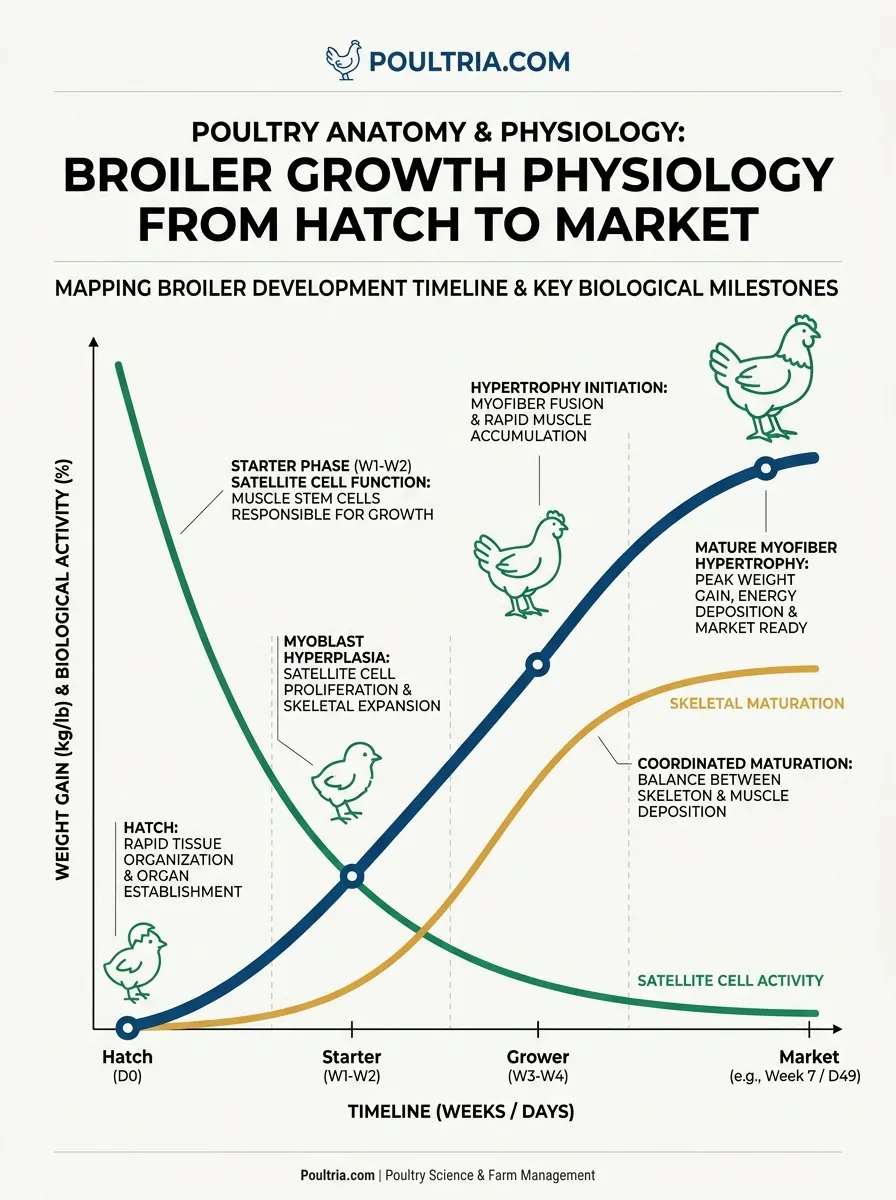
Scientific Overview & Physiological Context
In modern commercial broiler farming, a day-old chick weighing just 42 grams multiplies its body mass by more than 50 times in 38 to 42 days. Achieving this extraordinary growth requires understanding the biological phases of muscle cell multiplication and organ development.
The Golden First 7 Days: Muscle Satellite Cell Magic
A chick is born with all the muscle fibers it will ever have—muscle cell count cannot increase after hatch. Instead, post-hatch muscle growth happens by making existing fibers thicker. During the first 7 days of life, specialized muscle stem cells called satellite cells multiply rapidly and donate their nuclei into the growing muscle fibers. If chicks experience cold floors or delayed access to feed in week 1, satellite cell multiplication permanently stalls, capping maximum breast meat yield at harvest.
Organ Development First, Breast Meat Second
During the starter phase (Days 0 to 14), the chick's body prioritizes 'supply organs'—the heart, liver, gizzard, and intestines grow much faster than breast muscle. This early organ scaling builds the digestive and circulatory engine needed to handle the massive protein intake of the grower and finisher phases.
The Finisher Phase: Protein Accretion vs. Fat Pad Waste
After Day 28, breast muscle accretion peaks. As the bird approaches market weight (Day 35 to 42), the rate of lean protein deposition naturally slows down while abdominal fat deposition increases. Because building body fat takes roughly four times more feed energy than building lean muscle, managing the exact harvest day is crucial for maximizing profit margins.
Core Biological & Management Mechanisms
Chicks expand from 42g hatch weight to over 2,500g in 40 days under precision temperature and feed management.
Warm floor temperatures and immediate feed intake stimulate muscle satellite cells, setting final breast yield potential.
Cardiovascular and digestive organs develop during weeks 1–2 to support rapid muscle growth in weeks 3–5.
Growth follows an S-shaped Gompertz curve, reaching peak daily gain between 4 and 5 weeks of age.
Veterinary Takeaway & Practical Application
Every single extra gram of body weight achieved by Day 7 translates into +5 to +7 grams of live weight at slaughter on Day 35. Ensure 100% crop fill within 24 hours of chick placement to unlock full genetic growth potential.
Track Growth Targets →