
Cardiovascular System & Circulation
High-Pressure Hemodynamics & Renal Portal Shunt Mechanics
Scientific Overview & Physiological Context
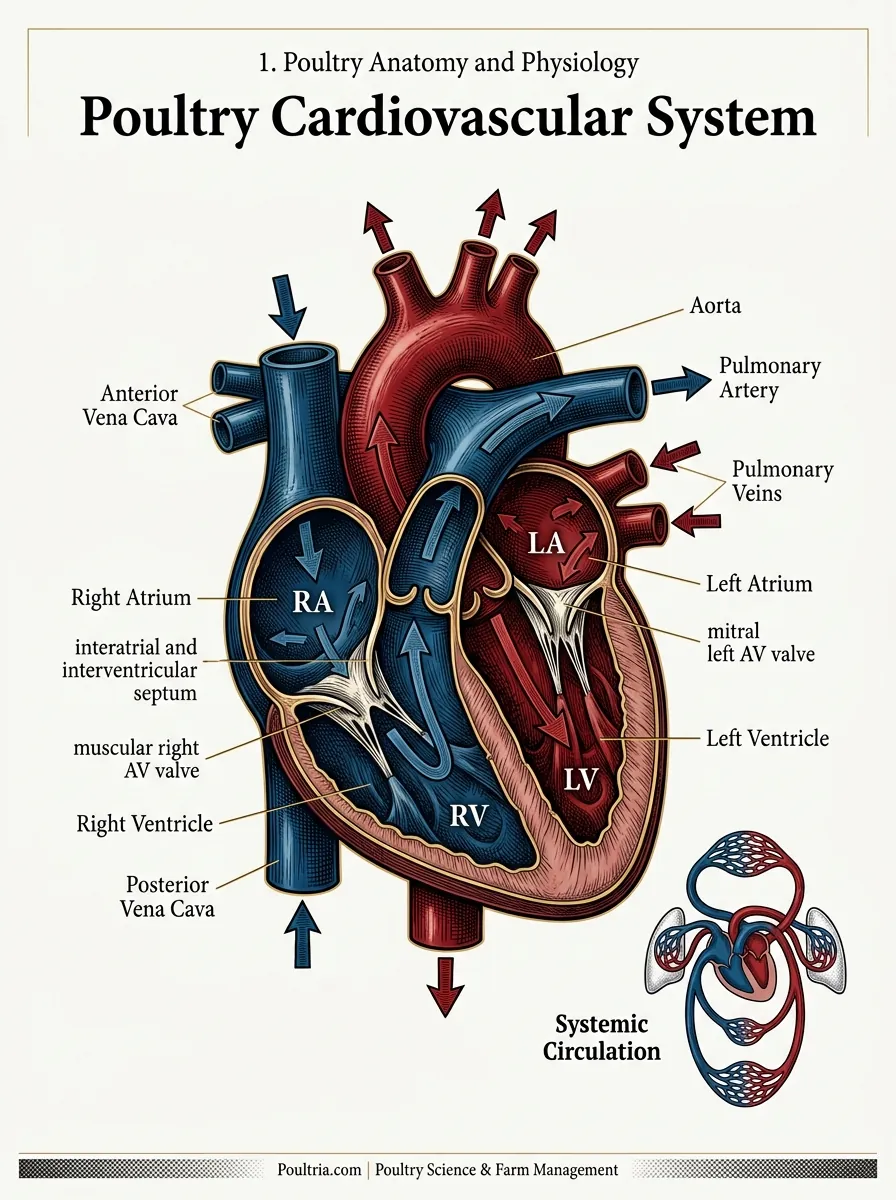
To support intense rapid growth, a chicken possesses a remarkably powerful four-chambered heart. Proportional to its body size, a chicken's heart is nearly twice as large as a mammal's, pumping blood at high systolic pressures (140 to 180 mmHg) to nourish fast-growing muscle tissue.
Four-Chambered Heart & Massive Cardiac Output
The avian heart is built for high performance, featuring complete separation between oxygen-rich arterial blood and oxygen-depleted venous blood across two atria and two thick ventricles. Instead of a delicate flapped tricuspid valve like mammals have, a chicken's right heart valve is a thick muscular wall. This muscular valve contracts forcefully with every beat to pump high volumes of blood through the lungs and out to the massive breast muscles.
The Unique Renal Portal Valve System
Chickens have a fascinating circulatory feature that mammals lack: a renal portal system. Venous blood returning from the legs and tail passes through specialized muscular valves. The bird's nervous system can open or close these valves to either filter the blood through the kidneys (to clear uric acid waste) or bypass the kidneys completely and shunt the blood straight back to the heart during periods of high physical stress.
The Hidden Danger: Pulmonary Hypertension & Ascites
Modern broilers grow breast muscle so rapidly that their hearts and lungs can struggle to keep pace. If the poultry house gets too cold or oxygen drops due to poor ventilation, the bird's body demands more oxygen. The heart responds by pumping faster and harder. Because the rigid lungs cannot expand to accommodate more blood flow, pressure spikes in the pulmonary artery. The right heart muscle enlarges, weakens, and eventually leaks plasma fluid into the belly—a condition known as Ascites (Water Belly).
Core Biological & Management Mechanisms
Rapid heart rate maintains strong blood flow and delivers nutrients continuously to fast-growing breast muscles.
Smart muscular valves direct venous blood from the legs either through the kidneys for waste filtration or back to the heart.
Managing early chick growth rates prevents heart muscle strain and eliminates fluid buildup in the abdomen.
Avian red blood cells retain active cell nuclei, efficiently carrying oxygen through high-velocity capillaries.
Veterinary Takeaway & Practical Application
Ascites (water belly) is fundamentally a heart failure caused by pushing early metabolic growth faster than lung capacity can support. Providing adequate brooding heat and using lighting programs during week 2 allows heart and lung capacity to develop safely.
Check Mortality Causes →