
Coccidiosis Eimeria Lesion Scale
Johnson & Reid 0-4 Lesion Scoring & Eimeria Species Mapping
Scientific Overview & Physiological Context
Coccidiosis is an intestinal parasitic infection caused by protozoa of the genus Eimeria. Costing the global poultry industry more than $14 billion annually, coccidiosis damages the gut lining, destroys feed conversion, and acts as the primary doorway for fatal necrotic enteritis.
Mapping the Eimeria Species to Specific Gut Zones
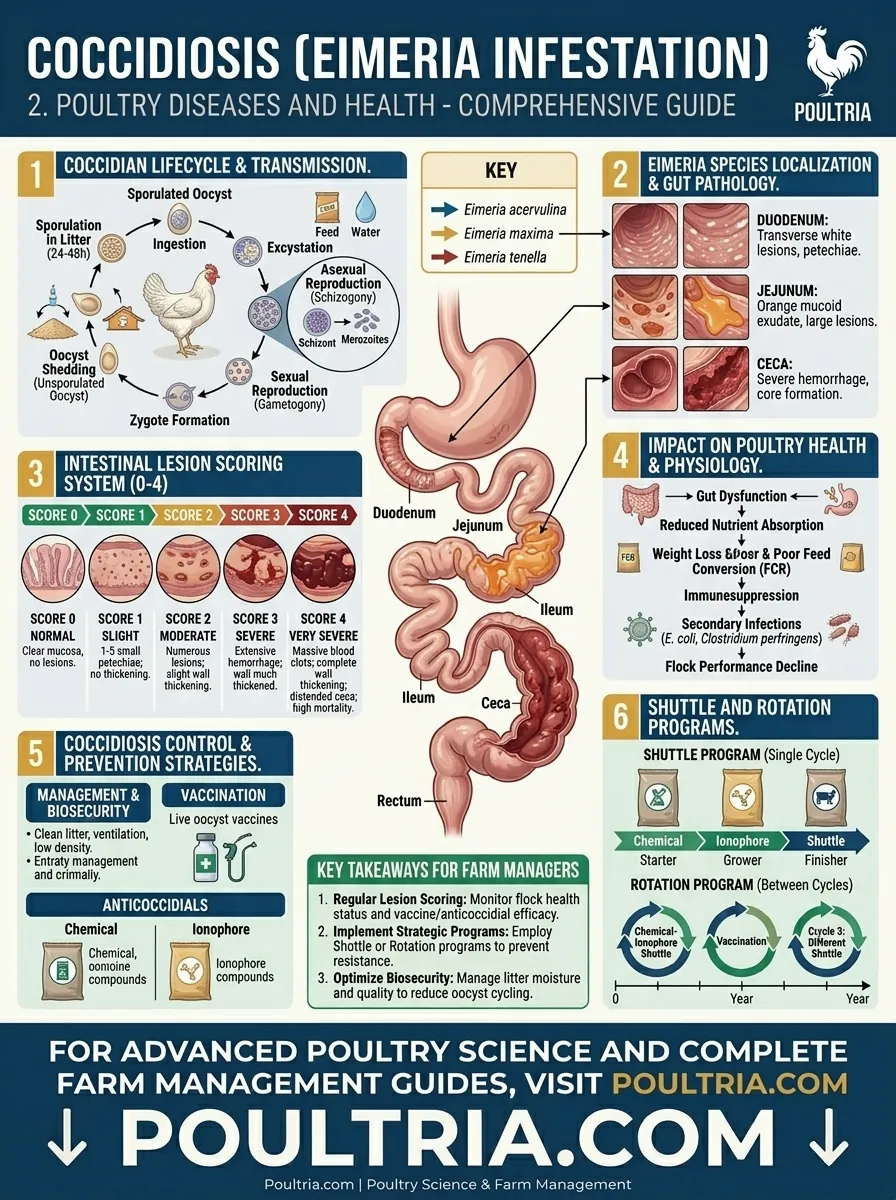
Different species of Eimeria attack specific segments of the digestive tract. Eimeria acervulina colonizes the upper duodenum, producing horizontal white ladder-like plaques. Eimeria maxima targets the mid-gut (jejunum), causing severe thickening, pinpoint petechiae, and thick orange mucoid exudate. Eimeria tenella destroys the blind ceca, filling them with clotted blood and solid caseous cores. Eimeria necatrix attacks the mid-gut with deep, ballooning hemorrhage.
The Johnson & Reid 0 to 4 Lesion Scoring Standard
To monitor subclinical gut damage in the field, poultry veterinarians use the standardized Johnson & Reid 0–4 scale: Score 0 = Completely healthy gut; Score 1 = Mild scattered white ladder plaques or tiny red pinpoints; Score 2 = Noticeably thickened intestinal wall with orange mucus; Score 3 = Severe wall thickening, blood clots, and ballooning; Score 4 = Total destruction of the mucosal lining with massive bleeding, core formation, and high mortality.
Shuttle and Rotation Programs vs. Oocyst Vaccination
Because Eimeria parasites adapt quickly to anticoccidial medications, farms use Shuttle Programs (using a synthetic chemical like nicarbazin in the starter feed, then switching to an ionophore like salinomycin in the grower feed) or full seasonal Rotations. In antibiotic-free (ABF) and layer flocks, live oocyst vaccines are sprayed on chicks at Day 0 to build natural active flock immunity through controlled cycling.
Core Biological & Management Mechanisms
Acervulina (Duodenum), Maxima (Mid-gut/Jejunum), and Tenella (Ceca) attack strictly defined intestinal zones.
The international gold standard used during routine weekly flock necropsies to catch subclinical gut damage early.
Rotating anticoccidial drug families across feed phases prevents drug resistance and preserves gut health.
Plasma leakage caused by E. maxima provides rich protein that fuels rapid Clostridium perfringens growth.
Veterinary Takeaway & Practical Application
Subclinical coccidiosis (Scores 1 to 2) causes zero visible mortality, but costs 5 to 10 points of FCR by destroying absorptive villi. Perform routine gut necropsies on 5 birds per house at Days 21, 28, and 35 to identify E. maxima peaks before performance drops.
Open Lesion Scorecard →