
Digestive System of a Layer
Calcium Flux Kinetics & Long-Term Gastrointestinal Endurance
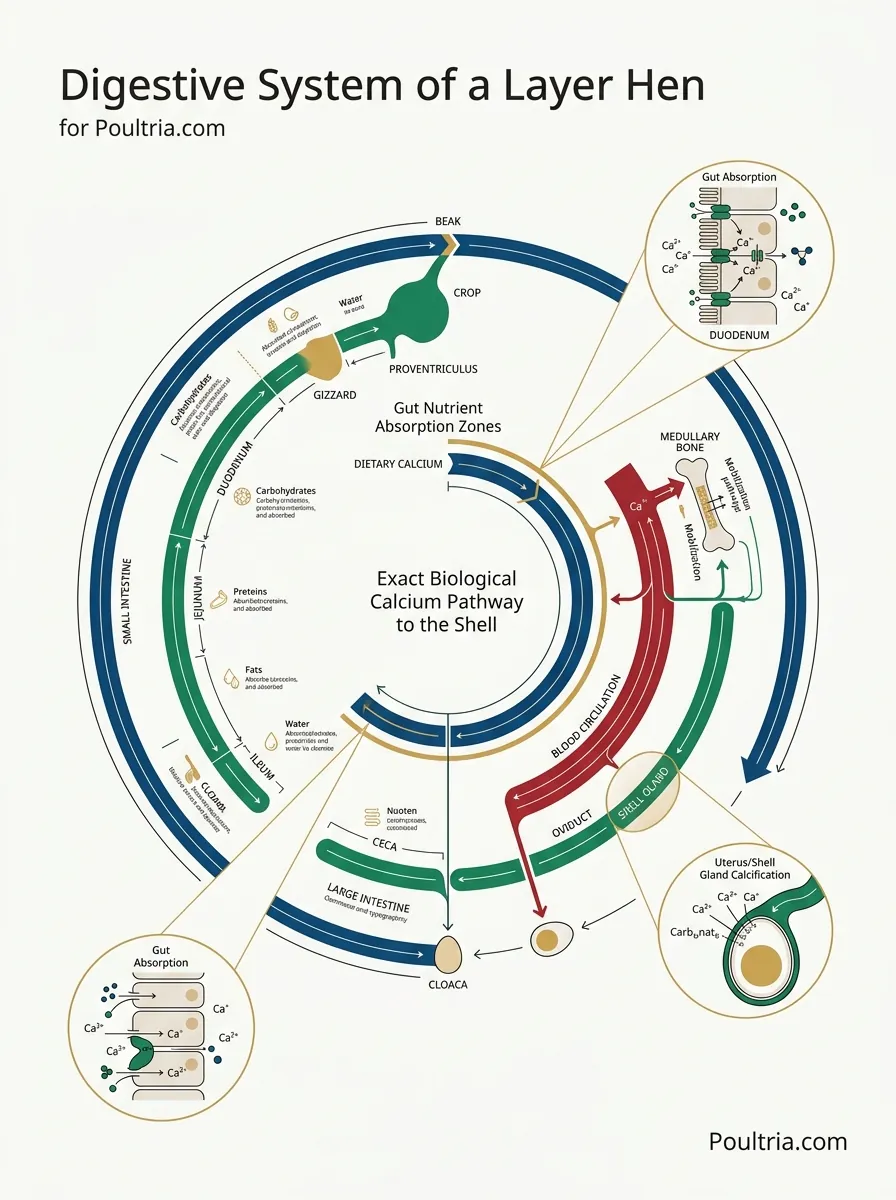
Scientific Overview & Physiological Context
While a broiler lives for around 6 weeks, a modern commercial laying hen is built for marathon endurance—producing over 350 eggs across 100+ weeks of life. Her digestive tract must process huge amounts of calcium every single day without burning out or breaking down her own bones.
The Daily Calcium Challenge: 2 Grams in 24 Hours
Every single eggshell requires roughly 2.0 to 2.2 grams of pure calcium. To supply that, a laying hen must absorb over 4 grams of dietary calcium daily. Her upper small intestine is packed with specialized calcium-transport proteins (Calbindin-D28k) activated by Vitamin D3. These cellular pumps extract ionized calcium from the gut and transport it straight into her bloodstream to supply the uterus (shell gland) during the critical nighttime calcification window.
Why Layer Gizzards Love Coarse Fiber
Compared to fast-growing broilers, adult laying hens have larger, more muscular gizzards and significantly longer ceca. This gives them the natural ability to digest fibrous feeds (4% to 6% crude fiber). Dietary fiber keeps feed moving steadily, satisfies the hen's natural foraging instinct, and drastically reduces behavioral feather pecking in modern cage-free aviary barns.
The Science of Afternoon Split-Feeding
Eggshell calcification primarily happens at night while the hen is resting in the dark. If the hen is only fed fine limestone powder in the morning, it dissolves too fast and gets excreted by noon, forcing her body to rob calcium from her own bones at night. Feeding coarse limestone particles (2 to 4 mm) in the afternoon keeps hard calcium stones slowly dissolving inside her gizzard all night long, protecting her skeleton.
Core Biological & Management Mechanisms
Vitamin D3-driven transport proteins in the gut wall pull up to 4g of dietary calcium daily to build strong eggshells.
Coarse limestone particles (>2.5 mm) dissolve slowly in the gizzard across 10 hours, keeping blood calcium steady all night.
Expanded ceca and gizzard allow layers to thrive on high-fiber diets, promoting natural satiety and calm flock behavior.
A resilient intestinal mucosal barrier designed to maintain peak egg production for over 700 consecutive days.
Veterinary Takeaway & Practical Application
Never feed pure fine-powder limestone to laying flocks. Ensure that 65% to 70% of afternoon dietary calcium is provided as coarse limestone grits (2–4 mm). This simple feeding adjustment prevents cage layer fatigue and reduces cracked eggs by up to 15%.
Open Layer ROI Tool →