
Mycoplasma Infections (MG vs MS)
Chronic Respiratory Disease (CRD) & Infectious Synovitis Pathology
Scientific Overview & Physiological Context
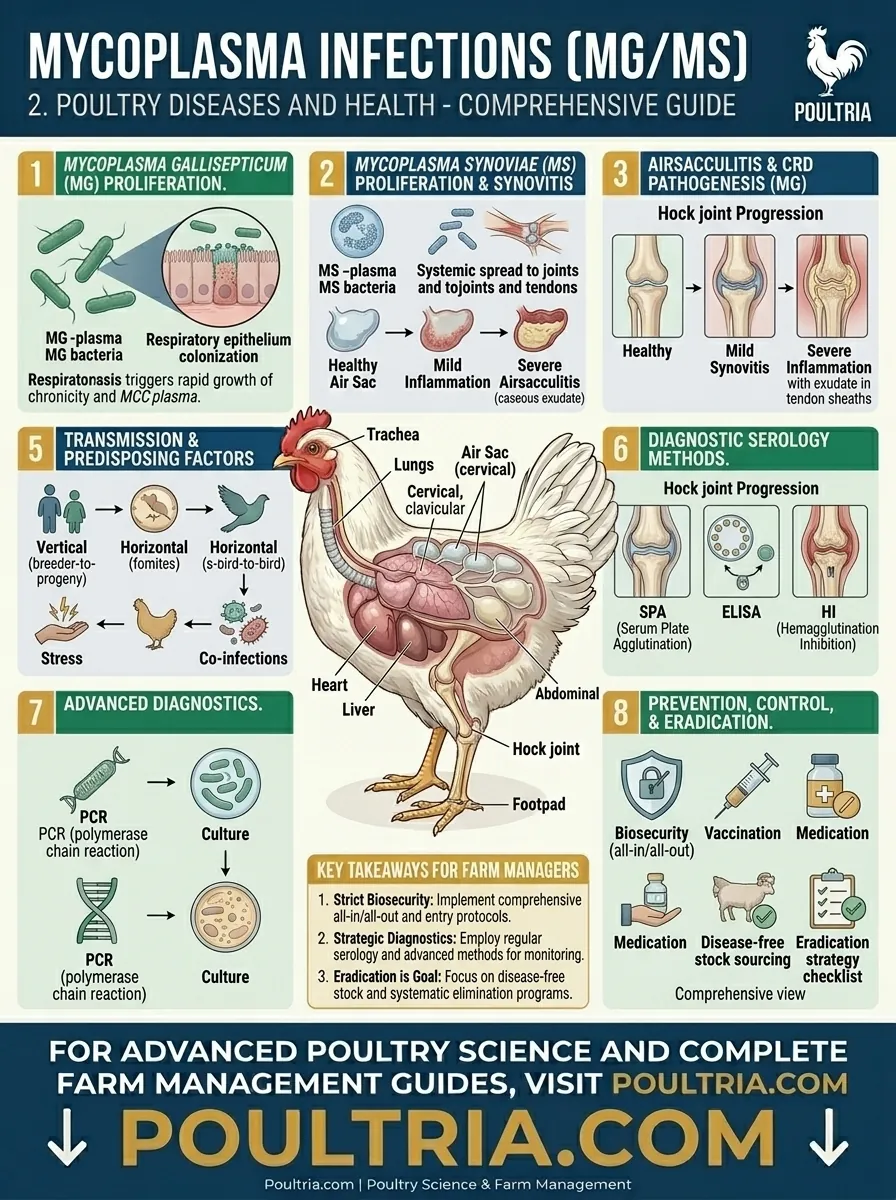
Mycoplasmas are tiny, specialized bacteria that completely lack a cell wall. In commercial poultry, Mycoplasma gallisepticum (MG) is the chief driver of Chronic Respiratory Disease (CRD), while Mycoplasma synovitis (MS) causes severe joint lameness and brittle, cracked eggshell apex abnormalities.
Why Penicillins Don't Work: The Zero-Cell-Wall Trap
Mycoplasma gallisepticum (MG) and Mycoplasma synovitis (MS) belong to the class Mollicutes. Unlike standard bacteria, they have no peptidoglycan cell wall—only a delicate triple-layered cell membrane. Because beta-lactam antibiotics (like penicillin and amoxicillin) work by destroying bacterial cell walls, they are completely useless against Mycoplasmas. Treatment requires macrolides (tylosin, tilmicosin), pleuromutilins (tiamulin), or tetracyclines.
MG: Chronic Respiratory Disease (CRD) and Airsacculitis
MG uses a specialized terminal attachment tip (pMGA adhesin) to latch onto ciliated cells in the windpipe. On its own, MG causes mild coughing and foamy eyes. But when combined with shed ammonia (>15 ppm) or live respiratory vaccines, it triggers severe Chronic Respiratory Disease (CRD). The air sacs thicken and fill with foul, yellow, cheesy caseous exudate, accompanied by fibrinous pericarditis around the heart.
MS: Swollen Hock Joints & Eggshell Apex Abnormalities (EAA)
Mycoplasma synovitis (MS) colonizes the synovial membranes of joints and tendon sheaths, causing swollen hocks, breast blisters, and severe flock lameness. Furthermore, certain MS strains infect the hen's oviduct shell gland, causing Eggshell Apex Abnormalities (EAA)—producing a rough, thin, translucent zone on the pointed end of the egg that easily cracks during packing.
Core Biological & Management Mechanisms
Lack of cell wall makes penicillins useless; requires macrolides (tylosin), tiamulin, or tetracyclines.
MG teams up with ammonia and E. coli, transforming mild snicks into severe cheesy airsacculitis and heart lesions.
MS infection in the shell gland produces a rough, translucent, easily broken cone at the pointed tip of the egg.
Transmitted vertically from breeder hens to chicks through the egg, making disease-free parent stock essential.
Veterinary Takeaway & Practical Application
Maintaining Mycoplasma-free parent stock is the gold standard of modern poultry production. In infected multi-age commercial layer complexes where eradication is impossible, vaccinate replacement pullets with live ts-11 or 6/85 vaccines to prevent field strain colonization.
View Mycoplasma Guide →