
Immune Organs of Poultry
Primary Lymphoid Tissues, Bursa of Fabricius & Mucosal Immunity
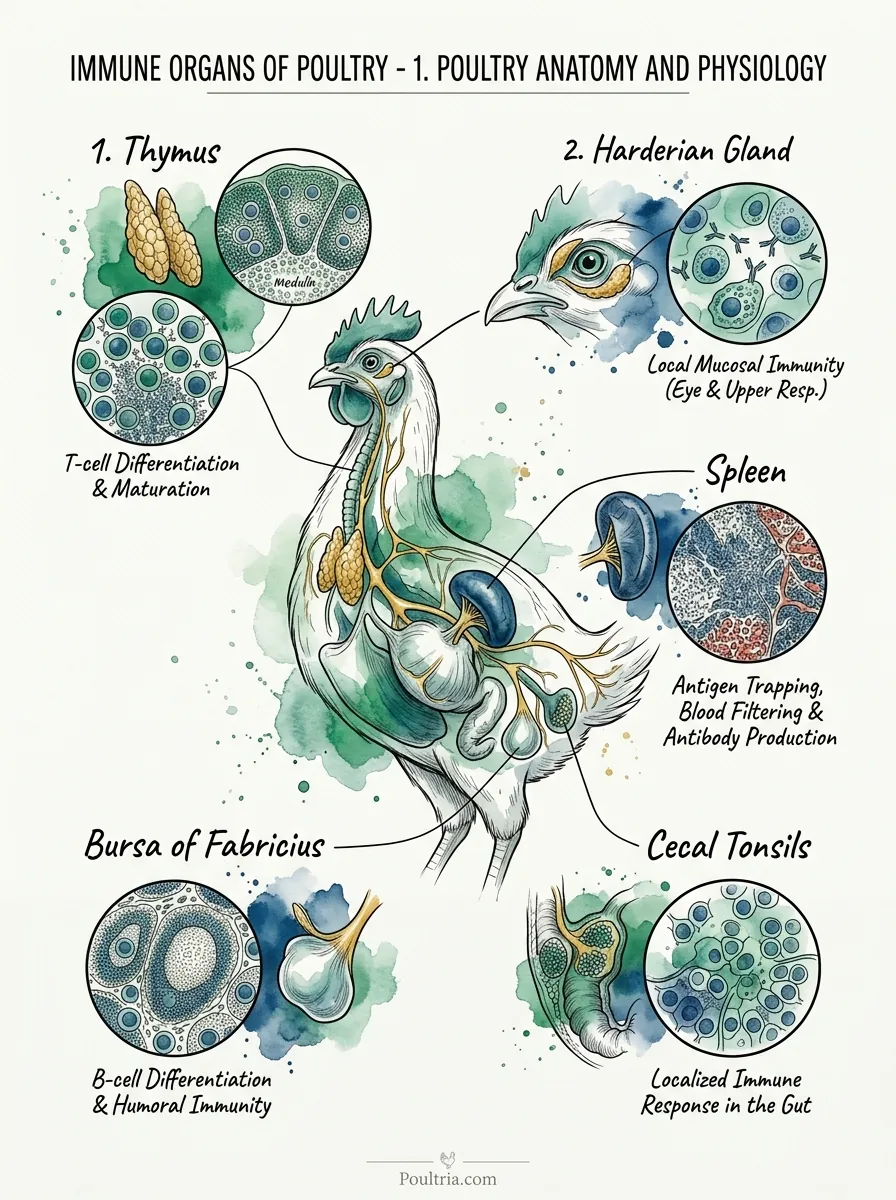
Scientific Overview & Physiological Context
Unlike mammals, chickens do not have encapsulated lymph nodes scattered along their blood vessels. Instead, poultry rely on specialized primary immune organs—most notably the Bursa of Fabricius and Thymus—along with dense immune tissue patches in the gut and eyes.
The Bursa of Fabricius: The B-Cell Antibody Factory
The Bursa of Fabricius is a round lymphoid sac located just above the cloaca. It is the absolute cradle of avian humoral immunity. In the first weeks of a chick's life, immature B cells migrate to the Bursa, where they undergo gene conversion to create diverse antibodies (IgY, IgM, and IgA). Without a healthy Bursa, a chicken cannot produce antibodies in response to vaccines or field infections.
The Thymus, Spleen, and Cecal Tonsils
Running in paired chains along both sides of the neck is the Thymus, which trains T lymphocytes for cell-mediated immunity. In the abdomen, the round Spleen acts as the blood's master filter, capturing circulating pathogens. Down in the gut, large lymphoid patches called Cecal Tonsils and Peyer's patches guard the intestinal entrance, neutralizing swallowed viruses and bacteria before they breach the mucosal wall.
The Devastation of Early Immunosuppression
Because the Bursa and Thymus develop during early chick brooding, viral diseases that attack these organs (such as Gumboro / IBD, Marek's Disease, or Chicken Anemia Virus) cause severe, permanent immune suppression. When the Bursa is damaged in young chicks, their bodies cannot respond to future vaccines for Newcastle or Bronchitis, leaving the flock defenseless.
Core Biological & Management Mechanisms
The dedicated factory where B cells mature and learn to produce protective antibodies against farm diseases.
Neck lobes that produce killer T cells and coordinate the body's cellular immune defense network.
A specialized gland behind the eye that secretes local mucosal IgA antibodies to protect the head and sinuses.
Massive lymphoid patches at the ileocecal junction that capture and destroy swallowed gut pathogens.
Veterinary Takeaway & Practical Application
The Bursa of Fabricius reaches peak size between 4 to 8 weeks of age before naturally shrinking. Any viral challenge (Gumboro) or mycotoxin exposure (Aflatoxin, T-2) during this critical window permanently damages flock immunity and vaccine response.
Open Vaccine Schedules →