Skeletal System & Pneumatic Bones
Biomechanical Framework, Keel Bone & Medullary Calcium Storage
Scientific Overview & Physiological Context
The avian skeleton is a masterclass in natural engineering. It achieves remarkable strength while remaining incredibly lightweight through hollow, air-filled bones and fused vertebral plates that provide a rigid, stable chassis for walking, perching, and wing movement.
Hollow Pneumatic Bones: Built Like an Airplane Wing
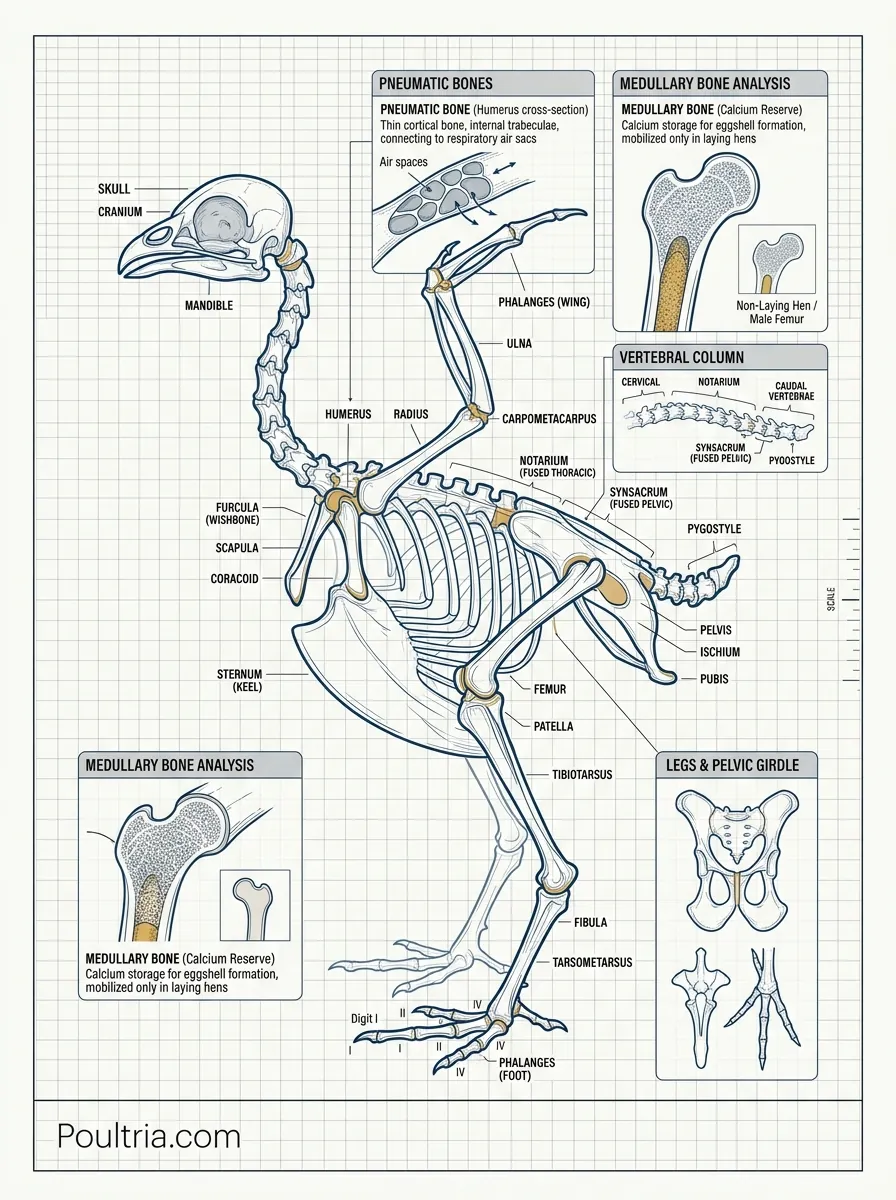
To keep body weight to a minimum, major avian bones (including the humerus, coracoid, vertebrae, and pelvic girdle) are hollow inside. Instead of being packed with heavy marrow, they are filled with honeycomb-like struts and air sac diverticula. These air cavities reduce total bone weight by roughly 40% while preserving high structural strength under compression and mechanical tension.
Fused Bones: The Keel, Notarium, and Synsacrum
While humans have flexible spines, a chicken's spine is fused into rigid bony sections to absorb physical shock. The upper thoracic vertebrae fuse into the notarium, while the lower spine and pelvis fuse into the synsacrum. On the bird's chest sits the massive keel bone (carina sterni), which acts as a broad structural anchor for the pectoralis major breast muscles—comprising up to 25% of the bird's total body weight.
Medullary Bone: The Hen's Emergency Calcium Bank
Female chickens possess a unique type of bone called medullary bone, found inside the marrow cavities of long bones. Under the influence of reproductive hormones, the hen builds this labile calcium bank before she lays her first egg. When she synthesizes an eggshell in the dark of night and gut absorption slows down, her body safely withdraws up to 1 gram of pure calcium from this internal bank.
Core Biological & Management Mechanisms
Hollow bones connected to the respiratory system reduce body mass while honeycomb struts prevent fractures.
The large chest keel provides a wide surface area to anchor massive pectoralis breast muscle meat.
Fused spinal sections (notarium & synsacrum) absorb ground impacts when running and perching without spinal strain.
A rapid-access calcium reservoir mobilized every night during eggshell formation to protect structural bones.
Veterinary Takeaway & Practical Application
In laying hens, if dietary calcium runs short, the bird will deplete her medullary bone reserves within days, leading to brittle bones and Cage Layer Fatigue (osteomalacia). Ensure pullets achieve 100% frame and shank development before lay begins.
Check Keel Health →