
Thermoregulation in Chickens
Sensible vs. Latent Heat Dissipation & Panting Dynamics
Scientific Overview & Physiological Context
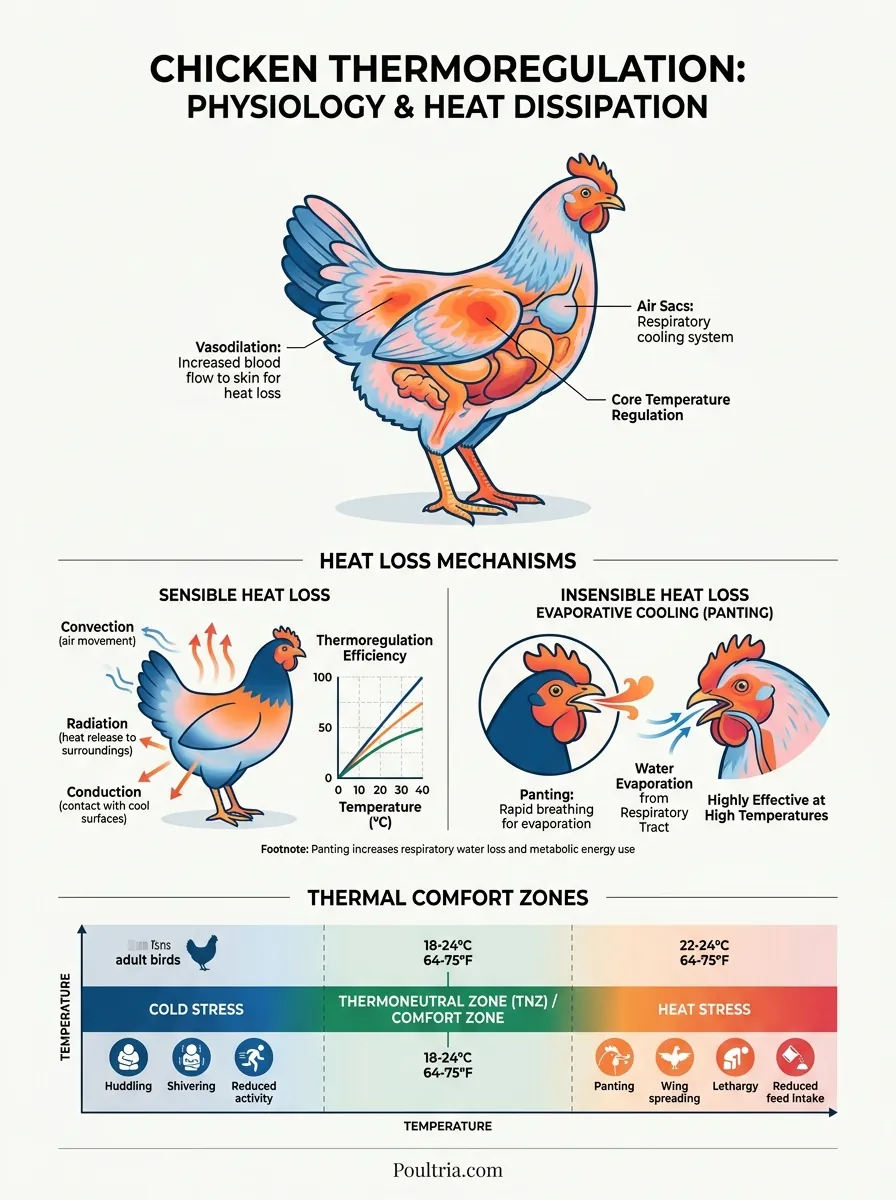
Because chickens lack sweat glands and wear an insulating feather coat, hot weather is their greatest physical challenge. To survive hot summer days, chickens rely on a delicate balance between sensible heat loss (radiating warmth from bare skin) and evaporative panting.
Sensible Heat Loss in the Comfort Zone (18°C–24°C)
Inside their natural comfort zone, chickens stay cool easily through sensible heat loss. Warm blood is pumped out to bare, unfeathered skin areas like the comb, wattles, and lower legs. Heat naturally radiates off into the cooler surrounding air or is carried away by gentle air movement. The bird barely needs to expend any extra metabolic energy to stay balanced.
The Evaporative Shift: When Panting Takes Over
When house temperatures rise above 28°C to 30°C (82°F–86°F), sensible heat loss stops working because the air is just as warm as the bird's skin. The chicken has only one remaining cooling tool: evaporative panting (gular fluttering). By breathing rapidly with an open beak (over 200 breaths a minute), the bird evaporates moisture from its throat and air sacs, shedding heat into the passing air.
The Risk of Respiratory Alkalosis and Thin Shells
Heavy panting carries a dangerous side effect. As the bird hyperventilates, it blows off huge amounts of carbon dioxide (CO2) from its blood. This causes the blood pH to turn alkaline (respiratory alkalosis). When blood pH rises, ionized calcium binds to blood proteins, leaving less free calcium available for eggshell calcification. This is why heat-stressed hens suddenly lay thin-shelled and cracked eggs.
Core Biological & Management Mechanisms
A bird's natural internal core temperature is high, requiring constant heat removal to prevent heat stroke.
High air velocity over feathered birds creates a convective wind-chill that lowers effective temperature by 5°C to 7°C.
Panting evaporates moisture from respiratory membranes when air temperatures rise above 30°C.
Panting-induced blood alkalosis requires supplemental sodium bicarbonate and potassium in drinking water.
Veterinary Takeaway & Practical Application
When shed humidity exceeds 70% during hot weather, evaporative cooling pads lose effectiveness. Prioritize high tunnel airspeed (2.5 to 3.0 m/s) to maximize convective wind-chill cooling, and supplement sodium bicarbonate in the feed to protect eggshell strength.
Check Heat Stress THI →