
Automatic Chicken Coop Doors: Light Sensor vs Timer & Predator Testing
Compare automatic chicken coop doors: lux sensors vs programmable timers, anti-pinch safety motors, winter freeze resistance, and raccoon pry-force testing.
Scientific Overview
Automatic chicken coop doors provide reliable protection against dusk predator ambushes, but choosing the wrong mechanism can trap hens outside or fail during sub-zero winters. While photocell (lux) sensors open and close with seasonal dawn and dusk shifts, sudden evening thunderstorms can trigger premature closure that locks out subordinate stragglers. In contrast, programmable real-time clock (RTC) timers offer absolute predictability. For predator defense, doors must utilize internal worm drives or automatic mechanical deadbolts to withstand the 4.5 kg (10.0 lbs) of upward lift force exerted by hungry raccoons.
1. Predator-Proof Automatic Chicken Coop Doors: Worm Drives vs Raccoon Lifting
The primary duty of automatic chicken coop doors is absolute nocturnal structural integrity. Choosing a genuine predator proof automatic coop door is critical because dusk and midnight are peak hunting windows for northern raccoons (Procyon lotor), red foxes (Vulpes vulpes), coyotes, and mink. Raccoons possess extraordinary tactile dexterity: wildlife field testing reveals an adult raccoon can wedge its claws into a 3 mm (1/8-inch) bottom seam and exert up to 4.5 kg (10.0 lbs) of upward vertical lift force.
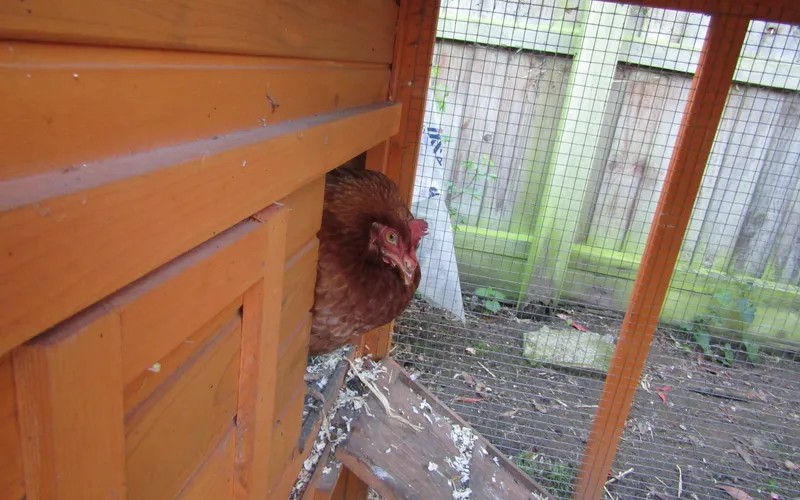
To ensure an automatic coop door raccoon proof defense, the internal motor drive mechanism must mechanically lock upon descent. Review the drive classifications below:
Drive Mechanism Classification & Predator Security
| Drive Type | Operating Principle | Raccoon Lift Resistance | Freeze Tolerance | Failure Vulnerability |
|---|---|---|---|---|
| Direct Worm-Drive Screw | Motor turns threaded steel lead-screw directly coupled to door | 100% Locked (Physically impossible to back-drive) | High (Heavy torque) | Debris jamming threads if unshielded |
| Rack-and-Pinion with Cam Lock | Toothed track driven by motor cog with mechanical drop-pin | High (When cam engages) | Moderate | Ice buildup in gear teeth |
| String / Cord with Auto-Locking Wings | Winch cord lowers door; side spring-loaded tabs flare into track | High (Locks against frame) | Moderate | String fraying or snapping over time |
| Basic Gravity Drop String Door | Smooth guillotine plate lowered by loose string (No lock) | FAIL (Lifted in seconds) | Low | Zero predator resistance; cord tangles |
The Raccoon Lift Test: Once your automatic door is installed and fully closed, insert your fingers beneath the bottom edge and pull upward with moderate strength (5 kg / 11 lbs of force). If the door lifts even 2 cm (1 inch), it is NOT predator proof. A raccoon will slide its hands underneath, push the panel up into the housing, and decimate your flock.
2. Light Sensor vs Timer Chicken Door Controls: Photocell vs. Digital RTC
When evaluating a light sensor vs timer chicken door configuration, understanding their distinct behavioral and environmental failure modes is essential for flock safety. Automated door controllers rely on either optical photocell sensors (measuring ambient lux) or Real-Time Clock (RTC) quartz digital timers.
The Photocell (Light Sensor) Dilemma
Photocells automatically adjust to changing day lengths throughout the year without requiring manual reprogramming. However, optical sensors suffer from two severe environmental vulnerabilities:
- The Summer Thunderstorm False-Close: Dense cumulonimbus thunderstorm clouds at 4:00 PM can drop ambient light levels below 5 lux. A simple light sensor interprets this darkness as nightfall and closes the door, locking the entire foraging flock outside in a severe storm.
- Artificial Light Interference: Motion-activated floodlights, yard security lights, or vehicle headlights hitting the sensor at midnight can trick the door into opening in pitch darkness, inviting nocturnal predators straight into the sleeping henhouse.
Flock Roosting Ethology: The 'Straggler' Rule
Chickens possess poor crepuscular (low-light) vision due to an evolutionary predominance of retinal cones over rods. When dusk falls, hens enter the coop in strict hierarchical order:
Dominant hens secure prime roost space first. Low-ranking subordinate pullets and timid older hens linger outside, waiting until the commotion subsides, often entering 15 to 25 minutes after the first bird. If an automatic door closes promptly at the onset of twilight, these subordinate stragglers are locked out and will huddle helplessly under the coop where predators pick them off.
The Veterinary Recommendation: Choose a door controller with a programmable delay offset (20 to 30 minutes after sunset lux threshold) or utilize a digital RTC timer set to lock 30 minutes after true sunset in your geographic latitude.
3. Anti-Pinch Chicken Coop Door Safety: Sensor Biomechanics & Stall Protection
A slow-moving motorized metal door with strong gear torque presents a serious physical hazard to late-entering birds. An engineered anti pinch chicken coop door prevents catastrophic compression injuries if a hen pauses in the threshold to inspect bedding or preen.
Biomechanical Injury Thresholds
An adult chicken’s trachea consists of delicate cartilaginous rings. Static compression exceeding 1.5 kg (3.3 lbs) across the cervical vertebrae causes tracheal collapse, rapid hypoxemic asphyxiation, and permanent nerve paralysis within minutes. Similarly, entrapment of the tarsometatarsus (lower leg) frequently results in compound bone fractures.
Essential Safety Countermeasures in Quality Doors
- Current-Sensing Motor Cut-Off: Advanced microprocessors monitor the DC motor’s electrical amperage draw in real time. When the descending door encounters even 0.5 kg (1.1 lbs) of resistance against a chicken's back, motor amperage spikes instantaneously. The controller detects this spike, halts motor rotation in < 150 milliseconds, and triggers an auto-reverse back to the fully open position.
- Infrared Optical Curtains: High-end doors project an invisible infrared beam across the bottom 5 cm (2.0 inches) of the door threshold. If a bird breaks the beam, the door will not descend.
- Multi-Cycle Re-Attempt Algorithm: After reversing from an obstruction, a properly programmed door waits 60 to 120 seconds for the bird to move inside before attempting a slow secondary closure.
4. Best Automatic Chicken Door for Winter: Sub-Zero Freeze Resistance & Batteries
Winter is the ultimate proving ground for automated henhouse equipment. Selecting the best automatic chicken door for winter requires engineering that operates reliably when temperatures plunge to -20°C to -30°C (-4°F to -22°F), overcoming mechanical and electrochemical failure points:
1. Track Freeze-Welding & Thermal Contraction
Chicken breath and droppings generate high relative humidity inside the coop. At night, warm moist internal air hits cold exterior aluminum guide rails, condensing and freezing into solid rime ice. If the door panel sits with tight tolerances, the ice bonds the panel to the frame, stalling the motor.
- Design Fix: Select doors with wide channel clearances (≥ 3 mm) and integrated bottom weep holes that allow meltwater to drain freely rather than pooling.
- Lubricant Rule: Never use grease, petroleum jelly, or WD-40 on door tracks. Petroleum greases congeal into sticky molasses below 0°C, and wet sprays attract fine pine dust that forms a gritty abrasive paste. Use only dry PTFE (Teflon) spray lubricant.
2. Battery Chemistry Under Extreme Cold
Standard alkaline AA batteries lose up to 70% of their operational capacity at -15°C (5°F) because chemical reaction rates slow drastically. The door may have enough power to lift on a sunny afternoon, but will fail to close during a sub-zero midnight freeze.
- Lithium Iron Phosphate (LiFePO4) or Energizer Ultimate Lithium: Lithium primary batteries operate reliably down to -40°C (-40°F) with minimal voltage drop.
- Solar Automatic Chicken Door Configurations: For completely off-grid homesteaders, configuring a solar automatic chicken door with a 10W monocrystalline solar panel connected to a 12V 7Ah rechargeable AGM/SLA battery housed inside an insulated battery box provides year-round, freeze-proof reliability.
5. Interactive Automatic Coop Door Selector: Solar, Battery & Timer Sizing
Evaluate your specific climate conditions, electrical power availability, and local predator pressure to receive a tailored engineering recommendation on drive mechanisms, control logic, and power supply configurations.
Automatic Chicken Coop Doors: Light Sensor vs Timer & Predator Testing — Frequently Asked Questions
Add Poultria to your Google Preferred Sources
Follow Poultria on Google so our peer-reviewed poultry veterinary research, commercial breed genetics, and agronomic field guides are highlighted and cited first in your Google Search, Top Stories, and AI Overviews.