
How to Tell Rooster from Hen: Vent Sexing, Feather Sexing & Comb Growth
The definitive poultry genetics and diagnostic guide to sex identification: Japanese vent examination, sex-linked feathering alleles (K/k+), autosexing breeds, and juvenile secondary sex traits.
Scientific Overview
Accurate sex identification of chickens (Gallus gallus domesticus) is a fundamental operational discipline in both commercial poultry hatcheries and smallholder flocks. Unlike mammals where the male is heterogametic (XY), birds utilize a ZW sex-determination system in which the female is the heterogametic sex (ZW) carrying the female-determining W chromosome, and the male is homogametic (ZZ). Determining the sex of day-old chicks is notoriously challenging because the external genitalia are largely internalized within the cloaca. Over the past century, commercial poultry breeding has evolved three specialized scientific methodologies: Japanese manual vent sexing, sex-linked rapid vs slow feathering crosses (the K/k+ gene complex), and down-color autosexing. For backyard flocks where genetic crosses are unknown, sequential tracking of juvenile endocrine markers—including comb vascularization, hackle and saddle feather geometry, and behavioral dominance—provides definitive differentiation as birds mature.
1. Japanese Vent Sexing: Cloacal Anatomy & Eminence Differentiation
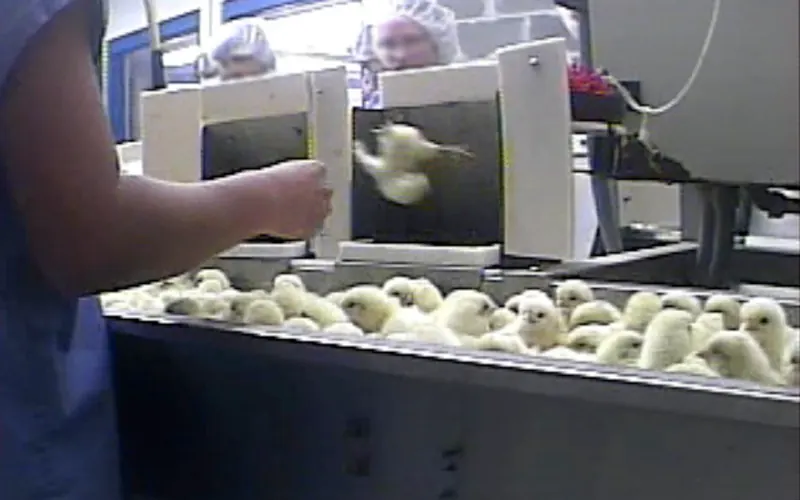
Developed in Japan during the 1920s by Drs. Kiyoshi Masui and Juro Hashimoto, manual vent sexing revolutionized the global commercial egg industry. By examining the micro-anatomical structures of the proctodeum within the inverted dorsal cloaca of 1-day-old chicks under a high-intensity 200W concentrated lamp, expert chick sexers achieve 95% to 98% accuracy at speeds exceeding 1,000 to 1,200 chicks per hour.
Cloacal Micro-Anatomy & Genital Eminence Conformations
The externalized proctodeum features a rudimentary copulatory papilla known as the genital eminence located on the ventral rim of the cloaca:
- Male Cockerel (ZZ): Possesses a distinct, firm, globular or bead-like central genital eminence (the rudimentary papilla penis). When lateral traction is applied to the vent margin, the male eminence remains rigid, raised, and glistening without disappearing. Over 15 micro-conformations exist, ranging from globular and conical to flanged types.
- Female Pullet (ZW): Typically exhibits no visible central eminence (flat, smooth mucosal wall) or displays an amorphous, soft, depressed fold that flattens out and vanishes completely when the cloacal rim is gently stretched. A small percentage of females possess a tiny non-erect pseudotubercle, requiring microscopic tactile discernment.
Professional vent sexing requires hundreds of hours of formal training. The neonatal cloacal and rectal walls are fragile single-cell layers. Inexperienced attempts to squeeze and evert the vent frequently cause rectal rupture, cloacitis, septic yolk sac contamination, cloacal prolapse, and fatal internal peritonitis. Backyard flock owners are strongly advised against attempting manual vent sexing on day-old chicks.
2. Sex-Linked Feather Sexing: The K and k+ Alleles & Wing Covert Anatomy
Feather sexing (wing sexing) is a rapid, non-invasive genetic technique that enables sex differentiation within the first 24 to 72 hours post-hatch based on the relative lengths of primary flight feathers versus overlying covert feathers. This method relies entirely on the sex-linked feathering locus located on the Z sex chromosome.
The Genetic Cross Formula
The dominant allele K confers slow early feathering (delayed primary feather emergence), while the recessive allele k+ confers rapid, normal early feathering. Because female birds are hemizygous (ZW) carrying only one Z chromosome:
• Female Dam: Slow-Feathering Hen (Genotype: K/– on Z chromosome)
• Male Sire: Rapid-Feathering Rooster (Genotype: k+/k+ homozygous recessive)
Progeny Distribution:
• Female Pullet Chicks (ZW): Inherit the sire's recessive k+ chromosome → Rapid Feathering (k+/–).
• Male Cockerel Chicks (ZZ): Inherit the dam's dominant K and sire's k+ → Slow Feathering (K/k+).
Wing Inspection Anatomy (Day 1 to 3)
Spread the chick's wing fan open under good light to inspect the two parallel tiers of nascent feather quills:
- Female Pullet (Rapid Feathering): The lower tier (primary flight feathers) is visibly longer (at least 2.0 mm to 3.0 mm) than the upper tier (covert feathers). This alternating step-up pattern confirms a female with > 98% accuracy.
- Male Cockerel (Slow Feathering): The primary flight feathers and covert feathers are identical in length, or the covert feathers are actually longer than the primaries. In severe slow feathering, the wing margin appears completely bare with barely visible stub quills.
- Critical Time Window: Inspection must occur between 12 and 72 hours post-hatch. By Day 4 to 5, the slow feathering gene allows secondary feather growth to catch up, completely erasing the differential tier length.
- Important Limitation: This test ONLY functions in specialized commercial crosses where the parent flock genotypes are verified. Applying wing sexing to purebred standard breeds (e.g. standard Barred Rocks or Orpingtons) is completely invalid, as both sexes share the same feathering alleles.
3. Autosexing Breeds & Color Sex-Links: Down Pattern Genetics
For smallholders and backyard breeders, color sex-linked crosses and true autosexing breeds eliminate all diagnostic guesswork. Chicks can be categorized with 100% precision the moment they hatch simply by inspecting their natal down color and head spots.
4. Post-Hatch Development Timeline: Combs, Hackles, Saddles & Behavior
When raising standard purebred heritage chickens or mixed backyard barnyard crosses where sex-linked genetics do not apply, sex determination relies on sequential physiological and endocrine milestones between 4 and 16 weeks of age.
Chronological Milestone Diagnostic Matrix
- Weeks 1 to 3 (Early Tail Sprouting): In many dual-purpose breeds (e.g., Orpingtons, Wyandottes, Australorps), female pullets develop visible tail feathers noticeably earlier (by Day 7 to 10) than male cockerels, whose tails remain stubby or bare until week 3. (Reliability: Moderate, 65–75%).
- Weeks 4 to 6 (Comb & Wattle Vascularization): As early testicular interstitial Leydig cells initiate basal testosterone secretion, male cockerels exhibit rapid widening, thickening, and pink-to-red vascular flushing of the comb serrations and wattle buds. In contrast, female pullet combs remain small, flat, narrow, and pale yellowish or flesh-toned until 14 to 16 weeks. (Reliability: High, 85–90%).
- Weeks 7 to 9 (Shank Caliber & Sparring Posture): Cockerels develop significantly thicker tarsometatarsal bones (leg shanks) and robust footpads. Behaviorally, young cockerels display an upright, chest-out sentry stance and engage in frequent mock sparring, running at each other with neck ruffs raised and bumping chests. While pullets occasionally spar during pecking order establishment, sustained sparring with vocal challenge is predominantly male. (Reliability: High, 88–92%).
- Weeks 10 to 12 (The Definitive Test: Hackle & Saddle Feathers): Between 10 and 12 weeks, true sexually dimorphic adult contour plumage emerges. Inspect the saddle feathers (the plumage cascading over the bird's lower back immediately in front of the tail base) and hackle feathers (neck plumage):
• Cockerel Plumage: Saddle and hackle feathers are lanceolate (narrow, elongated, dagger-pointed) with a glossy, highly reflective iridescent sheen that drapes vertically over the flanks.
• Pullet Plumage: Cushion and hackle feathers are paddle-shaped with broad, blunt, rounded tips and uniform matte pigmentation. (Reliability: Absolute, 99.9%). - Weeks 12 to 16 (Vocalizations, Sickle Feathers & Pelvic Spread): Cockerels begin awkward voice-cracking crowing attempts, develop curved arching sickle tail feathers, and show distinct spur nubs. Pullets develop a deep red comb flush only around week 16 to 18 as estrogen surges prior to oviposition, alongside a wide pelvic bone spread (2 to 3 finger widths between pubic pin bones vs 1 finger in cockerels).
Caution is required when evaluating Mediterranean light breeds (e.g., White Leghorns, Anconas, Minorcas). Pullets of these breeds naturally develop large, floppy combs at an early age (6 to 8 weeks) that can easily be mistaken for cockerels. Never cull a bird based on comb size alone without confirming pointed lanceolate saddle feathers at 10 to 12 weeks.
5. Interactive Multi-Marker Chick Sexing Diagnostic Decision Tree
Input your chick's age, genetic category, and observed physical anatomical markers to generate a veterinary diagnostic confidence score and definitive sex identification.
How to Tell Rooster from Hen: Vent Sexing, Feather Sexing & Comb Growth — Frequently Asked Questions
Add Poultria to your Google Preferred Sources
Follow Poultria on Google so our peer-reviewed poultry veterinary research, commercial breed genetics, and agronomic field guides are highlighted and cited first in your Google Search, Top Stories, and AI Overviews.