
Chick Starter vs Grower Feed: Protein Schedules & Coccidiostat Protocols
The definitive scientific guide to poultry growth phase rations: crude protein schedules, calcium thresholds to prevent visceral gout, amino acid balancing, and medicated amprolium vs vaccination protocols.
Scientific Overview
The first 18 weeks of a chicken's development represent the biological foundation for its entire productive lifespan. During this juvenile window, internal organ architecture, mucosal gut immunity, skeletal frame mineralization, and feather tract maturation undergo exponential development. Feeding errors during this period cannot be compensated for in adulthood. Specifically, feeding a diet deficient in crude protein or essential limiting amino acids (methionine, lysine, threonine) results in irreversible skeletal stunting and delayed sexual maturity. Conversely, feeding premature calcium-dense laying rations to immature pullets precipitates acute fatal visceral gout. Navigating the nutritional transitions between Starter Crumbles, Grower Rations, Developer Formulations, and Laying Feeds—while correctly managing coccidiostats—is essential for high-performance poultry husbandry.
1. Nutritional Profiles: Starter vs Grower vs Developer vs Layer
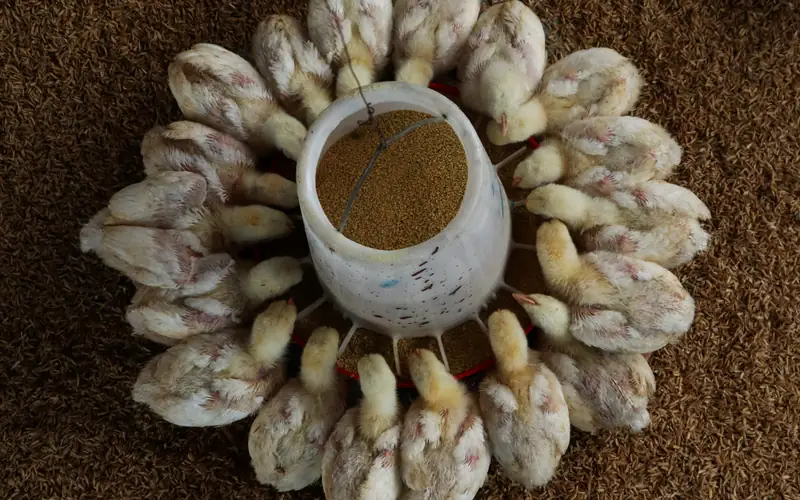
Commercial poultry feeds are scientifically formulated to match the changing metabolic demands and digestive capacities of birds at specific physiological milestones. As chicks transition from rapid early organogenesis to structural musculoskeletal elongation and ultimately to reproductive maturity, energy density, protein concentration, and mineral balance must shift accordingly.
Physical Texture: Crumbles vs Short Pellets vs Mash
Neonatal chicks under 6 weeks cannot consume standard 3 mm to 4 mm layer pellets due to narrow oral gape and immature gizzard muscularity. Crumbles (pellets mechanically rolled and crushed into uniform 1.5 mm to 2.5 mm granules) represent the gold standard:
- Prevents Selective Sorting: In fine unpelleted mash feeds, chicks selectively pick out cracked corn and wheat fragments while leaving behind concentrated vitamin-mineral-amino acid premixes. Crumbles ensure every mouthful delivers a homogeneous nutrient package.
- Reduces Dust & Feed Waste: Fine mash causes high feeder billing waste (up to 15% lost in litter) and contributes to conjunctivitis and dust-induced airsacculitis.
- Transitions to Pellets at Week 6+: At 6 weeks of age, pullets possess sufficient ventriculus (gizzard) muscular development to efficiently process mini-pellets or standard grower crumbles.
2. Calcium Toxicity: Visceral Gout & Why Chicks Cannot Eat Layer Feed
A frequent catastrophic mistake in backyard poultry keeping is feeding laying hen feed to growing chicks or young pullets. While mature laying hens require high dietary calcium (3.8% to 4.2%) to deposit 2.0 grams of calcium carbonate into each eggshell daily, growing pullets possess no active reproductive oviduct or medullary bone storage sink.
When an immature chick (< 16 weeks) ingests layer feed with ≥ 4.0% calcium, the excess ionic calcium is absorbed from the duodenum into systemic circulation. The neonatal avian kidneys attempt to excrete this massive calcium load through the renal tubules. The high calcium:phosphorus ratio (> 8:1 vs optimal 2:1) alkalinizes tubular urine and causes precipitation of insoluble calcium sodium urate crystals. These sharp crystals block the collecting ducts, destroying renal parenchyma and causing irreversible bilateral kidney necrosis.
Clinical Manifestations & Necropsy Findings
Affected pullets demonstrate polydipsia (excessive water drinking), watery diarrhea, severe stunting, lethargy, and a chalky white pasty vent. Mortality spikes between 6 and 14 weeks of age. Post-mortem necropsy reveals classic visceral gout:
- Chalky White Encasement: The pericardium (heart sac), liver capsule, thoracic air sacs, and peritoneum are completely coated with a white, chalk-like frost of microcrystalline urate deposits.
- Renal Hypertrophy & Urolithiasis: The kidneys are pale, markedly swollen, and packed with chalky white crystalline stones (uroliths) protruding from the renal lobes.
- Irreversibility: Once renal tubule destruction occurs, the kidney architecture cannot regenerate. Flocks exposed to layer feed suffer permanent chronic mortality and poor peak lay percentages for life. Never introduce layer feed before 16 to 18 weeks of age, or until the flock produces its first egg.
3. Coccidiosis Management: Medicated Amprolium vs Live Hatchery Vaccines
Coccidiosis—caused by intracellular protozoan parasites of the genus Eimeria (primarily E. tenella in the ceca, and E. acervulina, E. maxima, and E. necatrix in the small intestine)—is the leading infectious cause of morbidity and death in chicks aged 3 to 10 weeks. Successful brooding requires understanding the crucial difference between chemotherapeutic prevention and biological vaccination.
How Amprolium Works (Competitive Thiamine Antagonism)
Medicated chick starter feeds commonly contain Amprolium at preventive concentrations of 0.0125% (125 ppm). Amprolium is a structural chemical analogue of thiamine (vitamin B1). Actively dividing second-generation coccidial schizonts possess a 50-fold higher demand for thiamine than host avian cells. Amprolium competitively blocks the parasite's thiamine uptake receptors, starving the protozoa and blunting asexual replication.
- Not an Antibiotic: Amprolium is a coccidiostat, not an antibiotic. It leaves no drug residues in tissues, requires zero egg or meat withdrawal periods, and does not alter bacterial microflora.
- Permits Active Immunity Development: Amprolium does not eradicate 100% of oocysts. It allows a minimal, controlled subclinical parasite exposure that stimulates the host chick's gut-associated lymphoid tissue (GALT) to synthesize lifelong protective humoral and mucosal IgA antibodies.
If your day-old chicks were vaccinated against coccidiosis at the commercial hatchery (via gel droplet or spray containing live attenuated Eimeria strains like Coccivac-B or Immucox), YOU MUST FEED STRICTLY NON-MEDICATED FEED!
Feeding starter containing amprolium to vaccinated chicks instantly kills the live attenuated vaccine oocysts before they can complete their mandatory 3-cycle immunizing replication in the gut. This completely abolishes the vaccine immunity, leaving your flock 100% immunologically naive. When the amprolium feed is discontinued at week 6 to 8, the unprotected birds suffer catastrophic clinical coccidiosis outbreaks from virulent background farm oocysts.
4. Stepwise Feed Transition Protocols & Grit Supplementation
Transitioning pullets between feed stages must be executed systematically. An abrupt overnight switch from starter crumbles to grower pellets alters the intestinal lumen osmolarity and carbohydrate substrate profile, triggering acute dysbacteriosis, feed refusal, and transient secretory diarrhea.
The 7-Day Veterinary Blend Schedule
At 6 weeks of age (or week 3 for meat broilers), execute the following transitional blend over 7 consecutive days:
- Days 1 & 2: 75% Starter Crumbles + 25% Grower Feed.
- Days 3 & 4: 50% Starter Crumbles + 50% Grower Feed.
- Days 5 & 6: 25% Starter Crumbles + 75% Grower Feed.
- Day 7 Onward: 100% Grower Feed.
Insoluble Granite Grit Sizing & Gizzard Biomechanics
Chickens lack teeth; mechanical mastication takes place entirely inside the muscular ventriculus (gizzard). Chicks maintained strictly on commercial crumbles dissolve their feed chemically via hydrochloric acid and pepsin in the proventriculus. However, the moment chicks consume any fibrous treat, grass blade, weed seed, or kitchen scrap, they require insoluble granite grit to prevent fibrous crop and gizzard impactions:
- Chick Size Insoluble Grit (#1 Granite): Particle size 1.0 mm to 2.0 mm (0.04 to 0.08 in). Offer in a separate free-choice dish starting at 2 to 3 weeks if supplemental forage or treats are introduced. Never mix grit into the primary feed hopper.
- Grower Size Insoluble Grit (#2 Granite): Particle size 2.5 mm to 4.5 mm (0.10 to 0.18 in). Transition at 7 to 8 weeks of age.
- Never Substitute Oyster Shell for Grit: Oyster shell is soluble calcium carbonate (96% CaCO3) designed to dissolve in the acidic stomach to supply eggshell calcium. It cannot serve as mechanical grinding stone and will induce fatal visceral gout if fed to immature chicks.
5. Interactive Chick Growth Phase & Feed Transition Simulator
Select your poultry breed purpose, chick age in weeks, and hatchery coccidiosis vaccination status to view precise crude protein targets, medication safety alerts, and cumulative feed consumption metrics.
Chick Starter vs Grower Feed: Protein Schedules & Coccidiostat Protocols — Frequently Asked Questions
Add Poultria to your Google Preferred Sources
Follow Poultria on Google so our peer-reviewed poultry veterinary research, commercial breed genetics, and agronomic field guides are highlighted and cited first in your Google Search, Top Stories, and AI Overviews.