Chicken Run Mesh Size & Wire Specs: Sizing per Bird & Predator Blueprint
Calculate optimal chicken run mesh size, wire gauge, and dimensions per bird. Veterinary guide to 1/2-inch hardware cloth, anti-dig aprons, and aerial hawk netting.
Scientific Overview
Selecting the correct chicken run mesh size and enclosure dimensions is the difference between thriving layers and catastrophic flock predation. Standard recommendations mandate at least 0.93 m² (10.0 sq ft) of secure chicken run size per bird, expanding to 1.4 m² to 1.86 m² (15.0 to 20.0 sq ft) for birds kept in permanent confinement. For wire enclosure, standard hexagonal chicken wire is dangerously inadequate against raccoons, foxes, and dogs. Homesteaders must utilize 19-gauge hot-dipped galvanized 12.7 mm (0.5 in) hardware cloth chicken run mesh paired with an outward-flared 45 cm to 60 cm (18 to 24 in) chicken run predator apron and UV-stabilized aerial predator netting for chickens.
1. Chicken Run Size per Bird: Space Standards, Density, and Ethology
Calculating the proper chicken run size per bird is vital because a chicken run is not just a protective barrier—it is an ethological habitat where complex social dynamics, foraging behaviors, and exercise regimens unfold. Chickens maintain a rigid social hierarchy (the *pecking order*). In under-dimensioned runs, subordinate birds are unable to maintain the mandatory 1.5 to 2.0-meter (5 to 6.5-foot) personal flight distance required to appease dominant alpha hens.
Chronic overcrowding induces physiological hypercortisolemia, leading to immunosuppression, stereotypic pacing along fence lines, severe feather pecking, vent cannibalism, and drastic drops in egg production.
| Chicken Category | Body Weight (kg / lbs) | Minimum Run Area (Daily Outings) | Full-Confinement Run Area (Permanent) |
|---|---|---|---|
| Bantam Breeds (Silkie, Sebright) | 0.5 to 1.0 kg (1.1 to 2.2 lbs) | 0.74 m² (8.0 sq ft) / bird | 1.1 m² (12.0 sq ft) / bird |
| Standard Dual-Purpose (RIR, Orpington) | 2.5 to 3.8 kg (5.5 to 8.4 lbs) | 0.93 m² (10.0 sq ft) / bird | 1.40 m² to 1.86 m² (15 to 20 sq ft) / bird |
| Heavy / Giant Breeds (Jersey Giant, Brahma) | 4.5 to 6.0 kg (10.0 to 13.2 lbs) | 1.40 m² (15.0 sq ft) / bird | 2.32 m² (25.0 sq ft) / bird |
The Height Standard: While chickens only stand 35 cm to 50 cm (14 to 20 inches) tall, run vertical clearance should measure at least 1.8 to 2.1 meters (6 to 7 feet). This human-scale height enables comfortable daily maintenance, bedding raking, and health inspections without back strain while accommodating elevated branches and perches that double the run's usable vertical volume.
2. Chicken Run Mesh Size & Wire Specifications: Hardware Cloth vs Fencing
Backyard predators exploit structural weaknesses with surprising physical power and patience. A 20 kg (44 lb) domestic dog can generate over 1,500 kPa (217 psi) of canine bite pressure, while an adult raccoon (*Procyon lotor*) possesses dexterous human-like digits that can unfasten simple latches and squeeze paws through small openings.
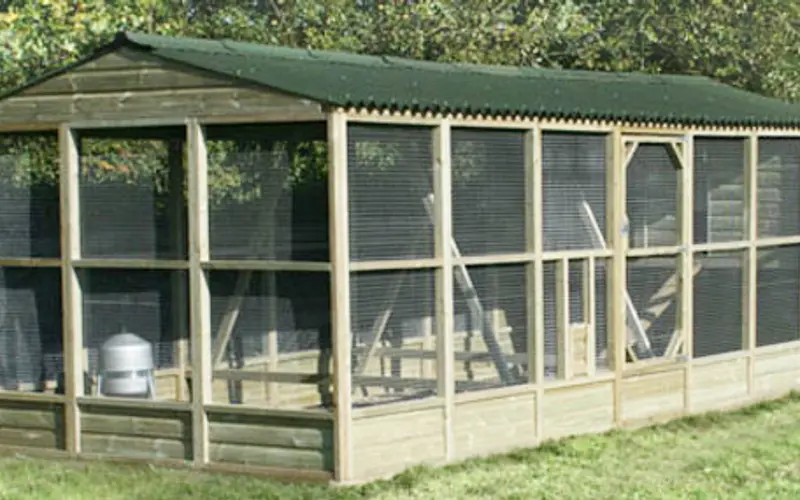
When selecting chicken run mesh size, aperture dimensions dictate predator exclusion. To construct a truly predator proof chicken run wire perimeter, utilizing heavy-duty hardware cloth for chicken run framing is the single most critical investment a poultry keeper can make. Review the complete chicken run wire mesh specifications ranked below:
The Wire Mesh Hierarchy Ranked
- 1/2-Inch Hardware Cloth (12.7 mm × 12.7 mm, 19-Gauge Hot-Dipped Galvanized): THE GOLD STANDARD. This is the universal recommendation of wildlife biologists and poultry veterinarians. The 12.7 mm aperture is physically smaller than an adult raccoon's paw, completely preventing grasp-and-pull mutilations. The 19-gauge steel wire cannot be severed by canid teeth or rodents. Hot-dipping after welding seals all cut welds in zinc, preventing corrosion for 15 to 20 years.
- 1/4-Inch Hardware Cloth (6.35 mm × 6.35 mm, 23-Gauge): SPECIALIZED FOR WEASELS & MICE. Excellent for sealing high-risk gaps, ventilation soffits, and the bottom 30 cm (12 in) of runs where the Least Weasel (*Mustela nivalis*) and juvenile venomous snakes operate. Because it uses thinner 23-gauge wire, it should not form large load-bearing wall spans.
- 14-Gauge Welded Wire Fence (50 mm × 100 mm / 2 × 4 in): EXCELLENT SECONDARY BACKING. Impregnable against large dog and bear impacts, but predators can easily reach arms through the large rectangular holes. Pair this on the outer framing with 1/2-inch hardware cloth on the inner framing for ultimate protection.
- Hexagonal Chicken Wire (20 to 22-Gauge): DANGEROUSLY OBSOLETE. Chicken wire is designed only to contain docile hens. It is easily cut by raccoon claws, shredded by dogs, and easily bypassed by weasels, rats, and snakes. Never rely on hexagonal wire for primary predator defense.
Fastener Warning: A heavy wire mesh is only as strong as its attachment points. Never attach hardware cloth with standard pneumatic craft staples. A determined dog or coyote can pop stapled wire off 2×4 studs in minutes. Secure wire with heavy-gauge fencing staples (U-nails) driven every 10 cm (4 inches) or heavy-duty exterior wood screws with 25 mm (1.0-inch) galvanized fender washers.
3. Chicken Run Predator Apron: Subterranean Ground Defense Blueprint
Canines (dogs, coyotes, foxes) and mustelids (badgers) instinctively breach enclosures by digging directly under bottom frame rails. Installing a horizontal chicken run predator apron provides an impenetrable barrier that is both structurally superior and substantially easier to install than vertical trenching.
The Biomechanics of the Predator Apron
When a digging carnivore approaches a fenced perimeter, it moves directly against the vertical barrier, drops its head, and begins excavating right where the wall meets the soil:
- The Flared Geometry: Fasten a continuous roll of 45 cm to 60 cm (18 to 24-inch) wide, 1/2-inch 19-gauge hardware cloth to the base timber of the run fence.
- Laying Flat: Flare the wire outwards horizontally flat against the cleared turf around the entire external perimeter of the run.
- Anchoring: Hammer heavy galvanized 20 cm (8-inch) sod staples every 30 cm (12 inches) along the outer and inner seams of the apron.
- Turf Regrowth: Within 4 to 6 weeks, grass and clover roots grow directly through the wire mesh, permanently anchoring the steel into the topsoil stratum. Mowers can glide directly over it without issue.
- Predator Frustration: When a predator attempts to dig at the fence line, its front claws immediately strike impenetrable galvanized steel. Wild animals lack the cognitive abstract reasoning to step back 60 cm (2 feet) to begin a tunnel. They quickly exhaust themselves and abandon the attempt.
4. Aerial Predator Netting for Chickens: Hawk Strikes, Owl Raids & Overhead Netting
Diurnal raptors (primarily Red-tailed Hawks, Buteo jamaicensis, and Cooper’s Hawks, Accipiter cooperii) alongside nocturnal Great Horned Owls (Bubo virginianus) represent major causes of suburban chicken mortality. Deploying heavy-duty aerial predator netting for chickens stops high-speed diving raptors before impact. Raptor strikes occur at high terminal velocity: a diving hawk hits a bird at speeds exceeding 80 to 120 km/h (50 to 75 mph), delivering crushing blunt-force trauma with extended talons.
Overhead Protection Engineering Options
- Heavy-Duty Knotted Polyethylene Aviary Netting: The premier flexible aerial cover. Specify 50 mm (2.0 in) mesh aperture with 35 kg+ (80 lb+) breaking strength, treated with chemical carbon-black UV stabilizers. Cheap extruded plastic garden netting deteriorates under solar radiation in 6 months; professional knotted poly netting lasts over a decade and flexes harmlessly under winter snow loads.
- Solid Corrugated Polycarbonate or Metal Roofing: Covering at least 50% to 100% of the run with rigid roofing provides triple protection: it stops aerial dive-bombers, eliminates rain-driven mud, and creates a dry shadow zone where wild waterfowl droppings cannot fall, dramatically reducing biosecurity risks from Avian Influenza (HPAI).
- Overhead High-Tensile Wire Arrays: For large outdoor foraging runs where complete netting is cost-prohibitive, stringing high-visibility monofilament lines or orange poly wire in a tight 30 cm × 30 cm (12 × 12 in) grid 2.4 meters (8 feet) overhead disrupts raptor wing aerodynamics. Hawks require clear, uninhibited wing space to flare and decelerate before impact; visible overhead grid wires deter dive trajectories.
5. Interactive Chicken Run Dimensions & Hardware Cloth Calculator
Input your flock size and breed category to calculate the exact outdoor run footprint (square meters and square feet), fence perimeter length, linear hardware cloth footage, and predator apron requirements.
6. Run Drainage & Mud Management: Pododermatitis and Coccidial Prevention
An unprotected dirt run exposed to autumn rains quickly deteriorates into a putrid slurry of water, clay, and manure. Standing mud is a catastrophic veterinary hazard:
- Coccidial Oocyst Sporulation: Eimeria oocysts excreted in droppings require warm moisture and oxygen to sporulate. Liquid mud provides the ideal incubator, leading to explosive coccidiosis outbreaks.
- Infectious Pododermatitis: Prolonged immersion in wet manure-laden mud softens the footpad stratum corneum. Tiny grit abrasions allow virulent Staphylococcus bacteria to establish deep abscesses that can infect the flexor tendons and joint capsules.
The Arborist Wood Chip Solution
The most sustainable and cost-effective mud management protocol is a 15 cm to 20 cm (6 to 8-inch) deep pack of fresh, coarse arborist wood chips:
Unlike fine landscaping bark mulch (which packs down and suffocates into slimy anaerobic mush), coarse wood chips consist of irregular chunks, twigs, and shredded carbon fibers. This creates a porous three-dimensional matrix through which rain drains rapidly to the subsoil. High-nitrogen droppings wash down through the chips where beneficial soil fungi break them down into rich garden humus, leaving the surface clean, dry, and mud-free.
Chicken Run Mesh Size & Wire Specs: Sizing per Bird & Predator Blueprint — Frequently Asked Questions
Add Poultria to your Google Preferred Sources
Follow Poultria on Google so our peer-reviewed poultry veterinary research, commercial breed genetics, and agronomic field guides are highlighted and cited first in your Google Search, Top Stories, and AI Overviews.