
How Chickens See the World: Tetrachromatic Vision & Senses
Avian neuroanatomy, ultraviolet cone photoreception, lateral panoramic field of view, and sensory perception in poultry.
Scientific Overview
To understand chicken behavior, one must first realize that chickens inhabit a perceptual reality radically different from our own. While humans possess trichromatic vision based on three retinal cone photoreceptors (red, green, and blue), the domestic chicken (Gallus gallus domesticus) possesses sophisticated tetrachromatic vision, equipped with a specialized fourth cone sensitive to ultraviolet-A (UVA) light between 300 nm and 400 nm. Chickens also possess pigmented lipid oil droplets within their retinal cones that act as microscopic optical filters, providing chromatic contrast and acuity that far exceeds human capabilities. From panoramic 300-degree visual fields to high-frequency flicker detection and infrasonic vibration sensing, this clinical guide explores the neurosensory apparatus of domestic fowl.
1. Ocular Neuroanatomy: The Tetrachromatic Retina & Ultraviolet Perception
Neurosensory Fact
The eyes of a domestic chicken constitute approximately 10% of its total cranial mass (compared to roughly 1% in humans). Their retina contains five distinct cone types: four single cones providing tetrachromatic color and UVA vision, plus a specialized double cone dedicated exclusively to high-speed motion tracking.
The domestic chicken represents one of the most sophisticated visual systems in the animal kingdom. While primate vision evolved for arboreal fruit gathering, avian ocular systems evolved to detect camouflaged insects, evaluate conspecific health via feather sheen, and instantly spot aerial raptors cruising miles above.
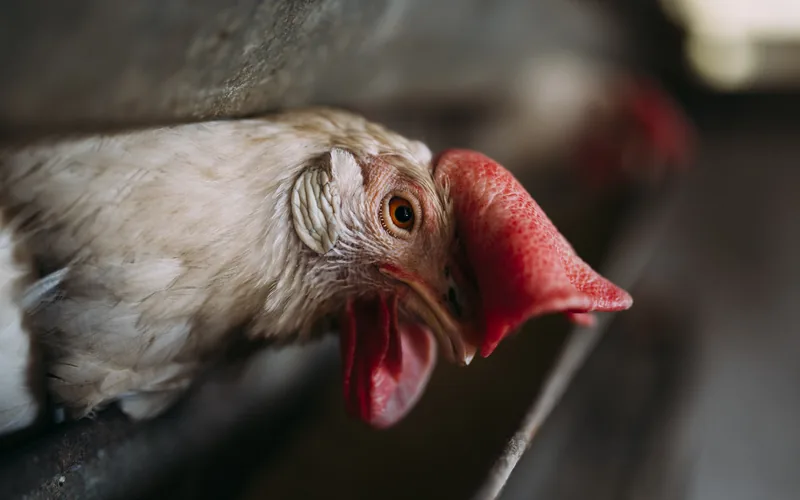
Retinal Photoreceptor Specializations:
- The Fourth (UVA) Cone: Sensitive to wavelengths between 300 nm and 400 nm. Chickens use ultraviolet reflection to identify healthy conspecifics: healthy feathers reflect strong UV light, whereas diseased or parasite-infested plumage appears dull and muted. UV vision also allows chicks to spot camouflaged insect larvae and seeds against green foliage.
- Pigmented Carotenoid Oil Droplets: Located in the inner segments of retinal cones, these tiny lipid spheres contain high concentrations of carotenoids (astaxanthin, zeaxanthin, and lutein). They act as precise optical micro-filters, cutting off short-wavelength chromatic aberration and sharpening spectral discrimination across long distances.
- Double Cones for Motion Detection: Comprising roughly 40% of all retinal cones, double cones do not participate in color processing. Instead, they operate as dedicated motion detectors, tracking predator velocity across the horizon.
- Avascular Fovea & The Pecten Oculi: Unlike the human retina, which is lined with blood vessels that scatter light, the avian retina is completely avascular. Nutrition and oxygen are supplied by the pecten oculi, a specialized, highly vascularized comb-like organ that projects from the optic disc into the vitreous humor, ensuring zero optical scattering.
2. Visual Fields, Hemispheric Asymmetry & Depth Perception
Because chickens are prey animals, their eyes are positioned laterally on either side of the cranium. This lateral anatomical orientation confers an extraordinary panoramic visual field spanning approximately 300 degrees, leaving only a tiny 60-degree blind spot directly behind the occiput.
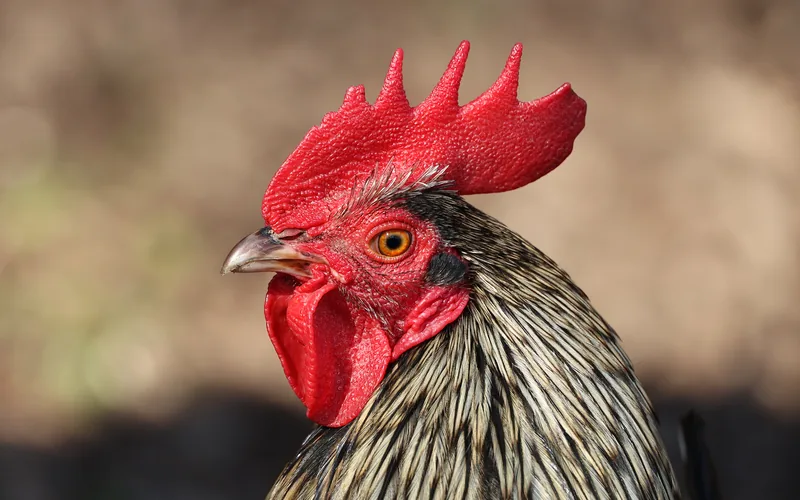
Their stereoscopic binocular overlap—the narrow forward zone where both eyes view an object simultaneously—spans only 26 to 30 degrees directly in front of the beak. Chickens use this binocular corridor to judge precise millimeter distances when pecking at seeds, grit, and bugs.
Cerebral Lateralization: Functional Asymmetry of the Avian Eyes
During the final days of egg incubation, chicken embryos tilt their heads inside the shell, tucking their left eye beneath their wing while the right eye is pressed against the translucent shell membrane, exposed to light. This embryonic light stimulation establishes lifelong hemispheric cerebral lateralization:
- The Right Eye (Left Cerebral Hemisphere): Specialized for near-field discrimination, categorizing familiar food objects, inspecting individual seeds, and recognizing close flock mates.
- The Left Eye (Right Cerebral Hemisphere): Specialized for distant panoramic scanning, spatial orientation, novel object evaluation, and immediate raptor predator detection. This is why a vigilant hen or cock consistently tilts its head sideways to aim its left eye directly at the sky when an eagle or hawk glides overhead.
3. Flicker Fusion Frequency & The Science of Coop Lighting
One of the most consequential discoveries in avian welfare is the dramatic difference in temporal visual resolution between humans and poultry. Critical Flicker Fusion Frequency (CFFF) is the threshold frequency at which intermittent flashes of light merge into a steady, continuous beam.
| Lighting Type | Operating Frequency | Avian Perception | Physiological & Behavioral Impact |
|---|---|---|---|
| Standard AC Fluorescent | 50 Hz – 60 Hz | Violent Strobe Light Effect | Induces chronic ocular fatigue, severe feather pecking, high corticosterone |
| Cheap Pulse-Width-Modulation LED | 100 Hz – 120 Hz | Perceptible Micro-Flicker | Subtle agitation, increased nervousness, reduced feed conversion |
| High-Frequency / Constant-Current LED | > 2,000 Hz or Pure DC | 100% Steady Natural Light | Calm flock demeanor, natural resting cycles, optimal oviposition |
Because chicken CFFF exceeds 100 Hz, lighting in coops and barns must be selected with extreme care. Always choose specialized agricultural high-frequency dimmable LEDs (minimum 2,000 Hz or true direct-current drivers) that incorporate UVA spectrum (380–400 nm) to replicate natural outdoor sunlight and eliminate flickering stress.
4. Non-Visual Sensory Perception: Hearing, Olfaction & Mechanoreceptors
While vision is the primary sensory modality in domestic fowl, chickens possess highly developed auditory, mechanoreceptive, and thermoregulatory senses that integrate to form a sophisticated environmental awareness network.
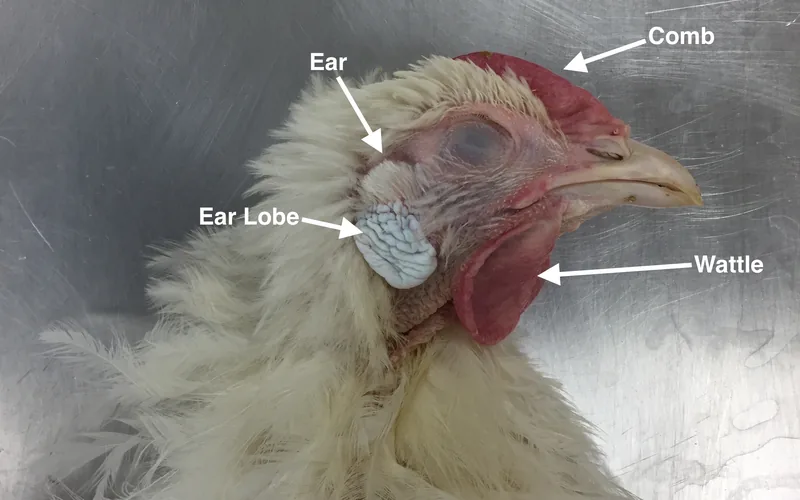
Non-Visual Avian Sensory Modalities:
- Acoustic Range & Directional Hearing: Chickens hear sound frequencies from 125 Hz to 2,000 Hz (with peak acoustic sensitivity between 1,000 Hz and 2,000 Hz, perfectly matching flock vocalization ranges). Although chickens lack external pinnae (ears), the acoustic coupling between their two internal tympanic membranes across cranial air canals allows them to pinpoint sound sources with remarkable precision.
- Herbst Corpuscles (Infrasonic Mechanoreception): Packed densely inside the beak tip, tongue, and lower legs, Herbst corpuscles are specialized lamellated nerve endings sensitive to micro-vibrations in the soil. Chickens detect the faint sub-audible footsteps of approaching predators or burrowing earthworms through their footpads long before the threat becomes visible.
- Comb and Wattle Vasculature & Thermoregulation: The large single comb and wattles are densely populated with arteriovenous anastomoses. Because birds cannot sweat, blood is diverted to the vast capillary surface of the comb to radiate excess body heat into the ambient air, while also acting as visual badges of gonadal testosterone and social rank.
- Extraretinal Encephalic Photoreceptors: Light penetrates directly through the thin avian skull bone to stimulate photoreceptive neurons within the pineal gland and hypothalamus. This extraretinal reception regulates seasonal molting, daily melatonin synthesis, and the onset of sexual maturity independent of ocular retinal input.
How Chickens See the World: Tetrachromatic Vision & Senses — Frequently Asked Questions
Add Poultria to your Google Preferred Sources
Follow Poultria on Google so our peer-reviewed poultry veterinary research, commercial breed genetics, and agronomic field guides are highlighted and cited first in your Google Search, Top Stories, and AI Overviews.