
Rooster Behavior: Aggression, Spur Trimming & Crowing Guide
Mastering cock ethology, territorial defense, humane spur blunting protocols, and circadian vocalization management.
Scientific Overview
Roosters (cocks) represent the biological sentinels, genetic anchors, and social stabilizers of the gallinaceous flock. An exemplary rooster scans the skies continuously for raptors, guides his hens to nutrient-dense forage, mediates squabbles between aggressive layers, and stands between his flock and mammalian predators at the cost of his own life. However, rising testosterone levels during adolescent maturation (16 to 24 weeks of age) frequently manifest as territorial human-directed aggression, relentless early morning crowing, and the growth of razor-sharp calcified spurs capable of inflicting severe puncture trauma on handlers and hens alike. This veterinary guide provides an ethological foundation for managing rooster behavior, details humane spur trimming techniques, and explains the circadian biology of avian vocalization.
1. Rooster Ethology: Tidbitting, Flocking Dynamics & The Alpha Sentinel
Evolutionary Sentinel Behavior
A healthy rooster consumes significantly less food during flock foraging than hens, spending up to 60% of his active day scanning the 360-degree perimeter and sky for aerial hawks and terrestrial predators.
Within avian biology, the male rooster fulfills vital ecological functions that extend far beyond reproductive fertilization. Understanding natural cock behavior allows poultry keepers to work with, rather than fight against, his evolutionary programming.
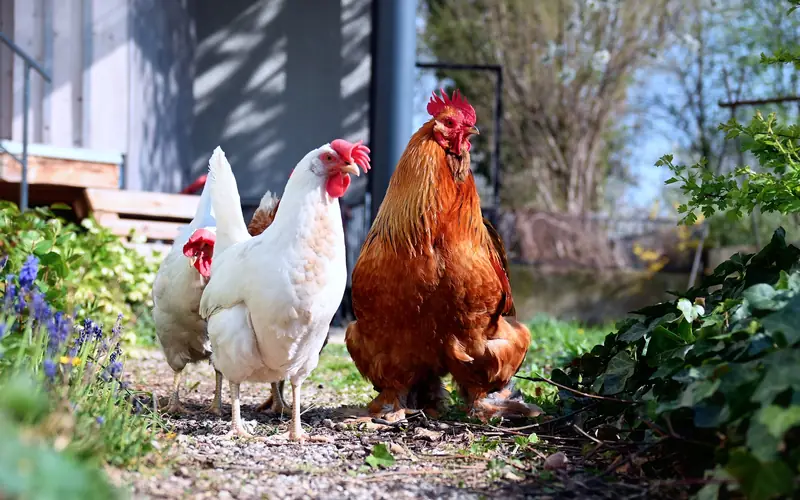
Hallmark Behaviors of a Balanced Alpha Cock:
- Tidbitting (Food Calling): Upon locating a nutrient-rich food cache—such as an earthworm or fallen fruit—a dominant rooster refuses to eat it himself. He utters rhythmic, high-pitched staccato vocalizations ('took-took-took'), rapidly picks up and drops the morsel, and bobs his head to alert and summon his hens to feed.
- The Wing-Drop Dance (Courtship Waltz): To solicit mating receptivity from a hen, the cock approaches laterally, lowers one wing until the primary flight feathers brush the soil, and performs a rapid shuffling circle. Receptive hens respond by squatting flat against the ground with wings slightly flexed.
- Predator Alarm Differentiation: Roosters utilize sophisticated distinct acoustic referential signals. A pulsed, guttural cackle signals ground predators (foxes, dogs, raccoons), triggering hens to freeze or climb roosts. A high-pitched, monotonic aerial shriek signals overhead raptors, directing the entire flock to sprint into heavy brush cover.
- Nest Site Inspection: Prior to oviposition, attentive roosters frequently enter coop nesting stalls, scratch down clean bedding, settle into the straw, and emit soft purring murmurs to reassure timid pullets preparing to lay their first eggs.
2. De-escalating Human-Directed Cock Aggression
Between 16 and 24 weeks of age, cockerels experience an explosive surge in circulating plasma testosterone, coinciding with comb enlargement and spur budding. In inexperienced or overly aggressive young cocks, the bird begins to perceive the human keeper not as a provider, but as a rival cock trespassing upon his breeding harem.
Common human behaviors inadvertently provoke rooster aggression. Backing away when a rooster postures, wearing brightly colored rubber boots that resemble rival combs, or kicking/shoving the bird triggers his territorial defense mechanism. Striking an aggressive rooster releases adrenaline, cementing a life-or-death combat mentality.
Veterinary Behavioral Protocol: The "Carry and Decondition" Technique
- Maintain Confident Posture: Never run, flinch, or turn your back on a challenging rooster. Walk directly toward him; a dominant bird yields right-of-way.
- Calm Interception: If the cock flares his hackles and charges, hold a small plastic rake, broom, or lightweight mesh net to intercept his charge without injuring his frame.
- The Physical Hold: Firmly scoop the rooster up, pinning his wings securely against his body. Cradle him comfortably beneath your arm against your ribcage, supporting his feet with your palm.
- Submissive Desensitization: Carry the rooster with you for 15 to 20 minutes while filling feeders, collecting eggs, and cleaning the run. Gently hold his head downward with two fingers for a few seconds if he thrashes. Walking around with the cock elevated above the hens displays his vulnerability to his entire flock, deflating his territorial bravado without physical trauma.
- Feeding from the Hand: Before setting him down, offer high-value mealworms or sunflower seeds directly from your open palm. Repeat this routine daily for one week until his approach shifts from territorial posturing to foraging anticipation.
3. Rooster Spur Anatomy & Safe Trimming Protocols
The spur of a male chicken is a specialized bony outgrowth of the tarsometatarsus bone, encased within a thick, cornified stratum corneum sheath of hard beta-keratin. In adult roosters over 2 years of age, spurs can exceed 5 cm to 7 cm (2 to 3 inches) in length, curling into needle-sharp arcs that lacerate hens' flanks during copulation and pose serious injury risks to flock caregivers.
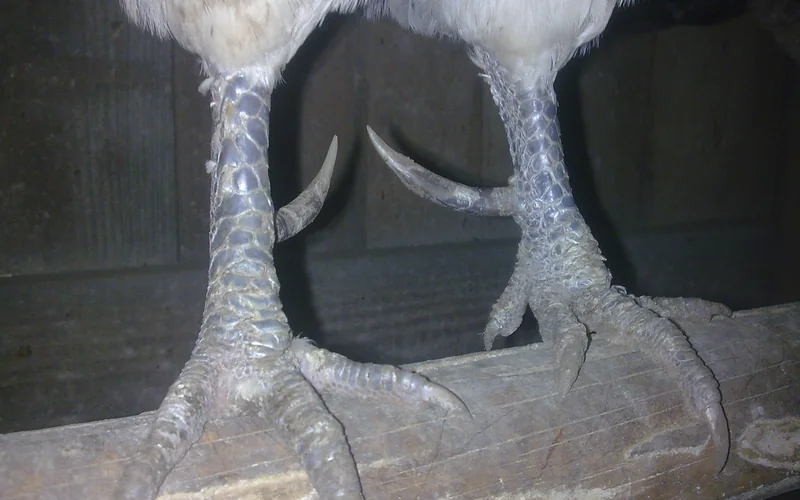
Comparative Trimming Methodologies:
| Technique | Equipment Required | Mechanism of Action | Veterinary Assessment |
|---|---|---|---|
| Dremel / Rotary File Blunting | Pet nail rotary grinder, styptic powder | Grinds sharp distal tip into a smooth, rounded dome without touching vascular bed | Gold Standard: Zero hemorrhage risk, entirely painless, stress-free |
| Guillotine Clipper Trimming | Heavy-duty large canine nail clippers | Clips distal 3 mm to 6 mm (0.12 to 0.25 inches) of dead keratin; file smooth | Recommended: Fast and humane if quick location is verified by candling |
| Keratin Sheath Twist (Warm Potato) | Baked potato or pliers, mineral oil | Heats keratin, causing entire outer shell to slough off the vascular bone core | High Risk: Leaves soft vascular bone stump exposed to bedding bacteria and pain |
Clinical Procedure for Guillotine or Rotary Trimming: Wrap the rooster snugly in a bath towel, leaving only one leg exposed. Illuminate the spur with a high-intensity LED penlight to visualize the pink shadow of the internal vascular bone (the "quick"). Ensure your cut remains at least 5 mm (0.2 inches) distal to the vascular shadow. Smooth any sharp edges with a diamond grit nail file. Keep potassium permanganate or styptic powder on hand in case of accidental capillary weeping.
4. Circadian Neurobiology of Crowing & Acoustic Mitigation
Rooster crowing is an innate, acoustic territorial announcement produced by the syrinx—the avian vocal organ situated at the bifurcation of the trachea. While urban mythology suggests roosters crow exclusively when seeing the sunrise, scientific research published in Current Biology demonstrated that roosters maintained in 24-hour continuous dim light still crowed on an internal 23.8-hour circadian rhythm.
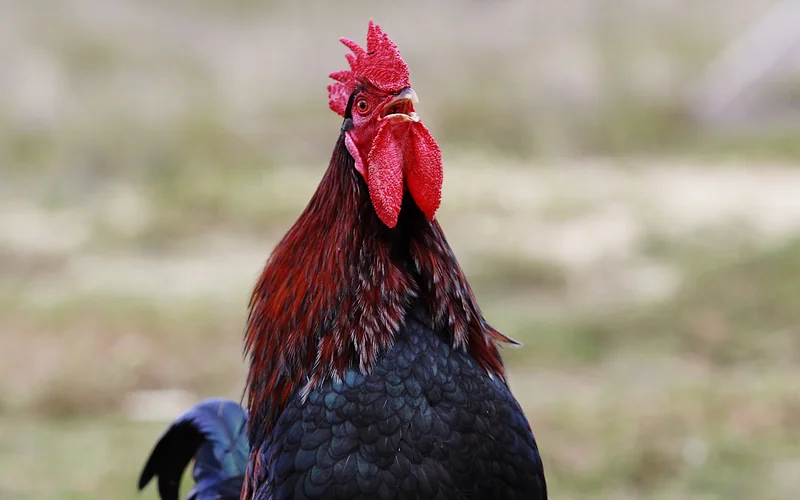
Scientific Strategies for Managing Crow Noise:
- Darkened Night Quarters (Blackout Coops): Light leakage into the coop stimulates extraretinal photoreceptors in the avian brain. Installing blackout shades, sealing roof gaps against morning twilight, and ensuring total darkness until 7:30 AM or 8:00 AM significantly delays morning crowing outbursts.
- Low Roost Ceiling Clearance: Roosters must fully extend their cervical vertebrae and expand their thoracic air sacs to deliver maximum vocal volume (often 90 to 100 dB). Positioning the night roost perch 30 cm (12 inches) below an insulated acoustic drop ceiling restricts full neck extension, muffling sound production.
- No-Crow Collars (Precision Application): A flexible hook-and-loop mesh collar applied around the lower neck feathers prevents full tracheal air-sac inflation. To ensure safety: the keeper must be able to slip an adult pinky finger easily between the collar and the trachea. Observe the bird for 60 minutes post-fitting: if he displays open-mouth gasping, wheezing, or loss of balance, loosen immediately.
- Acoustic Coop Insulation: Line the coop interior with 5 cm (2 inches) of mineral wool or recycled denim batting faced with solid exterior-grade plywood. This reduces external decibel transmission by 25 to 35 dB, satisfying municipal suburban noise ordinances.
Rooster Behavior: Aggression, Spur Trimming & Crowing Guide — Frequently Asked Questions
Add Poultria to your Google Preferred Sources
Follow Poultria on Google so our peer-reviewed poultry veterinary research, commercial breed genetics, and agronomic field guides are highlighted and cited first in your Google Search, Top Stories, and AI Overviews.