
Soft-Shell & Rubber Eggs in Chickens: Causes & Fast Treatment
A clear veterinary guide: why chickens lay soft or rubbery eggs, how to tell a harmless pullet glitch from a nutritional deficiency or illness, and simple steps to fix it fast.
Scientific Overview
Finding a squishy, shell-less 'rubber egg' on the coop floor or inside a nesting box can be startling for any chicken keeper. While it looks bizarre—resembling a water balloon filled with yolk and egg white—soft-shell eggs are actually quite common in backyard flocks. In simple terms, a rubber egg happens when an egg leaves the hen's shell gland before its hard calcium shell could be fully built. In most cases, a soft-shell egg is caused by something easily fixable, such as a young pullet whose laying cycle is still finding its rhythm, a hot summer heatwave, or a temporary shortage of calcium. In this practical veterinary guide, Dr. Imad Khan explains what causes soft-shell eggs, how to know if your hen needs help, and the proven steps to get your flock back to laying strong, sturdy shells.
1. What Is a Rubber Egg and How Does a Hen Make Shells?
How Eggs Are Made: Making an eggshell is one of the fastest mineral-building processes in nature. The egg spends roughly 4 hours traveling down the upper oviduct getting its yolk and egg white, and then spends 15 to 16 continuous hours in the shell gland (uterus). While the hen rests and sleeps overnight, her body draws calcium from her bloodstream and food, slowly crystallizing it into a tough, protective shield.
An egg is built from the inside out in distinct stages:
- The Inner & Outer Membranes: A strong, papery mesh of keratin fibers that encloses the egg white and yolk.
- The Hard Shell: Interlocking columns of calcium carbonate crystals that make up 95% of the shell's thickness.
- The Bloom (Cuticle): An invisible natural seal that blocks bacteria and locks in moisture.
When anything interrupts this overnight crystallization process—such as a lack of dietary calcium, severe heat stress, or a sudden fright—the hen simply lays the egg with only its flexible, rubbery membrane holding everything together.
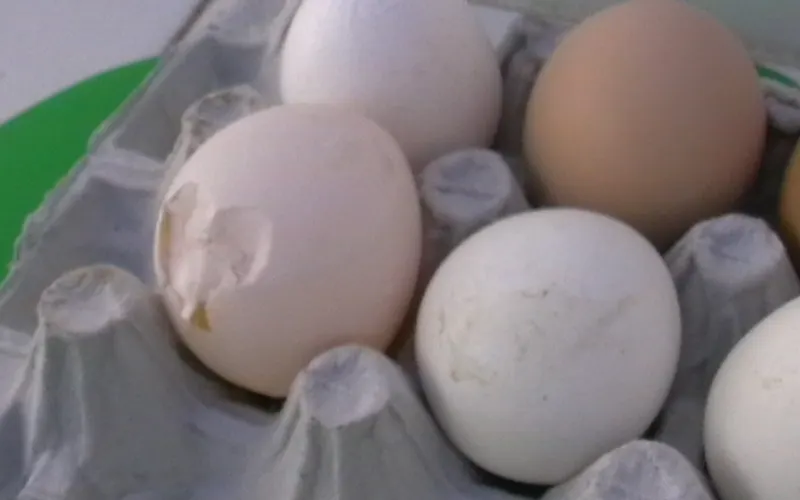
2. The 5 Main Causes of Soft-Shell & Rubber Eggs
If you find a rubber egg in your coop, investigate these five common causes:
1. The 'Rookie Pullet' Glitch (Harmless & Temporary)
Young pullets (18 to 22 weeks old) are brand new to laying. Their reproductive hormones surge unpredictably while their egg-laying machinery is still warming up. It is very common for a new layer to drop a rubber egg or two before settling into a steady daily routine. As long as the bird is active and eating, no medical treatment is needed.
2. Calcium Shortages & Too Many Treats
A laying hen needs 4.0 to 4.5 grams of calcium every single day to produce hard shells. The most common mistake backyard keepers make is giving their hens too many scratch grains, kitchen scraps, or bread. These treats fill up the hen's crop without providing calcium, diluting her complete layer feed. When dietary calcium drops, the hen exhausts her bone reserves in just a few days and begins laying soft eggs.
3. Summer Heatwaves & Panting (Respiratory Alkalosis)
When temperatures climb above 30°C to 35°C (86°F to 95°F), chickens cannot sweat, so they pant rapidly to stay cool. Panting blows off large amounts of carbon dioxide (CO2) from their lungs, which causes a drop in blood carbonate levels. Because eggshells are made of calcium carbonate, the hen simply runs out of carbonate building blocks—resulting in paper-thin or rubbery shells during heatwaves even if she has plenty of calcium in her feed.
4. Nighttime Scares & Predator Stress
If a raccoon stalks the coop after dark, a neighborhood dog barks aggressively near the run, or fireworks go off nearby, the sudden fright triggers a surge of adrenaline. This causes the hen's oviduct to contract rapidly, expelling the egg hours ahead of schedule before the hard shell could be finished.
5. Flock Illnesses (Infectious Bronchitis & Egg Drop Syndrome)
Certain poultry viruses target the reproductive tract. Infectious Bronchitis Virus (IBV) causes mild sneezing or coughing followed by wrinkled, corrugated, and soft-shell eggs with runny egg whites. Egg Drop Syndrome (EDS-76) causes an otherwise healthy-looking flock to suddenly drop 30% to 50% in egg production with an avalanche of completely soft, rubbery eggs.
3. Are Soft-Shell Eggs Safe to Eat? (Crucial Safety Rule)
While it can feel disappointing to throw food away, you should never eat a soft-shell or rubber egg. A hard eggshell and its dry bloom are nature's airtight barrier against bacteria. Without a hard shell, environmental bacteria (including Salmonella and E. coli) can pass straight through the moist membrane within minutes of the egg touching coop litter or nesting bedding. Discard rubber eggs safely in the trash or compost pile.
4. How to Fix Soft-Shell Eggs: A 4-Step Recovery Plan
If your hens are laying soft-shell or rubber eggs, follow this straightforward veterinary recovery plan:
Actionable 4-Step Shell Recovery Plan
- Offer Coarse Crushed Oyster Shell Free-Choice: Always provide coarse crushed oyster shell (particle size 2 to 4 mm) in a separate hopper beside their feed. Large flakes take 8 to 12 hours to break down in the hen's gizzard, steadily releasing calcium through the night while she sleeps and forms her eggshell.
- Give a Vitamin D3 & Electrolyte Boost: Hens need Vitamin D3 to absorb calcium from their food. Add water-soluble poultry vitamins with Vitamin D3 and electrolytes to their drinking water for 3 to 5 days.
- The Baking Soda Heatwave Trick: In hot summer weather (> 30°C / 86°F), add 1.0 g of sodium bicarbonate (plain baking soda) per liter of drinking water (roughly 1 teaspoon per gallon). This replaces the blood carbonate lost to panting and quickly restores strong shells.
- Enforce the 90/10 Feed Rule: Cut out all scratch grains, kitchen scraps, and bread for 14 days. Make sure at least 90% of their daily diet is a complete 16% to 18% protein layer feed.
5. When Is a Soft-Shell Egg an Emergency? Warning Signs to Watch For
Finding a single rubber egg in the nesting box is rarely an emergency. But if an individual hen is having trouble passing the egg, she may need medical help:
- Egg Binding (Dystocia): If a hen is straining continuously at the vent, walking with an upright "penguin stance", pumping her tail, or sitting puffed up and lethargic, an egg may be stuck in her oviduct. Because soft eggs lack a hard shell for the muscles to push against, they can be harder for a weak hen to expel.
- Emergency Care: Place the hen in a quiet, warm (29°C / 85°F), humid hospital crate. Administer oral calcium gluconate or liquid calcium if trained, and consult an avian veterinarian immediately if she does not pass the egg within a few hours.
Soft-Shell & Rubber Eggs in Chickens: Causes & Fast Treatment — Frequently Asked Questions
Add Poultria to your Google Preferred Sources
Follow Poultria on Google so our peer-reviewed poultry veterinary research, commercial breed genetics, and agronomic field guides are highlighted and cited first in your Google Search, Top Stories, and AI Overviews.