
Marek's Disease in Chickens: Symptoms, Pathology & Vaccine Protocols
Veterinary clinical guide on Gallid alphaherpesvirus 2 pathogenesis, sciatic nerve paralysis, ocular grey eye, and Rispens CVI988 vaccination.
Scientific Overview
Marek's disease in chickens is an oncogenic alphaherpesvirus condition caused by Gallid alphaherpesvirus 2 (MDV-1). The pathogen targets young chickens and pullets, driving neoplastic transformation of CD4+ T-lymphocytes into metastatic lymphomas across visceral organs and inducing demyelinating peripheral neuropathy. Recognizing marek's in chickens symptoms early is essential for flock biosecurity, as shedding through feather follicle dander contaminates poultry housing for months.
Etiology & Gallid Alphaherpesvirus 2 Pathotypes
Pathogen Profile: Gallid alphaherpesvirus 2 is an enveloped double-stranded DNA virus belonging to the genus Mardivirus. Strains are classified into four distinct pathotypes based on their virulence and ability to overcome existing vaccine immunity: mild (mMDV), virulent (vMDV), very virulent (vvMDV), and very virulent plus (vv+MDV).
The viral genome encodes the oncoprotein Meq (Marek's EcoRI-Q-encoded protein), a basic leucine zipper transcription factor that drives continuous proliferation of transformed T-lymphocytes. Field evolution over the past fifty years has produced progressively virulent pathotypes capable of inducing acute mortality in younger pullets before traditional nerve lesions develop.
Understanding chicken marek's disease symptoms requires tracking viral tropism through four distinct phases: early cytolytic infection of B-cells and macrophages (Days 2 to 7 post-exposure), latency within CD4+ T-cells (around Day 7 to 10), late cytolytic infection with severe immunosuppression, and finally proliferative neoplastic transformation yielding multi-organ lymphomas.
Chicken Marek's Disease Symptoms: The Four Clinical Syndromes
Flock owners searching for chicken merricks disease symptoms or merck disease in chickens symptoms encounter four primary clinical forms, depending on pathotype virulence, genetic line susceptibility, and bird age:
| Clinical Syndrome | Target Anatomy | Primary Clinical Manifestations | Typical Age of Onset |
|---|---|---|---|
| Neural Form (Classical) | Sciatic, brachial, vagus nerves | Asymmetric leg paralysis ("straddle split"), dropped wing, gasping respiration, pendulous crop | 6 to 24 weeks |
| Visceral Form (Acute) | Liver, spleen, gonads, proventriculus, heart | Severe cachexia, anorexia, pallor of comb and wattles, sudden death, palpable abdominal masses | 8 to 28 weeks |
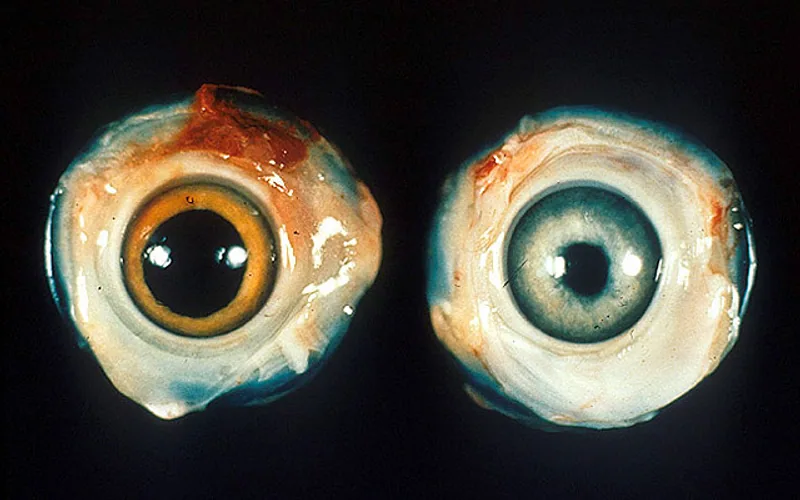
| Ocular Form ("Grey Eye") | Iris & ciliary body | Loss of orange-red iris pigmentation (pearl/grey eye), eccentric pinpoint or irregular pupil, partial or complete blindness | 12 to 36 weeks |
| Cutaneous Form | Feather follicle epithelium | Enlarged, nodular feather follicles, erythematous skin ("red leg" syndrome), carcass condemnation at slaughter | Broiler slaughter age (5 to 8 weeks) |
The classic sign of marek's in chickens symptoms is the unilateral straddle posture: the bird sits prostrate on the floor with one leg stretched forward and the other trailing backward. This posture stems directly from unilateral sciatic nerve demyelination. When the vagus nerve is infiltrated, birds suffer crop stasis, regurgitation, and respiratory gasping without tracheal discharge.
Necropsy Pathology & Nerve Striation Loss
Confirming a suspected field case requires systematic post-mortem inspection of both peripheral nerves and visceral organs. During dissection, the practitioner must expose both bilateral sciatic nerves along the inner thigh and vertebral canal to compare diameters directly:
- Sciatic & Brachial Nerve Enlargement: Affected nerve trunks swell to 2 to 3 times their normal diameter, lose their distinctive glistening white transverse striations, and turn edematous, grayish-yellow, or dull.
- Visceral Lymphomatosis: The liver and spleen present diffuse enlargement or discrete white, chalky tumor nodules. The proventricular wall thickens noticeably, obliterating lumen volume. In laying pullets, ovarian lymphoma presents as a cobblestone mass resembling a bunch of pale grapes.
- Bursa of Fabricius & Thymus Atrophy: Unlike Lymphoid Leukosis which produces nodular tumors within the bursa, Marek's disease generally induces interfollicular bursal atrophy or diffuse enlargement without discrete bursal nodules.
Histopathology of affected nerves reveals Type A lesions (active lymphoid cell proliferation, lymphoblasts, demyelination, and edema) or Type B lesions (diffuse infiltration by small lymphocytes and plasma cells with mild interneuritic edema).
Transmission Biology: Feather Dander & Environmental Persistence
Marek's disease virus replicates fully only in the fully differentiated, cornified epithelial cells lining feather follicles. Here, cell-free infectious virions wrap in lipid envelopes and shed continuously into the barn atmosphere inside feather dander, shed plumage, and dry poultry dust.
Infectious dander remains viable in cool, dry poultry litter for up to 12 months at temperatures between 20°C and 25°C (68°F to 77°F). Inhalation of microscopic dander particles (<5 microns) by non-immunized day-old chicks allows rapid pulmonary alveolar entry, where resident macrophages pick up the virus and transfer it to the spleen and thymus within 24 to 48 hours.
Vaccination Science: In-Ovo & Subcutaneous Protocols
Because treatment for infected birds is non-existent, flock survival depends exclusively on rigorous prophylactic vaccination. Commercial poultry production uses three primary serotype vaccine strains:
| Vaccine Serotype | Representative Strain | Cell Association & Storage | Primary Clinical Indication |
|---|---|---|---|
| Serotype 3 (HVT) | FC-126 (Herpesvirus of Turkeys) | Cell-free (lyophilized) or cell-associated (liquid nitrogen at -196°C / -321°F) | Standard protection in commercial broilers and backyard flocks |
| Serotype 2 | SB-1 or 301B/1 | Cell-associated (liquid nitrogen) | Used in bivalent combination with HVT to generate synergistic protection |
| Serotype 1 (Attenuated) | CVI988 (Rispens) | Cell-associated (liquid nitrogen at -196°C / -321°F) | Gold-standard defense against very virulent (vvMDV) and vv+ strains in commercial layers and breeders |
Application Timing: Administer vaccine either in-ovo at Day 18 to 19 of embryonated incubation via automated amniotic injection (0.05 mL / 0.0017 fl oz per egg), or subcutaneously in the back of the neck at Day 1 of age in the hatchery (0.2 mL / 0.0068 fl oz per chick).
The "Leaky Vaccine" Reality: Marek's vaccines prevent oncogenesis (tumor formation) and paralysis; they do not prevent super-infection or viral replication. Vaccinated birds exposed to wild MDV shed the virulent virus in their feather dander. Strict biosecurity, dust filtration, and keeping newly hatched chicks in clean brooding facilities for at least 14 days post-vaccination allow protective immunity to mature before field virus exposure occurs.
 biotech Clinical Pathology
Related Calculators
Scientific Literature
- Nair, V. (2018). Evolution of Marek's disease - A perpetual race between virus and host. Current Opinion in Virology, 31, 59-67.
- Baigent, S. J., & Smith, L. P. (2020). Marek's Disease Virus: Pathogenesis and Vaccination. In Diseases of Poultry (14th ed., pp. 550-603). Wiley-Blackwell.
- Gimeno, I. M., & Pandiri, A. R. (2022). Marek's disease virus: A review of its pathogenesis and immune evasion strategies. Frontiers in Veterinary Science, 9, 874921.
- World Organisation for Animal Health (WOAH). (2023). Marek's Disease. Manual of Diagnostic Tests and Vaccines for Terrestrial Animals.