What Do Ducks Eat? Commercial Feeding Rations, Niacin Protocol & Foraging Guide
Complete nutritional biochemistry for waterfowl: stage-by-stage crude protein curves, solving the fatal 10 mg/kg chick starter niacin gap, brewer's yeast dosing, and foraging botany.
Scientific Overview
Formulating rations for domestic ducks requires an understanding of distinct waterfowl metabolic adaptations: ducks grow with extraordinary velocity, doubling their hatch weight within the first 10 days of life, and possess a rapid digestive transit time of just 2.5 to 3.5 hours. Commercial chicken starter feeds are frequently lethal to ducklings due to a severe dietary deficiency in Vitamin B3 (niacin / nicotinic acid). Chick starter feeds contain only 30 to 35 mg/kg of niacin, whereas ducklings require 55 to 70 mg/kg to sustain rapid osteoblast elongation. Feeding unsupplemented chick starter causes irreversible crippling, bowed legs (perosis), and slipped tendons. This comprehensive veterinary manual details stage-by-stage crude protein requirements, physical pellet texture dynamics, brewer's yeast therapeutic dosing, foraging botany, and toxic food prevention.
1. Executive Summary: The Avian Digestive Paradox
The Golden Rule of Duck Nutrition: Never feed unfortified chicken chick starter to ducklings. Chickens convert dietary tryptophan into niacin via hepatic enzymes; ducklings lack this metabolic efficiency and require 55 to 70 mg/kg of niacin in their feed. Without supplementation, ducklings develop crippling angular limb deformities by week 3. Always fortify chicken feed with food-grade brewer's yeast at 10 to 15 grams per kg (1.5 to 2.0 tablespoons per lb) of feed or source dedicated waterfowl starter rations.
Waterfowl possess higher basal metabolic rates and higher digestive passage velocities than gallinaceous birds. While a chicken retains digesta in the crop, proventriculus, and gizzard for 4 to 6 hours, a duck passes feed through its alimentary canal in just 150 to 210 minutes. Consequently, ducks require highly digestible, nutrient-dense crumbles or pellets; fine powdered mash causes choking, sticky bill impactions, and excessive feed waste in water pans.
2. The Niacin (Vitamin B3) Deficit: Biochemical Mechanisms & Crippling Perosis
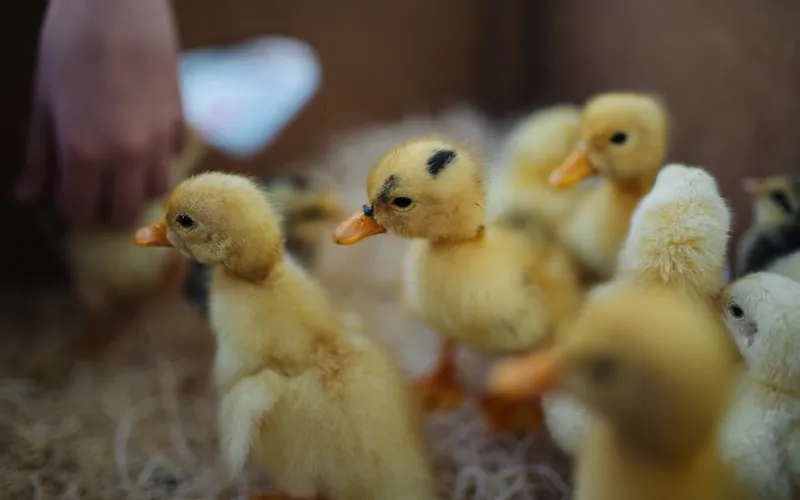
The most common clinical presentation in juvenile backyard waterfowl is perosis, commonly known as bowed legs or slipped tendon. Ducklings hatch with tiny skeletons that must support an explosive weight increase: an American Pekin duckling grows from 50 grams (1.8 oz) at hatch to over 1,500 grams (3.3 lbs) by week 4—a thirty-fold increase.
The Biological Mechanism of Duck Niacin Deficiency:
- Inefficient Tryptophan Conversion: In chickens and mammals, the liver converts excess dietary tryptophan (an essential amino acid) into nicotinic acid via the kynurenine-quinolinate pathway. Ducks possess very high levels of the competing enzyme picolinic acid decarboxylase, which shunts tryptophan breakdown intermediates into the citric acid cycle instead of forming niacin. As a result, ducks cannot synthesize functional amounts of niacin endogenously.
- Hock Joint Malformation & Achilles Slipped Tendon: Niacin is a mandatory cofactor in the coenzymes NAD (nicotinamide adenine dinucleotide) and NADP, essential for cellular energy production and collagen synthesis in growing epiphyseal growth plates. When niacin is deficient, the intercondylar groove at the distal end of the tibiotarsus fails to deepen. The thick gastrocnemius (Achilles) tendon slips laterally out of the groove, permanently dislocating the lower leg backward and sideways.
- Therapeutic Supplementation Protocol: If using non-medicated chick starter, immediately mix 10 to 15 grams of human-grade brewer's yeast or nutritional yeast per 1 kg of dry feed (approximately 2 tablespoons per 1 lb of feed). For acute veterinary treatment of early wobbly gait, administer liquid water-soluble niacin (pure nicotinic acid, NOT flush-free inositol hexanicotinate) in the drinking water at 100 to 150 mg per 3.8 liters (1.0 gallon) for 14 consecutive days.
3. Stage-by-Stage Nutritional Requirements & The 'Angel Wing' Danger
Waterfowl require precise crude protein (CP) and metabolizable energy (ME) curves across their life stages. Overfeeding protein during the rapid growth phase is just as hazardous as underfeeding:
Phase 1: Starter Ration (Weeks 0 to 2)
- Crude Protein: 20% to 22% CP.
- Metabolizable Energy: 2,900 to 3,000 kcal/kg.
- Niacin Standard: Minimum 60 to 70 mg/kg.
- Calcium / Phos: 0.90% Calcium / 0.45% Available Phosphorus.
- Form: Fine crumbles. Keep feed dry and clean.
Phase 2: Grower / Developer (Weeks 3 to 18)
- Crude Protein: Drop to 15% to 16% CP.
- Metabolizable Energy: 2,800 to 2,900 kcal/kg.
- Niacin Standard: 50 to 55 mg/kg.
- Calcium / Phos: 0.80% Calcium / 0.40% Available Phosphorus.
- Form: Standard 3.0 mm (0.12 in) pellets.
The 'Angel Wing' Warning (Carpal Valgus): Maintaining ducklings on high protein (20% to 24%) past 3 weeks of age triggers a condition known as Angel Wing or Slipped Wing. The heavy primary flight feathers grow faster than the carpal cartilage can ossify and support them, causing the weight of the feathers to twist the wing joint outward away from the body. Dropping crude protein to 15% to 16% at week 3 and providing pasture exercise completely prevents this permanent cosmetic deformity.
Phase 3: Layer & Breeder Rations (Adult Egg Production)
When ducks reach 18 to 20 weeks and initiate egg lay, dietary calcium requirements multiply dramatically:
- Crude Protein: 16% to 18% CP with a balanced amino acid profile (minimum 0.40% Methionine and 0.85% Lysine).
- Calcium Standard: 3.25% to 3.50% total dietary Calcium. Duck eggs are approximately 30% larger than chicken eggs with thicker shells, requiring immense daily calcium mobilization. Supplementing free-choice coarse oyster shell in separate hoppers is mandatory.
4. Physical Feed Texture: Pellets vs. Crumbles vs. Mash
The physical form of the feed is almost as important as the nutritional content. Due to their wide, spatulate bills, ducks are poorly equipped to eat finely ground powdery mash:
Pellets & Crumbles (Recommended)
Compressed pellets (3 mm to 4 mm / 0.12 to 0.16 inch diameter) allow ducks to scoop up mouthfuls cleanly and swallow without feed dusting. Pellets reduce feed wastage by up to 20% to 25% compared to mash and maintain uniform nutrient intake without selective sorting of grains.
Dry Mash (High Hazard)
Finely ground meal clings to the mucous membranes of duck mouths and nostrils, forming a paste that cements the bill shut and chokes young ducklings. Furthermore, ducks wash the powdery mash into their drinking water, fouling drinkers into sour anaerobic soup within hours.
5. Foraging Botany, Invertebrate Ecology & Safe Pasture Grazing
Ducks are aggressive omnivorous wetland foragers. When provided pasture and pond access, an adult duck can obtain 15% to 25% of its total dietary intake from wild vegetation and invertebrates, dramatically improving egg yolk carotenoid pigmentation:
High-Value Forage Crops & Aquatic Plants:
- Duckweed (Lemna minor): One of the most nutrient-dense aquatic plants on earth, containing 35% to 42% crude protein (dry weight) and rich lysine levels. Ducks consume duckweed voraciously.
- Broadleaf Pasture Greens: Dandelion greens, white and red clover, chickweed, plantain, and young tender alfalfa. Ducks preferentially graze soft, succulent dicot leaves over fibrous, woody grass stems.
- Invertebrate Biological Control: Ducks are supreme agricultural pest hunters, actively rooting out slugs, terrestrial snails, cutworms, grasshoppers, Japanese beetle grubs, and mosquito larvae from standing water puddles.
The Bread & Carbohydrate Trap: Never feed commercial white bread, crackers, popcorn, or chips to ducks. Highly refined processed carbohydrates provide zero vitamins, minerals, or bioavailable protein. Bread expands in the crop, predisposing ducks to impaction, candidiasis (sour crop), severe malnutrition, and juvenile angel wing.
6. Toxic Botanicals, Mycotoxins & Insoluble Grit Protocols
Waterfowl keepers must maintain strict biosecurity regarding feed storage and toxic garden flora:
Toxic Botanicals & Foods
- Raw / Dry Beans: Contain toxic phytohaemagglutinin; fatal even in small doses. Must be thoroughly cooked.
- Avocado (Skin & Pit): Contains persin, a fungicidal toxin causing cardiac failure and pulmonary edema in all avian species.
- Nightshade Foliage: Green potato skins, tomato leaves, and eggplants contain solanine alkaloids.
- Aflatoxins / Moldy Grain: Ducks are 10 times more sensitive to aflatoxins (from Aspergillus flavus in damp feed) than chickens. Ingesting moldy feed causes acute hepatic necrosis and rapid mortality.
Insoluble Granite Grit Protocol
- Why Grit is Essential: Ducks possess no teeth. Insoluble granite grit lodges in the muscular gizzard to mechanically grind whole grains, bugs, and fibrous pasture forage.
- Chick Size (0–3 wks): Fine granite sand (1 mm to 2 mm / #1 grit).
- Grower Size (3–8 wks): Medium crushed granite (3 mm to 5 mm / #2 grit).
- Adult Size (9+ wks): Coarse insoluble granite (5 mm to 8 mm / #3 grit). Offer free-choice in dry hoppers.
7. Technical Performance Matrix: Duck Nutrition Across Production Stages
| Nutrient Metric | Starter (0 to 2 Wks) | Grower (3 to 8 Wks) | Developer (9 to 18 Wks) | Layer / Breeder (19+ Wks) |
|---|---|---|---|---|
| Crude Protein (CP) | 20.0% to 22.0% | 15.0% to 16.0% | 14.0% to 15.0% | 16.0% to 18.0% |
| Metabolizable Energy (ME) | 2,900 to 3,000 kcal/kg | 2,850 to 2,950 kcal/kg | 2,750 to 2,850 kcal/kg | 2,800 to 2,900 kcal/kg |
| Dietary Niacin (Vitamin B3) | 65 to 70 mg/kg | 55 to 60 mg/kg | 50 to 55 mg/kg | 55 to 60 mg/kg |
| Calcium (Ca) | 0.90% to 1.00% | 0.80% to 0.90% | 0.80% | 3.25% to 3.50% |
| Available Phosphorus (AvP) | 0.45% | 0.40% | 0.35% | 0.45% |
| Total Lysine | 1.10% | 0.85% | 0.70% | 0.85% |
| Physical Feed Presentation | Crumbles (1.5–2.0 mm) | Pellets (3.0 mm) | Pellets (3.0–4.0 mm) | Pellets (3.0–4.0 mm) |