
Duck Housing & Waterer Drainage: Wet Litter Solutions, Slat Flooring & Coop Plans
Engineering blueprints and hydraulic management for waterfowl: solving wet litter ammonia spikes with elevated slatted floors, French drain aprons, and winter ventilation.
Scientific Overview
Managing ducks in backyard and commercial poultry systems presents a unique biophysical challenge: waterfowl drink 2 to 3 times more water than chickens of comparable body mass and excrete droppings with 85% to 90% moisture content. Left unmanaged on standard chicken-style bedding, ducks rapidly transform dry bedding into an anaerobic, ammonia-saturated mire within 48 to 72 hours. This elevated humidity and soggy substrate directly cause ulcerative pododermatitis (bumblefoot), sternal keel bursitis, aspergillosis fungal outbreaks, and acute eye infections. This engineering guide details proven hydraulic drainage architecture, elevated slatted flooring installations, minimum ventilation rates, and floor space specifications required to maintain bone-dry resting quarters and optimize waterfowl welfare.
1. Executive Summary: The Waterfowl Wet Litter Crisis
The Engineering Rule of Waterfowl Housing: Ducks cannot be kept successfully on standard flat chicken bedding without dedicated hydraulic water management. A flock of 10 adult Pekin ducks drinks 4.0 to 5.5 liters (1.0 to 1.5 gallons) of water daily and deposits over 80% of that volume back into the environment as high-moisture slurry and drinking splash. Successful duck coops separate the drinking/washing zone from the sleeping/nesting zone using elevated slatted flooring over drainage troughs or exterior gravel French drain aprons.
The primary failure mode of novice duck keepers and converting chicken farmers is treating ducks like landfowl. Chickens scratch and turn dry litter, creating a composting dry pack. Ducks, by contrast, possess broad, sensitive, unfeathered webbed foot pads and shovel-shaped serrated bills engineered by natural selection to dabble in mud and filter water. When kept in standard coops, their constant dabbling disintegrates pine shavings and straw into an impermeable anaerobic seal, suffocating aerobic microbes and causing hazardous ammonia (NH3) gas concentrations to exceed 25 ppm within days.
2. Duck Drinking Mechanics: The Physiological Need for Head Submersion
Understanding why ducks make a mess requires examining their cranial anatomy. Unlike gallinaceous poultry, ducks lack hands, teeth, or lateral cheeks. They possess sensitive bill lamellae used for food filtration. Crucially, their nares (nostrils) and eye orbital glands continuously collect dust, feed particles, and dried secretions.
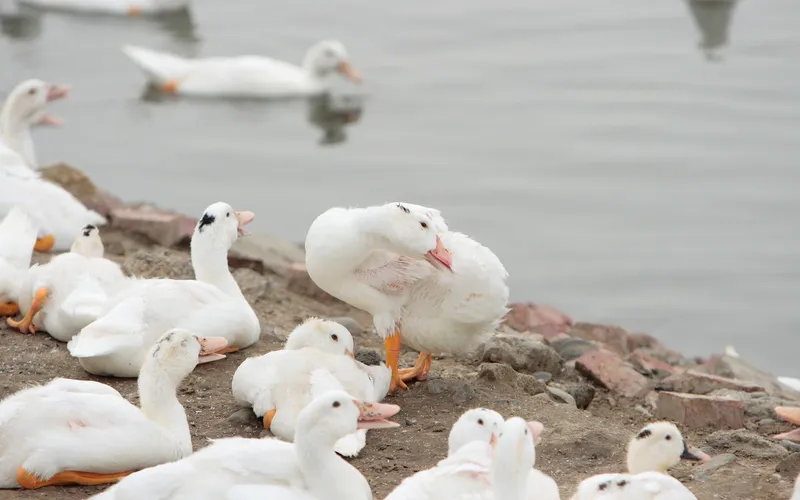
Why Chick Nipple Drinkers Fail as Sole Water Sources:
- Bilateral Nares Flushing: Ducks must submerge their entire bill past the nares to blow water through their sinuses. If ducks cannot flush their nares daily, feed mash cements inside the nostrils, leading to chronic rhinitis, infectious sinusitis (frequently caused by Mycoplasma gallisepticum), and bilateral orbital keratitis.
- Preen Gland (Uropygial Gland) Activation: To maintain feather waterproofing, ducks scoop water over their mantle and back, triggering oil distribution from the dorsal uropygial gland. Birds deprived of open water develop "wet feather" syndrome, losing water-repellency and thermal insulation.
- Dabbling Reflex & Feed Swallowing: Ducks eat dry pellets or crumbles and immediately run to the waterer with a bill full of feed, plunging their bill into the water to create a slurry. This natural ingestion reflex washes 10% to 20% of the feed into the water, creating heavy sediment that jams standard commercial chicken ball-valves and micro-nipples.
3. Drainage Architecture: French Drains, Sump Pits & Gravel Aprons
To keep duck bedding bone-dry, hydraulic water containment must be built directly into the housing infrastructure. Waterers should never sit on flat wooden floors or directly on pine shavings. Three physical drainage solutions have proven effective across veterinary and smallholder production:
Solution A: Sub-Floor French Drain System
Excavate a trench 30 cm to 45 cm (12 to 18 inches) deep directly beneath the water station. Line with permeable geotextile fabric, lay a 100 mm (4-inch) perforated PVC drain pipe sloped at a 2% grade toward an outdoor soakaway or greywater swale, and backfill with washed 20 mm to 40 mm (0.75 to 1.5 inch) crushed river stone. Top with a removable slatted grate. All splash drains away instantly.
Solution B: Exterior Gravel Wash Apron
Locate all open swimming pools, trough waterers, and bathing tubs exclusively outdoors in the predator-proof run. Lay an exterior drainage apron measuring at least 1.5 to 2.0 meters (5.0 to 6.5 feet) around all water sources using coarse pea gravel (10 mm to 20 mm) over heavy wire mesh. This prevents the formation of muddy wallows and keeps duck feet clean before re-entering the sleeping coop.
For indoor winter setups where freezing outdoor temperatures prevent open water runs, install a catch-basin water box: place a galvanized steel or heavy-duty food-grade poly containment pan beneath an elevated vinyl-coated hardware cloth platform (12 mm × 12 mm / 0.5 in mesh) on which bell waterers sit. The pan collects 100% of overflow, which is drained via a bottom bulkhead fitting and flexible hose through the coop sidewall.
4. Flooring Systems: Deep Litter Management vs. Raised Plastic Slats
Choosing the appropriate flooring material determines coop sanitation, labor hours, and foot pad health. The two prevailing systems each have distinct engineering requirements:
System 1: Commercial Polypropylene Slatted Flooring (Recommended for High Density)
Interlocking virgin polypropylene poultry slats featuring rectangular openings (approximately 20 mm × 20 mm / 0.75 in with 40% to 50% open area) elevated 30 cm to 60 cm (12 to 24 inches) above a concrete or membrane-lined subfloor.
- Advantage: Droppings and splash pass directly through underfoot pressure. Birds remain dry, clean, and elevated above manure gases.
- Foot Health: High-grade plastic slats feature smooth, rounded support ribbing designed specifically to prevent foot pad abrasions, hyperkeratosis, and staphylococcal bumblefoot.
- Maintenance: Bottom pit can be hosed down or scraped out weekly using automated drag scrapers or manual squeegees.
System 2: Deep Litter Carbon Pack (Pastured Homestead Coops)
If using traditional solid floor coops, the bedding depth must be maintained at a minimum of 15 cm to 25 cm (6 to 10 inches). Bedding selection is critical:
- Coarse Pine Shavings: Optimal carbon-to-nitrogen ratio. Avoid fine wood dust or sawdust, which causes bill clogging and corneal ulcers when wet.
- Chopped Wheat or Barley Straw: Straw must be chopped into 5 cm to 10 cm (2 to 4 inch) lengths. Long intact straw forms an impenetrable woven mat that traps wet manure on top, soiling duck bellies.
- Daily Capping Protocol: Rather than full cleanouts every week, add a fresh 2.5 cm (1 inch) top-dressing of dry shavings every 24 to 48 hours to lock down nitrogen and maintain a dry walking surface. Apply agricultural hydrated lime or zeolite clinoptilolite beneath bedding layers to adsorb moisture and neutralize ammonia.
5. Psychrometric Ventilation & Moisture Evaporation in Waterfowl Housing
Because ducks generate substantial water vapor through respiration and watery droppings, closed coops rapidly accumulate high relative humidity (RH). When indoor RH exceeds 75% in cold weather, water condenses on ceilings, walls, and bedding, promoting rapid fungal sporulation of Aspergillus fumigatus.
Minimum Winter Ventilation Standard: Duck housing requires a continuous airflow exchange rate of 0.15 m³ to 0.20 m³ per minute per kg of live weight (2.4 to 3.2 CFM/lb). In passive coops, ridge vents or high soffit openings must provide at least 0.1 m² (1.0 sq ft) of open ventilation area per 1.0 m² (10 sq ft) of floor space, positioned well above duck head height to avoid direct cold floor drafts.
Ducks possess thick subcutaneous fat layers and dense down plumages that provide cold tolerance far superior to chickens; adult Pekins and Muscovies easily tolerate sub-zero temperatures down to -15°C to -20°C (5°F to -4°F) provided their bedding is dry and ambient humidity is kept below 65%. Never seal a duck coop airtight in winter to keep it warm—trapping moisture causes hypothermia and pneumonia far faster than cold fresh air.
6. Floor Space Standards, Headroom & Nest Box Ergonomics
Ducks are heavier, wider, and less vertically agile than chickens. They do not fly up to elevated perches (with the exception of Muscovies) and will not climb steep ladders into elevated chicken coops. Housing dimensions must accommodate their physical footprint:
Coop Floor Area & Headroom
- Night Shelter (Bedded Floor): 0.37 m² to 0.46 m² (4.0 to 5.0 sq ft) per bird for standard breeds (Pekin, Rouen); 0.55 m² (6.0 sq ft) for heavy Muscovy toms.
- Night Shelter (Slatted Floor): 0.23 m² to 0.28 m² (2.5 to 3.0 sq ft) per bird due to rapid manure clearing.
- Outdoor Run Area: Minimum 1.8 m² to 2.8 m² (20 to 30 sq ft) per bird.
- Entry Door & Ramp: Door width must be at least 35 cm to 40 cm (14 to 16 in). Ramps must have a gentle slope (under 20° incline) with cleats spaced every 10 cm (4 in).
Ground-Level Nest Box Design
- Ground Placement: Ducks lay on the ground. Nest boxes must sit directly on the floor along the darkest, most secluded wall.
- Dimensions: 35 cm wide × 35 cm deep × 35 cm high (14 × 14 × 14 inches) for standard layers; 40 cm × 40 cm (16 × 16 inches) for heavy Pekins and Muscovies.
- Low Retaining Lip: Install a 7.5 cm to 10 cm (3 to 4 inch) wooden lip on the front to prevent the hen from rolling straw bedding out while allowing easy entry without stepping on eggs.
- Ratio: 1 nest box per 4 to 5 laying ducks.
7. Technical Specification Matrix: Duck Housing & Drainage Standards
| Engineering Parameter | Standard Meat Duck (Pekin) | Egg Layer (Khaki Campbell) | Heavy Perching (Muscovy) |
|---|---|---|---|
| Enclosed Coop Floor (Bedded) | 0.37 m² to 0.46 m² (4.0 to 5.0 sq ft) | 0.28 m² to 0.37 m² (3.0 to 4.0 sq ft) | 0.46 m² to 0.55 m² (5.0 to 6.0 sq ft) |
| Enclosed Coop Floor (Slats) | 0.25 m² to 0.28 m² (2.7 to 3.0 sq ft) | 0.20 m² to 0.23 m² (2.2 to 2.5 sq ft) | 0.30 m² to 0.35 m² (3.2 to 3.8 sq ft) |
| Outdoor Run Enclosure | 1.8 m² to 2.5 m² (20 to 27 sq ft) | 1.8 m² to 2.3 m² (20 to 25 sq ft) | 2.5 m² to 3.5 m² (27 to 38 sq ft) |
| Daily Water Intake / Bird | 0.5 to 0.7 L (0.13 to 0.18 gal) | 0.4 to 0.5 L (0.10 to 0.13 gal) | 0.5 to 0.8 L (0.13 to 0.21 gal) |
| Water Drainage Apron Width | 1.5 m (5.0 ft) perimeter | 1.2 m (4.0 ft) perimeter | 1.8 m (6.0 ft) perimeter |
| Nest Box Placement | Ground floor level only | Ground floor level only | Ground floor or low shelf (< 60 cm) |
| Perch Requirements | None (causes foot lesions) | None (causes foot lesions) | Broad 5×10 cm (2×4 in) perches required |