
How Long Do Eggs Last in the Fridge? The Egg Float Test Science, Haugh Unit Quality & Freshness Assessment
The definitive scientific guide to egg shelf life, refrigeration physics, the egg float water test, breakout quality grading, and laboratory Haugh Unit calculations.
Scientific Overview
Understanding interior egg freshness, shell microbiology, and storage dynamics is essential for food safety, commercial table egg grading, and home culinary performance. This scientific manual answers the vital question of how long eggs last in the fridge, explains the biophysics behind the egg float water test, outlines USDA Grade AA, A, and B breakout standards, details the biochemical breakdown of ovomucin albumen proteins over time, and demonstrates how to calculate egg quality scores using Raymond Haugh's mathematical Haugh Unit formula.
1. The Biophysics & Biochemistry of Egg Aging
A freshly laid chicken egg is a marvel of biological engineering. Encased within a calcium carbonate (CaCO3) shell perforated by 7,000 to 17,000 microscopic breathing pores, the egg contains four distinct physical layers: the inner and outer shell membranes, the yolk encased in its elastic vitelline membrane, and four albumen layers (outer thin, inner thick, inner thin, and chalaziferous layers anchored by spiral chalaza cords).
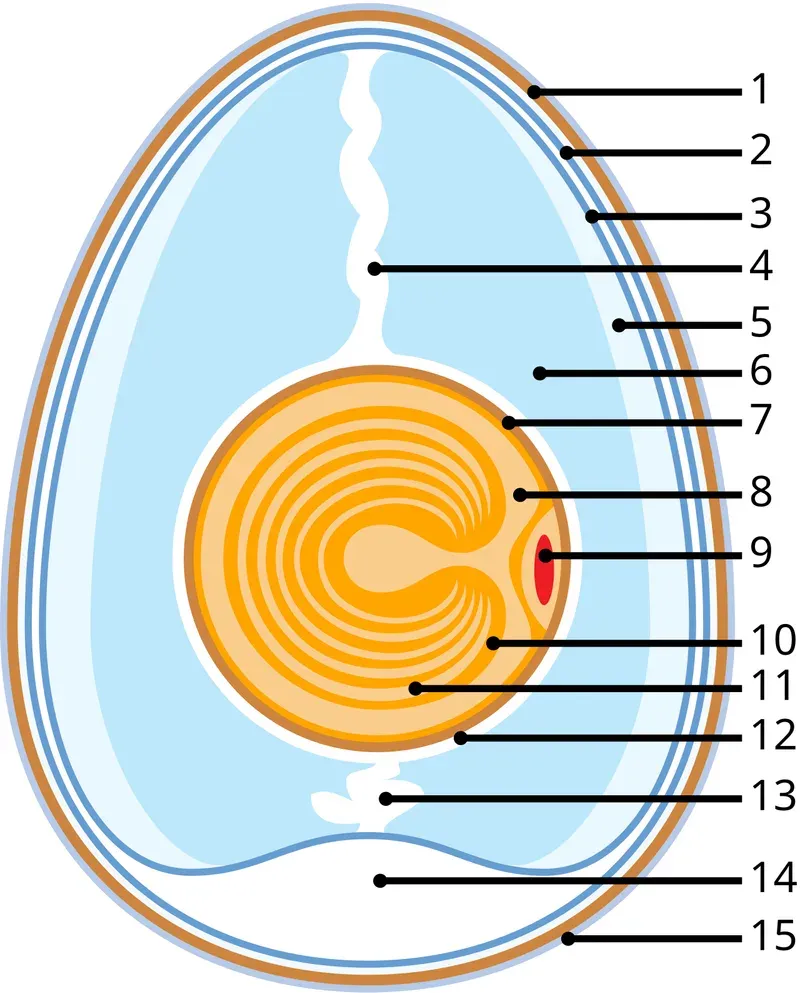
Diagram Key — Numbered Callouts:
The Three Inevitable Biochemical Aging Processes:
- 1. Carbon Dioxide (CO2) Loss & Alkaline Shift: At lay, egg albumen contains high concentrations of dissolved carbon dioxide and exhibits a near-neutral pH of 7.6. Because ambient atmosphere contains far less CO2 than the freshly laid egg, CO2 gas continuously diffuses outward through the microscopic shell pores. As carbon dioxide escapes, carbonic acid dissociates, driving the albumen pH up to an alkaline 9.2 to 9.5 within several days.
- 2. Ovomucin Gel Breakdown (Albumen Thinning): In a fresh egg, the thick albumen consists of an insoluble gel matrix formed by fibrous ovomucin protein cross-linked with lysozyme enzymes. As the albumen becomes increasingly alkaline, the electrostatic bonds between ovomucin and lysozyme dissociate. The thick jelly-like albumen depolymerizes, collapsing into a watery, runny liquid white that spreads widely across flat surfaces.
- 3. Transpiration & Air Cell Expansion: Liquid water from the albumen continuously evaporates through the shell pores into ambient air. As moisture leaves, the internal contents contract. Atmospheric air is sucked through the shell pores at the broad blunt end of the egg, separating the inner and outer shell membranes and progressively inflating the air cell from a microscopic 3 mm bubble into an expansive pocket.
2. How Long Do Eggs Last in the Fridge? The Definitive Shelf-Life Timeline
Refrigerated Shelf Life Answer: Commercial washed supermarket eggs stored in an intact carton in the refrigerator at 1.7°C to 4.4°C (35°F to 40°F) last for 3 to 5 weeks beyond the carton pack date (Julian date), and routinely remain wholesome and safe to eat for 60 to 90 days if shells remain clean and uncracked. Unwashed farm-fresh eggs with intact protective cuticles remain wholesome in the refrigerator for up to 3 to 4 months.
Egg Storage Shelf-Life Comparison Matrix:
| Egg Processing Type | Storage Temperature | Freshness Duration | Primary Degradation Factor |
|---|---|---|---|
| Commercially Washed Carton Eggs | 1.7°C to 4.4°C (35°F to 40°F) (Refrigerated) | 4 to 6 weeks past pack date (Safe up to 90 days) | Slow moisture evaporation; air cell growth |
| Commercially Washed Carton Eggs | 20°C to 25°C (68°F to 77°F) (Room Temp) | 1 to 2 weeks maximum | Rapid condensation, bacterial entry through open pores |
| Unwashed Farm-Fresh (Bloom Intact) | 1.7°C to 4.4°C (35°F to 40°F) (Refrigerated) | 3 to 4 months (90 to 120 days) | Extremely slow moisture loss through sealed pores |
| Unwashed Farm-Fresh (Bloom Intact) | 15°C to 20°C (59°F to 68°F) (Cool Pantry) | 2 to 3 weeks | Gradual moisture evaporation and albumen thinning |
| Hard-Boiled Eggs (In-Shell) | 1.7°C to 4.4°C (35°F to 40°F) (Refrigerated) | 7 days maximum | Boiling strips cuticle and micro-fractures shell |
The Temperature Acceleration Curve: High temperatures accelerate egg degradation exponentially. Storing an egg for 1 single day at 25°C (77°F) degrades its Haugh Unit quality and expands its air cell as much as storing it for one full week in the refrigerator at 4°C (39.2°F).
3. The Egg Float Test: The Exact Biophysics Behind Sinking vs Floating
The egg float test (also called the egg water test) is the most widely utilized non-destructive home kitchen method for evaluating egg freshness. The test relies on Archimedes' principle of buoyancy and the physical expansion of the blunt-end internal air cell over time:
Stage 1: Lies Flat on the Bottom (Fresh: 1–7 Days Old)
The egg sinks instantly to the bottom of the water bowl and rests completely flat horizontally on its side. The air cell is tiny (depth < 3.2 mm / 1/8 inch), meaning minimal water has transpired. The egg's overall specific gravity is approximately 1.085, significantly denser than water (1.000). Ideal for poaching, frying, and delicate baking.
Stage 2: Stands Upright on the Bottom (14–21 Days Old)
The egg rests on the bottom of the bowl but tilts upright with its small pointed end touching the floor and its broad blunt end tilting upward. The air cell has expanded to 4.8 mm to 6.4 mm (3/16 to 1/4 inch), providing upward buoyant lift at the blunt end. The egg is completely wholesome and safe to eat. Culinary Tip: This is the optimal stage for making hard-boiled eggs; the enlarged air cell and alkaline pH cause the shell to peel cleanly without tearing the egg white!
Stage 3: Bobbing in Mid-Water (3 to 5 Weeks Old)
The egg hovers semi-suspended near the bottom or mid-level of the water. Extensive moisture has evaporated, bringing the egg's bulk density close to that of water (1.000). The albumen is thin, but the vitelline membrane remains intact. Perfectly safe for baking cakes, scrambling, or casseroles.
Stage 4: Floats Completely on Top (Very Old / Suspect)
The egg bobs directly on the water surface. The air cell has expanded to over 9.5 mm (3/8 inch) depth due to massive water loss. Important Distinction: Floating indicates age, not necessarily bacterial rot. If the shell has remained sterile, an old floating egg may simply be desiccated. However, because its defenses are depleted, always crack floating eggs individually into a separate bowl for an olfactory sniff check before use. If it smells off or displays mixed rot, discard it immediately.
4. The Breakout Test: How to Tell If an Egg Is Good or Bad
When assessing egg quality in home kitchens or food service, the visual breakout test onto a flat plate provides definitive confirmation:
Visual & Olfactory Breakout Criteria:
- Grade AA (Peak Freshness): When cracked onto a flat plate, the yolk stands tall, round, and centered. The thick albumen stands high and compact in a tight ring closely encircling the yolk, with very little watery thin white spreading outward.
- Grade A (Standard Good Quality): The yolk is fairly high, but the thick albumen has begun to loosen, spreading somewhat further across the plate. This is the quality profile of typical fresh grocery store eggs.
- Grade B (Aged but Edible): The yolk is completely flat and fragile; the vitelline membrane ruptures easily when touched with a fork. The thick albumen has liquefied, creating a wide, watery puddle across the entire plate. Wholesome for baking and commercial processing, but poor for poaching.
- Spoiled / Inedible (The Sniff Test): Any egg that has succumbed to bacterial decomposition (such as Pseudomonas green rot, Proteus black rot, or hydrogen sulfide rot) emits an overwhelming, pungent, unmistakable sulfur rotten egg stench the second the shell cracks. Discard immediately.
Blood Spots vs Spoilage: A tiny red blood spot on the yolk does NOT mean the egg is fertilized or bad. Blood spots occur in less than 1% of commercial eggs when a tiny follicle capillary ruptures during ovulation on the hen's ovary. Blood spots are completely safe to consume or can be lifted away with the tip of a clean spoon.
5. The Haugh Unit: Laboratory Gold Standard for Albumen Quality
The Haugh Unit Formula (Raymond Haugh, 1937):
HU = 100 × log10( h - 1.7w0.37 + 7.6 )
Where h is the observed thick albumen height in millimeters (mm), and w is the total egg weight in grams (g).
Prior to 1937, egg quality assessments suffered from subjective visual bias. Raymond Haugh recognized that heavier eggs naturally produce taller albumen domes than small pullet eggs simply due to greater liquid volume. By introducing the logarithmic weight correction exponent (w0.37), Haugh created a size-independent universal index that correlates directly with molecular ovomucin integrity.
USDA Grade Tiers Based on Haugh Units:
| USDA Grade | Haugh Unit Range | Albumen Height (60g Egg) | Vitelline Membrane State | Commercial Destination |
|---|---|---|---|---|
| Grade AA | 72 HU and higher | > 5.0 mm | Firm, elastic, highly centered | Premium carton table eggs |
| Grade A | 60 to 71 HU | 3.9 mm to 4.9 mm | Reasonably firm, slight spread | Standard retail distribution |
| Grade B | 31 to 59 HU | 2.0 mm to 3.8 mm | Flattened, weakened membrane | Liquid egg breaking, baking |
| Reject / Inedible | Below 31 HU | < 2.0 mm | Ruptured, watery liquefaction | Discarded; animal feed rendering |
Laboratory Measurement Protocol:
In avian physiology laboratories and quality-control egg packing stations, technicians weigh the unbroken egg on a high-precision scale to the nearest 0.1 gram. The egg is cracked cleanly onto a perfectly leveled, chilled breakout glass table. An electronic tripodal micrometer or spherometer is positioned halfway between the outer edge of the yolk and the perimeter of the thick white. When the micrometer needle tip touches the gelatinous surface of the thick albumen, the electrical circuit completes, recording the height h in millimeters to two decimal places.
Complementary Quality Indices: Albumen Index & Yolk Index:
Beyond Haugh Units, poultry researchers employ two complementary morphological ratios:
- Albumen Index (AI): Computed as AI = h / √(d1 × d2), where d1 and d2 represent the perpendicular diameters of the thick white spread. Fresh Grade AA eggs show an Albumen Index of 0.090 to 0.120, collapsing below 0.040 in aged eggs.
- Yolk Index (YI): Computed as YI = hy / dy (yolk height divided by yolk diameter). In a freshly laid egg, the vitelline membrane is taut, maintaining a YI of 0.40 to 0.44. As water migrates from albumen into the yolk via osmotic pressure, the yolk swells and flattens, dropping the YI below 0.30 in stale eggs where the vitelline membrane is prone to spontaneous rupture.
Culinary Foam Biophysics: Fresh vs Aged Albumen:
Egg freshness drastically impacts kitchen performance. For delicate emulsifications (mayonnaise, hollandaise) and poached or fried eggs, fresh Grade AA eggs with high Haugh Units are non-negotiable; their viscous thick white clings tightly around the yolk in boiling water without forming ragged shreds. Conversely, for whipping meringues, soufflés, and angel food cakes, slightly older eggs (Grade A or B, 2 to 3 weeks old) actually whip faster to higher foam volume. Their alkaline pH and lower viscosity allow proteins (ovalbumin and conalbumin) to unfold more rapidly at the air-water interface, creating massive foam expansiveness, though fresh whites produce denser, more thermally stable foam networks.
6. Commercial Candling: Non-Destructive Quality Grading & Air Cell Sizing
While breakout Haugh Unit testing requires destroying the egg, commercial packing plants inspect millions of eggs non-destructively using automated high-speed optical candling:
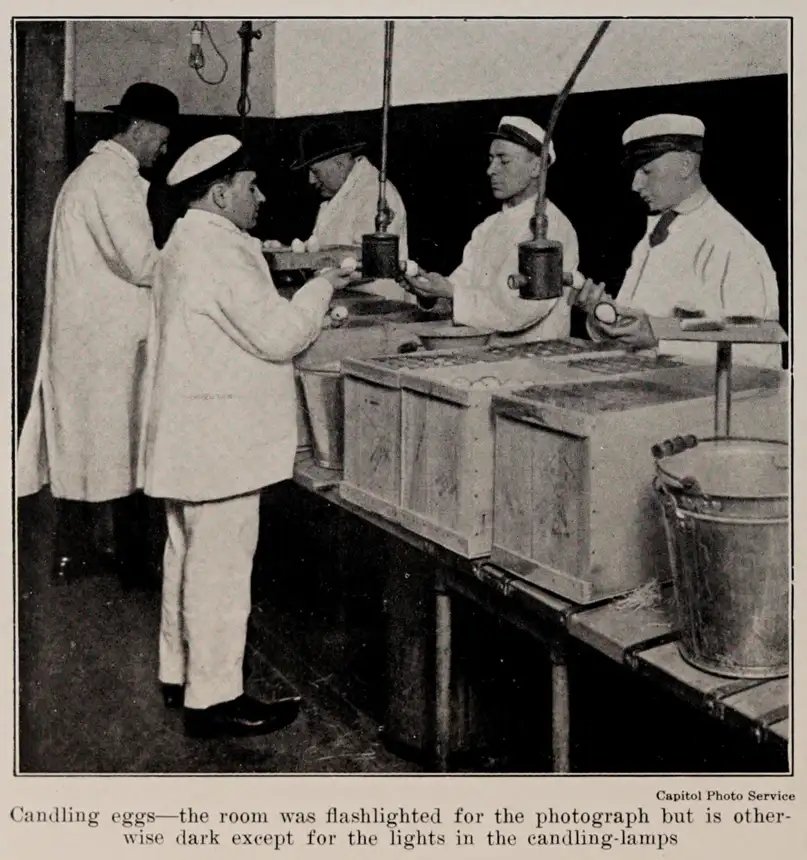
USDA Candled Air Cell Depth Standards:
- Grade AA Standard: Air cell depth must not exceed 3.2 mm (1/8 inch). The yolk shadow is only faintly outlined and barely moves when the egg is twirled, indicating a firm, thick albumen cushioning the yolk.
- Grade A Standard: Air cell depth may measure up to 4.8 mm (3/16 inch). The yolk outline is fairly well defined, moving somewhat more freely.
- Grade B Standard: Air cell depth exceeds 4.8 mm (3/16 inch) with unlimited depth. The yolk is distinctly dark, enlarged, flattened, and drops freely against the shell wall.
- Candling Defect Rejection: Candling detects hidden internal flaws that render an egg inedible: hairline shell micro-cracks (checks), internal meat spots > 3 mm, blood rings indicating early embryo death in fertile eggs, and microbial rot colonies.
7. Commercial & Farm Egg Storage Best Practices
To maximize egg freshness, prevent foodborne pathogens, and preserve culinary functionality, implement these scientific storage protocols:
- The Pointed-End Down Rule: Always store eggs with their pointed narrow end facing downward and their broad blunt end facing upward. The internal air cell is located at the broad blunt end. Storing eggs pointed-end down keeps the air cell stabilized at the top and prevents the buoyant yolk from floating upward against the inner shell membrane, where bacterial penetration occurs.
- Maintain the Cold Chain (1.7°C to 4.4°C / 35°F to 40°F): Commercial eggs washed in water must remain refrigerated continuously. If a refrigerated egg is brought to room temperature, ambient humidity condenses on the cold shell, creating water droplets ("egg sweating"). Moisture on the porous shell dissolves surface bacteria and transports them straight through shell pores into the egg interior.
- Store Inside the Original Closed Carton: Never store eggs in the open molded plastic shelves found inside refrigerator doors. Opening and closing the refrigerator door subjects eggs to constant temperature fluctuations and mechanical shaking that weakens the vitelline membrane. Additionally, eggshell pores readily absorb volatile food odors (such as onions, raw fish, and garlic); the enclosed paperboard carton acts as a protective odor barrier.
- Freezing Protocol for Surplus Eggs: Never freeze whole eggs in their shells; freezing expands water content, shattering the shell and exposing contents to contamination. To freeze surplus eggs safely: crack eggs into a bowl, whisk whites and yolks together gently to avoid whipping in air bubbles, add a pinch of salt (0.5 g per egg for savory dishes) or sugar (0.5 g per egg for baking) to prevent gelatinous yolk curdling, and freeze in airtight silicone molds for up to 12 months.
How Long Do Eggs Last in the Fridge? The Egg Float Test Science, Haugh Unit Quality & Freshness Assessment — Frequently Asked Questions
Add Poultria to your Google Preferred Sources
Follow Poultria on Google so our peer-reviewed poultry veterinary research, commercial breed genetics, and agronomic field guides are highlighted and cited first in your Google Search, Top Stories, and AI Overviews.