
Can Turkeys Fly? Wild vs. Domestic Flight Physics & Roosting Habits
The biomechanical breakdown of avian flight: why wild turkeys reach 88 km/h (55 mph) and roost 15 meters (50 feet) in trees while commercial Broad Breasted Whites remain grounded.
Scientific Overview
The question of whether turkeys can fly is one of the most widely misunderstood topics in poultry science. The accurate biological answer depends entirely on genetics: wild turkeys (Meleagris gallopavo) are exceptionally powerful, highly agile fliers capable of explosive burst speeds exceeding 88 km/h (55 mph) over short distances and roosting 9 to 15 meters (30 to 50 feet) high in forest canopies. In contrast, modern commercial meat turkeys—most notably the ubiquitous Broad Breasted White—have undergone intensive anthropogenic selection for massive pectoral muscle hypertrophic mass, creating an anatomical wing-loading ratio that renders sustained aerodynamic lift biomechanically impossible. Meanwhile, heritage turkey breeds occupy a fascinating intermediate status, readily clearing 1.8 to 2.4 meter (6 to 8 foot) perimeter fences without proper husbandry management.
1. Executive Verdict: Flight Capabilities by Turkey Class
The Biological Rule of Turkey Flight: Wild turkeys fly up to 88 km/h (55 mph) for distances of 400 meters (0.25 miles) and effortlessly roost 9 to 15 meters (30 to 50 feet) high in mature hardwoods. Heritage breeds (Bourbon Red, Narragansett, Royal Palm) can clear 1.8 to 2.4 meter (6 to 8 foot) boundary fences. Commercial Broad Breasted White and Bronze meat varieties are completely flightless past 10 weeks of age due to extreme pectoral muscle hypertrophy.
Public misconceptions surrounding turkey flight stem largely from commercial factory farming, where millions of supermarket meat birds spend their lives on litter floors incapable of lifting off the ground. In nature, however, wild turkeys rely on explosive burst flight as their primary life-saving defense against apex terrestrial predators including coyotes (Canis latrans), bobcats (Lynx rufus), and red foxes (Vulpes vulpes).
2. The Aerodynamics & Flight Physics of Wild Turkeys
Wild turkeys are gallinaceous ground birds characterized by a low wing aspect ratio: their wings are short, broad, and deeply cupped. This anatomical architecture is not engineered for long-distance migratory soaring like waterfowl or raptors, but rather for explosive vertical velocity.
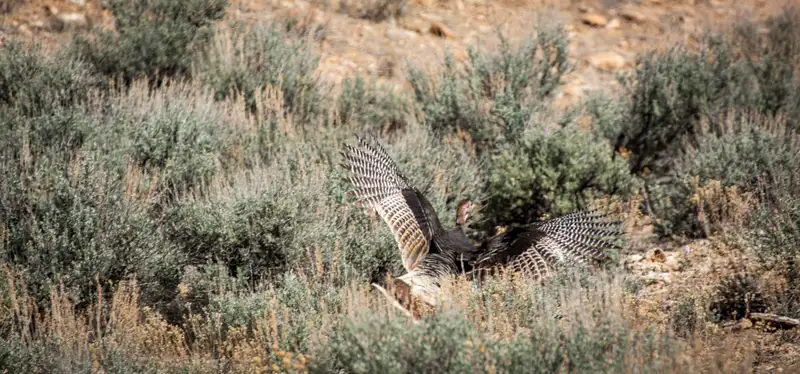
Biomechanical Factors Governing Turkey Flight:
- Pectoral Muscle Fiber Composition: The primary flight muscles of turkeys (the pectoralis major for downstroke and supracoracoideus for upstroke) are dominated by Type IIb fast-twitch glycolytic muscle fibers. These white muscle fibers contract with tremendous velocity and power, utilizing anaerobic glycogen pathways to generate rapid lift. However, because white muscle lacks high capillary density and myoglobin, it fatigues rapidly due to lactic acid accumulation, limiting sustained flapping flight to approximately 400 meters (0.25 miles).
- Explosive Launch Trajectory: When startled, a wild turkey crouches, transferring kinetic energy through its heavy tibiotarsus and tarsometatarsus leg bones, leaping 1.5 to 2.0 meters (5.0 to 6.5 feet) vertically into the air before the wings achieve full rhythmic downstroke extension. This explosive launch clears low brush and shrubs instantly.
- Wing Loading & High Airspeed: Wing loading is defined as body mass divided by total wing area (g/cm²). While songbirds exhibit wing loading under 0.2 g/cm², an adult wild tom weighing 8.0 kg to 10.0 kg (17.6 to 22.0 lbs) has a wing loading of approximately 1.2 to 1.5 g/cm². To sustain aerodynamic lift with heavy wing loading, the bird must maintain a high airspeed—explaining why wild turkeys fly at 80 to 88 km/h (50 to 55 mph) rather than hovering or gliding slowly.
3. Wild Turkey Roosting Habits: Why They Sleep High in Trees
A fundamental behavior of wild turkeys across North America is nocturnal arboreal roosting. Despite spending their daytime hours foraging, dust bathing, and strutting on open forest floors and pastures, turkeys never sleep on the ground unless incubating an active clutch of eggs.
The Roosting Ascent Routine
At twilight, wild turkey flocks gather beneath established roost trees—frequently mature oaks, pines, cottonwoods, or sycamores. Rather than flying straight up the trunk, birds launch from 15 to 30 meters (50 to 100 feet) away at an incline, landing on horizontal branches positioned 9 to 15 meters (30 to 50 feet) above the ground. If reaching high branches directly is difficult, they hop from limb to limb in an ascending spiral.
The Dawn Descent Maneuver
At first light, turkeys fly down from the roost. Because descending straight down would cause catastrophic impact on heavy breastbones, birds pitch downward into a shallow, extended glide across 50 to 100 meters (160 to 330 feet) of open field, flapping rhythmically just prior to touchdown to arrest descent momentum with their muscular legs.
4. Why Commercial Turkeys (Broad Breasted Whites) Are Flightless
The flightlessness of modern commercial meat turkeys (Broad Breasted White and Broad Breasted Bronze) is not an evolutionary trait; it is a direct artifact of 20th-century quantitative genetics and selective breeding.
Anatomical Shift: Broad Breasted White toms are bred to achieve harvest live weights of 16 kg to 22 kg (35 to 48 lbs) in just 18 to 22 weeks. Pectoral muscle mass accounts for over 30% of total carcass weight. This disproportionate anterior mass shifts their center of gravity downward and forward, while their wing span remains unchanged from ancestor stocks. Wing loading exceeds 3.0 g/cm², far surpassing the physiological limit required for aerodynamic lift.
If a mature Broad Breasted White attempts to flap vigorously, it can at most generate a 30 cm to 60 cm (12 to 24-inch) horizontal hop. Because of their heavy mass, dropping from elevated perches higher than 60 cm (24 inches) frequently results in sternal bone fracture, keel bursitis, or plantar pododermatitis (bumblefoot). Consequently, commercial turkey houses maintain single-level flat bedding with no elevated roosting perches.
5. Heritage Breeds: Sizing, Flight Ranges & Fence Clearing
Smallholders, homesteaders, and pastured poultry farmers frequently choose traditional heritage turkey breeds recognized by the American Poultry Association (APA). These include the Bourbon Red, Narragansett, Standard Bronze, Slate (Blue Slate), Black Spanish, and Royal Palm.
Unlike commercial hybrids, heritage turkeys retain normal proportional anatomy and natural mating capabilities. Adult heritage toms weigh 10.0 kg to 15.0 kg (22 to 33 lbs), while heritage hens weigh 5.0 kg to 7.5 kg (11 to 16 lbs). Juvenile birds and adult hens possess a sufficiently light wing-loading ratio to easily clear 1.8 to 2.4 meter (6 to 8 foot) perimeter fences. They frequently fly onto barn roofs, tractor canopies, low tree branches, and greenhouse frames if left uncontained.
6. Containment Protocols: Perimeter Fencing & Wing-Clipping Guide
Keeping heritage or semi-wild turkeys safe from road traffic, neighboring gardens, and predators requires proven physical containment strategies:
Fencing & Overhead Netting
- Fence Height: Minimum 1.8 meters (6 feet) for heritage breeds. Standard 1.2 m (4 ft) chicken fencing will not contain young turkeys.
- No Perch Top Rails: Avoid installing rigid horizontal wooden top rails on fences; turkeys land on the top rail first before hopping down outside. A loose, high-tensile wire top discourages perching.
- Overhead Netting: For total flight containment, cover outdoor pens with UV-stabilized heavy knotted polypropylene game-bird netting (50 mm / 2-inch mesh).
Humane Unilateral Wing Clipping
- One Wing Only: Always clip the primary flight feathers of ONE wing only. Clipping both wings maintains aerodynamic balance, allowing the bird to hop-flap over fences. Trimming one wing causes an aerodynamic stall and spin.
- Primary Feathers Only: Trim the first 10 primary flight feathers on the outer wing edge back by approximately 50% to 60%.
- Blood Quills Warning: Never trim growing feathers with pink, blood-filled central shafts (blood feathers); this causes profuse hemorrhage. Wait until feather shafts become clear and mature.
7. Technical Performance Matrix: Wild vs. Heritage vs. Broad Breasted
| Performance Metric | Wild Turkey (M. gallopavo) | Heritage Breeds (Bourbon Red/Royal Palm) | Commercial Broad Breasted White |
|---|---|---|---|
| Adult Male Mass | 7.5 kg to 10.5 kg (16.5 to 23.0 lbs) | 10.0 kg to 15.0 kg (22.0 to 33.0 lbs) | 16.0 kg to 22.0+ kg (35.0 to 48.5 lbs) |
| Adult Female Mass | 3.8 kg to 5.4 kg (8.4 to 12.0 lbs) | 5.0 kg to 7.5 kg (11.0 to 16.5 lbs) | 9.0 kg to 13.5 kg (20.0 to 30.0 lbs) |
| Top Flight Velocity | 80 to 88 km/h (50 to 55 mph) | 40 to 50 km/h (25 to 31 mph) | Flightless (0 km/h) |
| Max Flight Distance | 400 meters (0.25 miles) | 20 to 50 meters (65 to 160 feet) | Ground hops < 1 m (< 3.3 ft) |
| Arboreal Roost Height | 9 to 15 meters (30 to 50 feet) | 1.5 to 3.0 meters (5 to 10 feet) | Floor bedding only (0 meters) |
| Fencing Needed | Overhead flight netting mandatory | 1.8 m (6 ft) + wing clip or netting | 1.0 m to 1.2 m (3.3 to 4.0 ft) |