
Infectious Bursal Disease (Gumboro)
Birnavirus Immunosuppression & Bursal Atrophy Scoring
Scientific Overview & Physiological Context
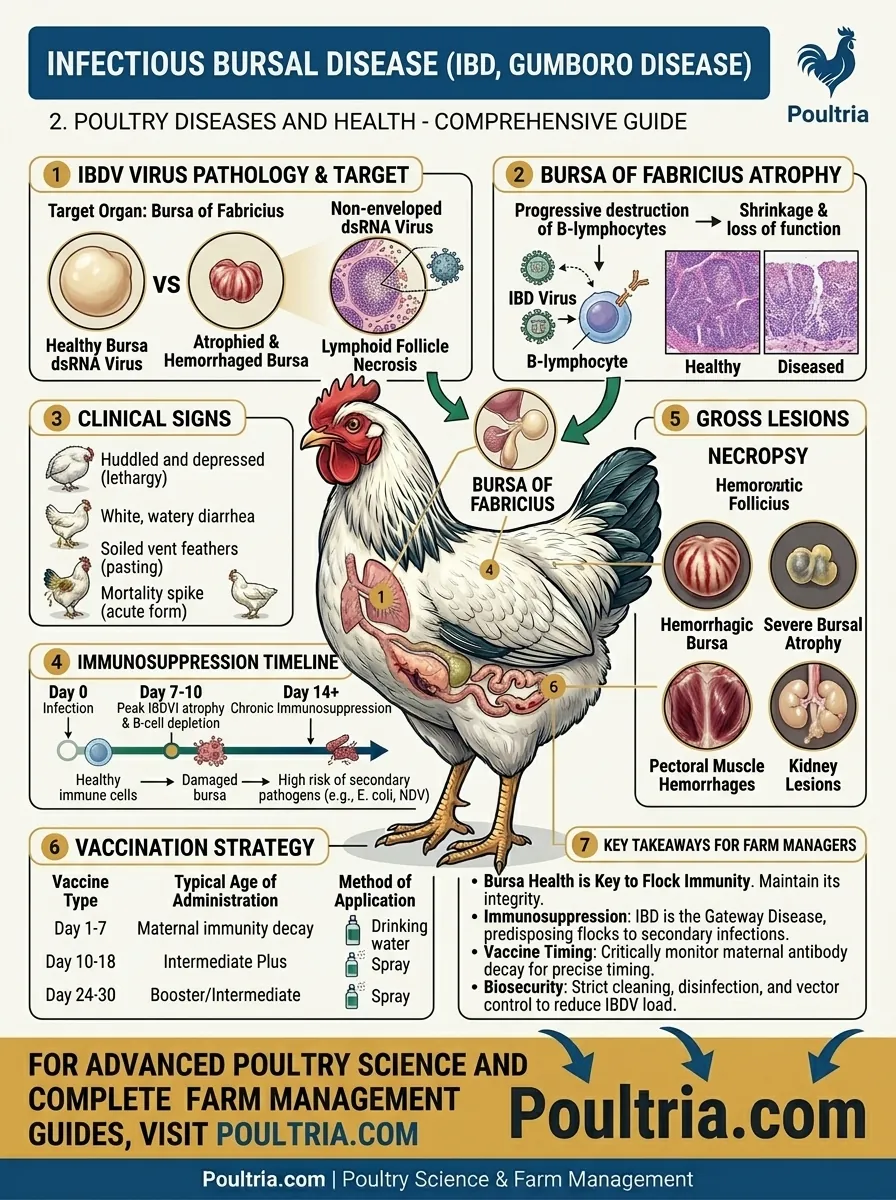
Infectious Bursal Disease (IBD), commonly called Gumboro disease, is an insidious viral infection that specifically destroys developing B lymphocytes inside the chick's Bursa of Fabricius. Even when it doesn't kill birds directly, it leaves the flock permanently immunosuppressed.
A Tough, Non-Enveloped Birnavirus
IBDV is a non-enveloped, double-stranded RNA Birnavirus. Because it lacks a delicate lipid membrane, the virus is exceptionally hardy—it easily survives heat, cold, acidic environments, and standard barn disinfectants. Once IBD virus enters a poultry house, it can persist in the concrete cracks and dried litter for months between flock rotations.
The Bursal Cycle: From Swelling to Complete Atrophy
When a young chick is infected, the virus homes in on immature B lymphocytes in the Bursa of Fabricius. By Day 3 post-infection, the Bursa becomes severely inflamed, doubling in size and turning jelly-like with a yellowish transudate. Hemorrhages develop across the mucosal folds. By Day 8, all the B cells have been destroyed, and the Bursa withers into a tiny, fibrous, shriveled sac.
Timing Vaccines with the Deventer Formula
Chicks receive maternal antibodies (MDA) from the hen through the egg yolk. These antibodies protect the chick early on, but they also neutralize live drinking-water IBD vaccines if given too soon. To solve this, poultry veterinarians use the mathematical Deventer Formula: by testing flock blood samples on Day 1, they calculate the exact day maternal antibodies will decline enough for the vaccine to safely take effect.
Core Biological & Management Mechanisms
Selectively wipes out immature B lymphocytes in the Bursa of Fabricius, crippling antibody-producing capacity.
Bursa doubles in size with yellowish jelly on Day 3 before shriveling into a scarred, non-functional remnant by Day 8.
A proven mathematical calculation using ELISA titers to determine the optimal day for live flock vaccination.
Modern recombinant HVT-IBD hatchery vaccines bypass maternal antibody interference entirely.
Veterinary Takeaway & Practical Application
Subclinical Gumboro infection in chicks under 3 weeks of age causes zero visible mortality, but destroys 80%+ of their B cells—causing silent vaccine failures for Newcastle, Bronchitis, and E. coli. Check Bursa-to-Body Weight ratios at Day 28 (normal ratio >1.5).
View Gumboro Guide →