
Gumboro Disease (Infectious Bursal Disease): Pathology, Symptoms & Vaccination
Comprehensive veterinary guide on Avian Birnavirus pathogenesis, bursa lesion progression, Deventer formula vaccination timing, and immunosuppression management.
Scientific Overview
Gumboro disease, known clinically as Infectious Bursal Disease (IBD), is an acute, highly contagious viral infection of young chickens caused by an Avian Birnavirus. The pathogen selectively targets and destroys dividing B-lymphocytes in the Bursa of Fabricius, inducing profound immunosuppression and secondary bacterial coinfections. Understanding infectious bursal disease symptoms, distinguishing classical from very virulent (vvIBD) strains, and timing maternal antibody vaccination using the Deventer formula are fundamental to commercial broiler and pullet management.
Etiology & Birnavirus Molecular Architecture
Pathogen Characterization: Infectious Bursal Disease Virus (IBDV) is a non-enveloped, double-stranded bi-segmented RNA virus belonging to the family Birnaviridae. Segment A encodes the structural proteins VP2, VP4, and VP3, while Segment B encodes the RNA-dependent RNA polymerase VP1.
Two serotypes exist: Serotype 1 is pathogenic to chickens, while Serotype 2 infects turkeys and ducks without causing clinical disease. The major host-protective immunogen and neutralization site resides in the hypervariable domain of the VP2 capsid protein (amino acids 206 to 350). Key mutations at positions 222, 256, 294, and 299 have driven the emergence of very virulent IBDV (vvIBDV) strains capable of breaking through moderate levels of maternal immunity.
The virus is remarkably stable in the farm environment. Without a lipid envelope, IBDV resists heat up to 56°C (133°F) for 5 hours, survives across pH ranges from 2.0 to 12.0, and withstands treatment with ether, chloroform, and standard phenolic disinfectants. It can persist in empty poultry houses for more than 120 days.
Infectious Bursal Disease Symptoms & Chronological Progression
Clinical infectious bursal disease symptoms present primarily in chickens between 3 and 6 weeks of age, corresponding to the developmental zenith of the Bursa of Fabricius. In chicks infected earlier than 3 weeks (often subclinical), permanent immunosuppression occurs without acute mortality:
| Timeline Post-Infection | Clinical Signs & Flock Behavior | Physiological Markers | Post-Mortem Anatomy |
|---|---|---|---|
| Day 1 to 2 | Decreased feed consumption, slight flock depression, initial resting on hocks | Transient fever: body temperature rises to 42.5°C to 43.0°C (108.5°F to 109.4°F) | Bursa shows mild edema and pale gelatinous coating |
| Day 3 to 4 (Acute Peak) | Severe prostration, watery chalk-white diarrhea, ruffled feathers, vent-picking, trembling | Hypothermia: body temperature drops below 40.0°C (104.0°F); severe dehydration | Bursa doubles in weight, shows intense edema, hyperemia, or dark red hemorrhage ("strawberry bursa") |
| Day 5 to 7 | Mortality spikes sharply and plateaus; surviving birds slowly resume drinking | Progressive reduction in bursa size; extensive B-cell necrosis in lymphoid follicles | Bursa turns greyish-yellow with necrotic caseous cores |
| Day 8+ (Chronic Stage) | Flock appears clinically recovered but remains severely immunosuppressed | Depressed antibody responses to Newcastle, Bronchitis, and Salmonella vaccines | Severe bursal atrophy: bursa shrinks to less than one-third of normal weight |
A signature behavioral clue is auto-pecking at the vent: birds experience intense local irritation from inflammatory swelling of the bursa directly dorsal to the cloaca. Droppings present as profuse chalky-white urates mixed with watery mucoid feces, staining the vent plumage.
Necropsy Pathology & The Bursal Weight Ratio
Definitive necropsy diagnosis rests on characteristic macro-pathological lesions across three anatomical sites:
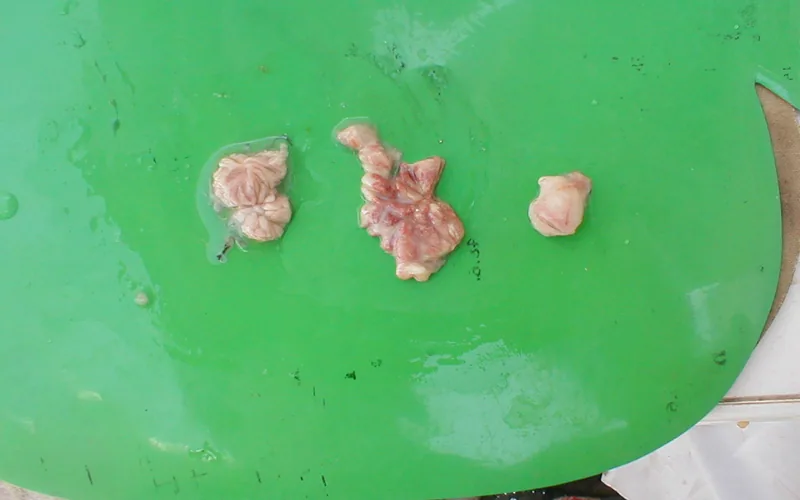
- Bursa of Fabricius: Progression from dramatic gelatinous yellowish edema on Days 3 to 4, through petechial and suffusive mucosal hemorrhage ("black cherry bursa"), to severe follicular atrophy and caseous core formation by Day 8.
- Skeletal Muscle Hemorrhages: Linear ecchymotic and petechial hemorrhages consistently appear on the pectoral (breast) and thigh musculature, caused by immune-complex coagulopathy.
- Kidney Engorgement: Kidneys swell severely, displaying pale parenchymal degeneration with renal tubules heavily distended by white urate crystal deposits due to acute dehydration.
Veterinary pathologists evaluate the Bursa-to-Body Weight Index (BBIX) to quantify follicular depletion:
A BBIX ratio below 1.0 in birds older than 4 weeks of age signifies severe pathological bursal atrophy and immunocompromise.
Vaccination Science: The Deventer Formula & Maternal Titers
Controlling Gumboro disease in commercial broilers requires overcoming a classic immunological dilemma: high maternal antibodies (MDA) transferred from breeder hens protect young chicks from field infection, but simultaneously neutralize live vaccines administered too early. If vaccination is delayed, an immunity window opens where maternal titers drop below protective levels while remaining high enough to neutralize vaccine strains.
To solve this, commercial operations calculate the precise flock vaccination day using the Deventer Formula:
In commercial broiler stock, the antibody half-life is typically 3.0 to 3.5 days (and 4.0 to 4.5 days in slower-growing layer pullets). Breakthrough titers vary by vaccine invasiveness:
- Mild Vaccine Strains: Breakthrough ELISA titer ≤ 100 to 125 (safe for SPF or zero-MDA birds, neutralized easily by maternal antibodies).
- Intermediate Vaccine Strains: Breakthrough ELISA titer 125 to 250 (standard application around Day 14 to 18 in broilers).
- Intermediate Plus / Hot Strains: Breakthrough ELISA titer 250 to 500 (can overcome higher maternal immunity, but cause transient bursal lesions).
- Immune-Complex & Recombinant HVT-IBD Vaccines: Administered in-ovo at Day 18 or subcutaneous at Day 1; the virus-antibody complex or viral vector bypasses maternal antibody interference entirely.
Biosecurity, Cleaning & Disinfection Protocols
Because IBDV survives in soil, wood, and dry litter for months, standard superficial cleaning fails to eradicate farm resident viruses. Effective terminal decontamination requires a structured chemical protocol:
- Litter Removal & Dust Sweeping: Completely clear all old litter down to the concrete pad. Blow dust off roof trusses and curtains.
- Detergent Pressure Wash: Wash all interior surfaces with an alkaline foaming detergent (pH >11.0) at 60°C (140°F) to strip organic biofilm.
- Virucidal Disinfection: Apply an EPA-registered virucide proven effective against non-enveloped birnaviruses: 1% Virkon S (potassium peroxymonosulfate), glutaraldehyde-quaternary ammonium combinations, or 0.5% formalin solution.
- Lesser Mealworm Control: Darkling beetles (Alphitobius diaperinus) ingest IBDV particles and transmit infectious virus in their feces for weeks. Apply pyrethroid or spinosad insecticides to floor perimeters immediately after litter cleanout.
 biotech Clinical Pathology
Related Calculators
Scientific Literature
- Müller, H., Mundt, E., Eterradossi, N., & Islam, M. R. (2012). Current status of vaccines against infectious bursal disease. Avian Pathology, 41(2), 133-139.
- Eterradossi, N., & Saif, Y. M. (2020). Infectious Bursal Disease. In Diseases of Poultry (14th ed., pp. 257-295). Wiley-Blackwell.
- De Wit, J. J., & Baxendale, W. (2007). The Deventer formula: Calculation of the optimal age for vaccination against IBD. Poultry International, 46(11), 22-26.
- World Organisation for Animal Health (WOAH). (2023). Infectious Bursal Disease (Gumboro Disease). Terrestrial Manual.