
Lohmann LSL Chickens: Commercial White Egg Champion Guide
Complete management manual on Lohmann Selected Leghorn genetics, feed conversion, chalk-white shells, and housing.
Scientific Overview
Originating in Germany from Lohmann Tierzucht, the Lohmann LSL (Lohmann Selected Leghorn) is universally recognized across the poultry industry as the world's most feed-efficient commercial white egg layer. Developed through half a century of pedigree genetic selection on specialized White Leghorn lines, the LSL is engineered to produce massive volumes of pristine, chalk-white eggs with exceptionally high Haugh unit albumen quality while maintaining the lowest body maintenance feed requirement of any commercial avian strain. Weighing just 3.6 lbs (1.65 kg) at maturity, the Lohmann LSL converts modest feed rations into pure egg mass with unmatched economic precision. Deployed extensively in cage-free barns, multi-tier aviaries, and high-efficiency commercial egg complexes globally, this guide details LSL production benchmarks, dietary amino acid profiles, and lighting protocols.
1. Breeding Pedigree, Trim Conformation & Hybrid Vigor
The Lohmann LSL is a specialized commercial hybrid derived from closed pedigree White Leghorn breeding lines. Selected for aerodynamic lightness, rapid nutrient conversion, and calm behavior under flock conditions, the LSL features a trim, wedge-shaped Mediterranean body frame with tight white feathering.
| Performance Metric | Standard Cycle (to 72 Weeks) | Extended Cycle (to 90–100 Weeks) |
|---|---|---|
| Mature Body Weight | 3.6–3.8 lbs (1.65–1.75 kg) | Ultra-low body maintenance overhead |
| Cumulative Eggs per Hen Housed | 325–335 eggs | 415–430 eggs (at 90 weeks) |
| Peak Hen-Day Production | 95% to 97% | Extremely persistent peak lay |
| Average Egg Weight | 2.20 oz (62.5–63.5 grams) | Chalk-white porcelain shell |
| Daily Feed Intake | 3.6–3.8 oz (103–108 grams/day) | FCR: 1.95–2.05 kg feed / kg egg mass |
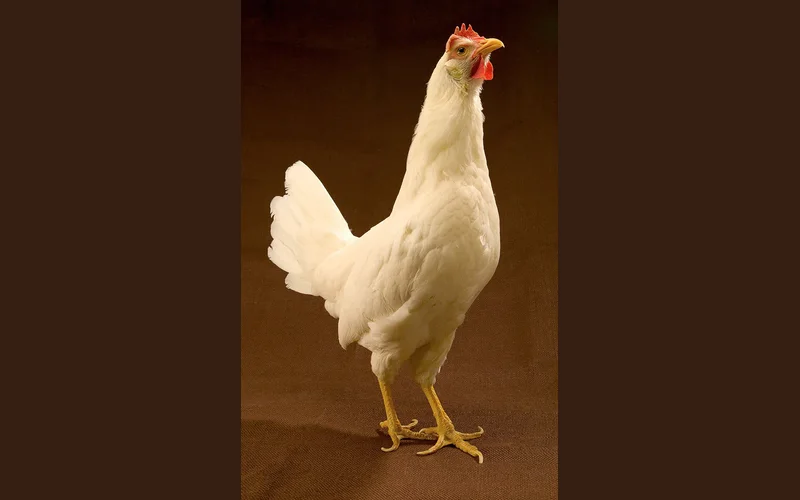
Hens feature bright white earlobes (the biological marker of white-shelled eggs), large single combs that drape gracefully to one side in full lay, and unfeathered yellow shanks that bleach to clean bone-white as carotene is concentrated into egg yolks.
2. Feed-to-Egg Economics & Shell Quality Metrics
The economic supremacy of the Lohmann LSL lies in its extraordinary Feed Conversion Ratio (FCR). Because an adult LSL hen weighs roughly 1 lb (450 g) less than a commercial brown layer, her daily metabolic maintenance energy requirement is significantly lower. She consumes just 3.6 to 3.8 oz (103–108 g) of feed daily while producing the exact same weight of egg mass.
Calculate your flock's live feed efficiency using the Feed Conversion Ratio (FCR) Calculator and monitor daily production percentages with the Hen-Day Egg Production Calculator.
Haugh Unit Albumen Density & Shell Calcite
Lohmann LSL eggs are renowned in commercial grading for exceptional internal albumen thickness, consistently grading above 80 Haugh units throughout early and mid-lay.
Their pristine white shells have uniform crystal pore density, resisting bacterial contamination and delivering top market prices in table egg, liquid egg, and bakery processing channels.
3. Nutrition, Amino Acid Density & Lighting Management
Because LSL hens have small digestive tracts and high laying velocity, feed formulation must be nutrient-dense:
- Digestible Methionine & Lysine: Provide a minimum of 0.42% digestible methionine and 0.85% digestible lysine in peak layer rations to sustain albumen synthesis and prevent drop-offs in egg size. Check nutrition with the Layer Feed Intake Calculator.
- Calcium Particle Sizing: Supply 3.8% to 4.2% calcium, with 70% provided as coarse 2–4 mm limestone chips fed in late afternoon to maintain shell thickness into late lay.
- Lighting Programs: Maintain 14 to 15 hours of consistent light at 20 lux. Never decrease daylength during active production, as Leghorn hybrids are sensitive to photoperiod drops.
4. Housing Systems, Aviaries & Confinement Care
Modern Lohmann LSL selections are bred specifically for calm, non-flighty behavior in alternative cage-free and multi-tier aviary barns:
- Spatial Navigability: LSL hens are agile flyers that easily reach perches and intermediate aviary tiers, virtually eliminating floor eggs when trained early during rearing. Plan housing capacity with the Coop Space Calculator.
- Ventilation & Air Quality: Maintain ammonia levels below 10 ppm and relative humidity between 55% and 65% to support respiratory health in high-density houses.
5. Health Maintenance & Management Considerations
High-metabolic white layers require attentive flock health management:
Ensure adequate dietary crude fiber (at least 5% to 6%), provide foraging enrichment like alfalfa bales or pecking stones, and maintain uniform diffuse lighting without bright hotspots to prevent cannibalism.
Their trim 3.6-lb body weight and large single comb give them superior heat dissipation compared to heavy brown hens. In extreme heat, maintain cold drinking water and tunnel ventilation. Check heat stress with the Poultry Heat Stress (THI) Calculator.
6. Summary: The Undisputed Efficiency King of Table Eggs
For commercial egg producers focused on the bottom line, the Lohmann LSL provides the lowest feed cost per dozen eggs produced in global poultry farming. Its combination of prolific lay, long persistency, and superior shell strength makes it an economic powerhouse.
6. Practical Aviary Navigability & Floor-Egg Prevention Protocols
Deploying the Lohmann LSL in commercial cage-free and aviary systems delivers industry-leading egg margins, provided early rearing establishes correct nesting behavior:
Pullets intended for aviary lay houses must be reared in aviary brooding systems that include perches, ramps, and tiered feed/water platforms starting from week 4. Pullets raised on flat floor systems without elevation fail to jump confidently to upper nesting tiers as adults, causing high rates of dirty floor eggs.
LSL hens instinctively search for secluded, dark, draft-free spaces to lay. Maintain nest interior illumination below 1 lux while keeping scratching areas brightly lit (at least 25 to 30 lux). Program sunrise lighting to illuminate the house slowly over 15 minutes to prevent flock panic.
Weigh 100 hens bi-weekly across different sectors of the barn. If body weight deviates more than 5% below breeder standard, immediately increase dietary energy density or add an early morning feeder run to safeguard lay persistency.
 zoom_in Click to Enlarge
Related Calculators
Scientific Literature
- Lohmann Tierzucht GmbH. (2023). Lohmann LSL-Classic Management Guide.
- Flock, D. K., & Preisinger, R. (2002). Breeding of Laying Hens for High Egg Production and Shell Quality. World's Poultry Science Journal.
- Aviary Housing Standards & Layer Management Bulletin. (2021). European Poultry Science.