
Lohmann Brown Chickens: Commercial Brown Egg Layer Guide
Complete management manual on peak lay persistency, feed conversion efficiency, cage-free housing, and shell strength.
Scientific Overview
Bred in Cuxhaven, Germany, by Lohmann Tierzucht, the Lohmann Brown stands as the world's leading commercial brown egg layer, deployed across industrial poultry complexes, enriched colonies, aviary barn systems, and commercial free-range operations globally. Developed through sophisticated multi-line genetic selection involving Rhode Island Red and White Rock pedigrees, the Lohmann Brown is engineered for an extraordinary combination of traits: rapid onset of lay, prolonged peak production exceeding 96% Hen-Day Egg Production, remarkable feed conversion efficiency, and superior shell breaking strength that minimizes packing-line losses. Known for their calm, non-flighty temperament in high-density cage-free barns, Lohmann Browns are equally favored by small-scale pasture-egg producers seeking reliable carton yields. This guide details standard production targets, nutritional phasing, photoperiod lighting schedules, and biosecurity management.
1. Breeding Lineage, Physical Conformation & Hybrid Genetics
The Lohmann Brown is a four-way cross hybrid layer rather than a heritage purebred. Breeding lines are maintained under strict pedigree biosecurity, combining pure lines of Rhode Island Red (sire line) and Rhode Island White/Plymouth Rock (dam line). This genetic architecture exploits maximum heterosis (hybrid vigor), ensuring uniform growth rates, high livability, and predictable feed intake.
| Physical & Performance Parameter | Standard Benchmark (to 72 Weeks) | Extended Cycle (to 90–100 Weeks) |
|---|---|---|
| Body Weight at 20 Weeks | 3.5–3.7 lbs (1.60–1.70 kg) | Uniform flock body mass before lay onset |
| Mature Body Weight (End of Lay) | 4.2–4.5 lbs (1.90–2.05 kg) | 4.4–4.7 lbs (2.00–2.15 kg) |
| Cumulative Eggs per Hen Housed | 315–325 eggs | 405–420 eggs (at 90 weeks) |
| Peak Hen-Day Production | 94% to 96% | Maintained above 90% for 30+ weeks |
| Average Egg Weight | 2.24 oz (63.5–64.5 grams) | Uniform USDA Large to Extra Large grading |
| Daily Feed Consumption | 3.9–4.1 oz (110–116 grams/day) | Feed Conversion Ratio: 2.1–2.2 kg feed/kg egg |
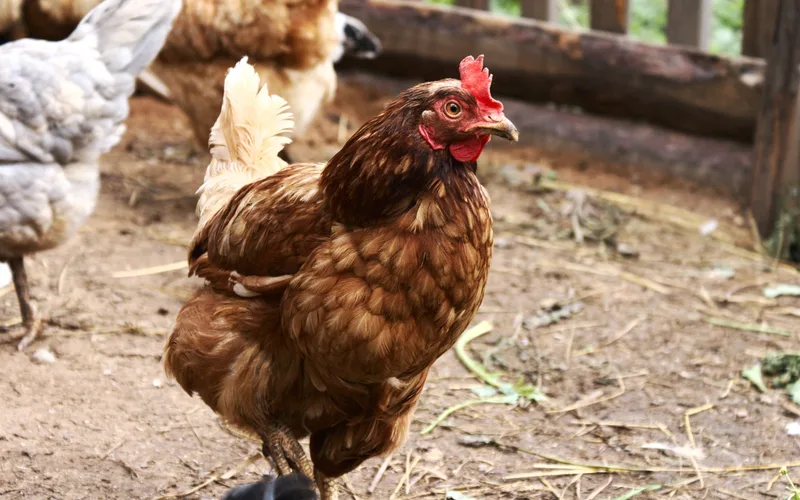
Lohmann Brown hens display rich golden-chestnut plumage with subtle white down highlights around the neck hackles and tail base. They possess neat single combs with 5 upright points, bright red wattles, and unfeathered yellow shanks that naturally bleach to creamy-white as dietary carotenoids are mobilized into egg yolks during heavy production.
2. Production Trajectory, Persistency & Shell Breaking Strength
The Lohmann Brown is engineered for an aggressive production curve. Under standard management, pullets reach 50% Hen-Day production at 140 to 145 days (20 weeks) of age, climbing rapidly to a peak lay of 95% to 96% by week 26 to 28.
A primary scientific breakthrough in the Lohmann breeding program is persistency of lay: whereas older commercial strains experienced steep declines after 60 weeks of age, modern Lohmann Brown flocks routinely sustain lay rates above 80% past 80 weeks without molting. Track your flock's live laying percentages using the Hen-Day Egg Production Calculator.
Biomechanical Shell Breaking Strength
Lohmann Browns are selected for shell breaking strength exceeding 40 Newtons throughout their early and mid-lay periods. Their shells exhibit uniform crystalline calcite palisade structures and deep protoporphyrin pigmentation.
In commercial packing stations, this high structural integrity reduces micro-cracks and washing breakages to less than 1.5%, delivering substantial cost savings over multi-thousand-bird houses. Model carton revenues with our Backyard Egg Profitability Calculator.
3. Phase Nutrition & Calcium Phasing Protocols
Sustaining 320+ eggs per bird requires disciplined nutritional management across distinct physiological phases:
- Pre-Lay Phase (Week 17 to 5% Production): Transition pullets from developer feed to pre-lay mash containing 2.0% to 2.5% calcium. This prepares the hen's medullary bone reserves without damaging the immature kidneys.
- Phase 1 Layer Ration (Onset to 45 Weeks): Supply 17.5% crude protein, 2,800 kcal/kg metabolizable energy, 0.42% digestible methionine, and 3.8% to 4.0% calcium. Formulate feeds precisely using the Layer Feed Requirement Calculator.
- Split-Feeding / Coarse Calcium Strategy: Layer hens form eggshells primarily at night while resting on perches. Supply at least 60% to 70% of their dietary calcium in coarse particle form (crushed oyster shell or 2–4 mm limestone grit) in late afternoon feedings. Coarse particles dissolve slowly in the gizzard overnight, providing direct calcium ions into the bloodstream and sparing bone reserves.
4. Housing Systems, Aviary Adaptability & Photoperiods
Lohmann Browns are bred for exceptional docility and low feather-pecking tendencies, making them the industry standard for multi-tier aviary barns and free-range pasture operations:
- Cage-Free Aviary Navigation: Lohmann Browns possess confident spatial awareness, moving smoothly between ground scratch areas, intermediate feeding slats, and upper roosting levels without floor-egg mislaying. Plan barn dimensions with the Coop Housing Calculator.
- Photoperiod Management: Never decrease day length during the laying cycle. Provide 14 to 16 hours of light daily at 20 to 30 lux intensity to stimulate pituitary gonadotropin release and maintain active ovulations.
- Pasture Grazing: In commercial free-range operations, Lohmann Browns exhibit calm curiosity, ranging outward from mobile coops to graze clover and insects without flighty panic when farm machinery passes.
5. Health Maintenance & Management Considerations
High-metabolic production requires proactive flock biosecurity and veterinary oversight:
In cage-free barn and aviary systems, poultry red mites represent the most serious threat to welfare and egg production. Inspect slatted perches and nest crevices weekly. Implement integrated pest management using silica dust barriers or veterinary fluralaner treatments.
Due to high calcium demands for shell deposition, monitor flock bone density in late lay. Ensure ramps and perches are cushioned to prevent keel bone fractures when birds navigate multi-tier aviary systems.
6. Summary: The Global Benchmark for Brown Egg Production
Whether managed in a commercial 50,000-bird enriched aviary or a 500-bird mobile pasture egg enterprise, the Lohmann Brown delivers world-class egg numbers, unmatched shell strength, low feed conversion ratios, and calm flock manners, representing the pinnacle of modern poultry genetics.
 zoom_in Click to Enlarge
Related Calculators
Scientific Literature
- Lohmann Tierzucht GmbH. (2023). Lohmann Brown-Classic Management Guide: Alternative Systems.
- Pottgüter, R. (2018). Calcium Nutrition in Modern Laying Hens. Lohmann Information, 52(2).
- World's Poultry Science Association. (2021). Commercial Egg Layer Performance Benchmarks.