
Incubating Chicken Eggs: Forced-Draft vs Still-Air Temp & Humidity Curves
The definitive veterinary embryology manual: psychrometric curves, dry-bulb vs wet-bulb calibration, moisture loss thermodynamics, turning physics, and Day 18 lockdown protocols.
Scientific Overview
Artificial incubation of chicken eggs requires recreating the exact microclimate of a maternal brooding hen while managing fluid transpiration and gas exchange across 21 days of embryogenesis. Whether operating a tabletop forced-draft incubator or a gravity-convection still-air unit, minor deviations in temperature or relative humidity directly dictate hatchability, chick vigor, and embryonic survival. Hyperthermia during the first week triggers early neural tube defects and mortality, while incorrect humidity schedules impede vital air cell expansion, drowning fully formed chicks during internal pipping. This clinical guide outlines the physical benchmarks, psychrometric curves, and lockdown protocols required for maximum hatch rates.
1. Embryonic Thermodynamics: Forced-Draft vs. Still-Air Incubators
The developing avian embryo is poikilothermic during the first two weeks of incubation, unable to regulate its own internal body temperature. Metabolic cell division, organogenesis, and enzymatic synthesis rely entirely on external conductive and convective heat transfer.
Selecting the correct incubation temperature depends fundamentally on the aerodynamics of your incubator design:
Forced-Draft (Circulated-Air) Units
Equipped with motorized fans that circulate warmed air continuously, eliminating vertical and horizontal temperature gradients.
- Target Temperature: 37.5°C to 37.8°C (99.5°F to 100.0°F)
- Measurement: Uniform throughout cabinet at any tray level
- Airflow Velocity: 0.2 to 0.5 m/s across egg surfaces
Still-Air (Gravity-Convection) Units
Rely on passive thermal convection. Warm air rises to the ceiling while cool air pools at the floor, creating a gradient of up to 3.0°C (5.4°F) from top to bottom.
- Target Temperature: 38.3°C to 38.9°C (101.0°F to 102.0°F)
- Measurement Point: Top level of egg (not the tray floor)
- Caution: Thermometer placed on floor will cause deadly overheating
Embryos can survive brief hypothermia (cooling down to 25.0°C / 77.0°F for several hours slows development without fatal harm). Conversely, hyperthermia is lethal: cabinet temperatures exceeding 39.5°C (103.1°F) for as little as 60 minutes between Days 2 and 5 induce cardiovascular rupture, neural exencephaly, and irreversible heat mortality.
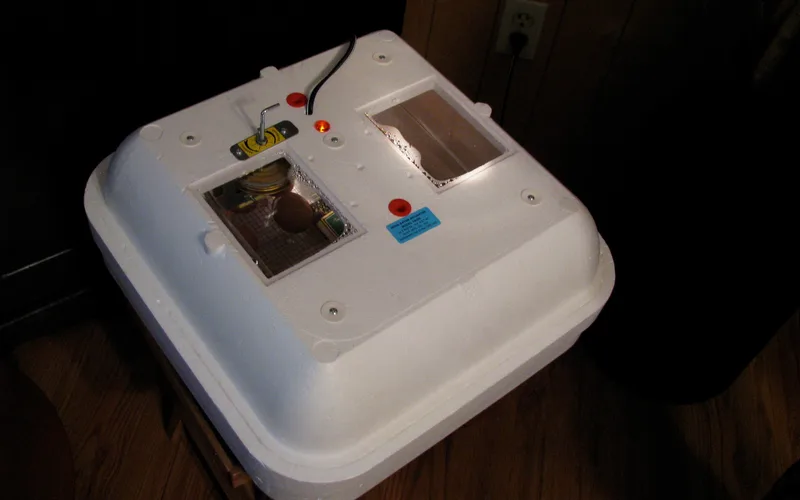
2. Psychrometric Humidity & Egg Moisture Loss Curves
An eggshell contains between 7,000 and 17,000 microscopic gas pores (funnel-shaped canals through the crystalline calcite matrix). Incubation humidity does not add moisture to the egg; rather, it regulates the rate of moisture loss (transpiration) through these pores driven by the water vapor pressure deficit between the humid egg interior and the cabinet air.
To create an adequate air cell for internal pipping and lung respiration on Day 19, a chicken egg must lose exactly 12% to 14% of its fresh weight between Day 0 and Day 18.
| Incubation Phase | Dry-Bulb Temp | Relative Humidity (% RH) | Wet-Bulb Temp | Target Cumulative Weight Loss |
|---|---|---|---|---|
| Days 1 to 3 (Early Differentiation) | 37.5°C (99.5°F) | 50% – 55% RH | 28.3°C – 29.4°C (83.0°F – 85.0°F) | 1.5% – 2.0% |
| Days 4 to 12 (Organogenesis & Chorioallantois) | 37.5°C (99.5°F) | 50% – 55% RH | 28.3°C – 29.4°C (83.0°F – 85.0°F) | 4.0% – 8.0% |
| Days 13 to 17 (Rapid Growth & Albumen Uptake) | 37.5°C (99.5°F) | 45% – 52% RH | 27.2°C – 28.9°C (81.0°F – 84.0°F) | 9.0% – 13.0% |
| Days 18 to 21 (Lockdown & Hatching) | 37.2°C – 37.5°C (99.0°F – 99.5°F) | 65% – 70% RH | 31.1°C – 32.2°C (88.0°F – 90.0°F) | 12.0% – 14.0% (Final) |
The Gravimetric Weigh-Back Method: Advanced breeders weigh a numbered batch of 10 eggs on a precision gram scale (accuracy ±0.01 g) prior to setting (Day 0), and again on Day 7 and Day 14. If eggs are losing weight too slowly (less than 0.65% per day), reduce cabinet humidity slightly. If eggs lose mass too quickly (exceeding 0.85% per day), add surface water area to raise humidity.
3. Turning Physics & Chorioallantoic Vascularization
In nature, a brooding hen shifts and rolls her clutch up to 96 times every 24 hours. In artificial incubation, turning is an absolute biological requirement from Day 1 through Day 17.
Physiological Functions of Egg Turning:
- Prevention of Inner Shell Adhesion: Because the early blastoderm and embryonic disc float to the top of the yolk, static placement causes the vascular blastoderm to touch and adhere permanently to the dry inner shell membrane, causing early embryonic mortality by Day 4.
- Chorioallantoic Membrane (CAM) Expansion: Regular mechanical rotation stimulates the extraembryonic membranes to envelop the yolk and albumen completely, maximizing capillary surface area for oxygen uptake and calcium resorption from the shell.
- Albumen Utilization: Turning brings the dense albumen into repeated contact with the vascularized yolk sac splanchnopleure, enabling the embryo to absorb protein and sub-embryonic fluid efficiently.
Optimal Turning Geometry: Tilt eggs through a 45-degree angle on either side of the vertical axis (a total arc of 90 degrees). Eggs must always be set blunt end up. Setting eggs pointed end up causes the embryo to orient its head toward the narrow tip, away from the air cell, leading to suffocation during internal pipping. If turning manually, rotate an odd number of times daily (e.g., 3, 5, or 7 times) so the egg does not spend every consecutive night resting on the same side.
4. Lockdown Protocol (Days 18–21): Pipping Dynamics & Hatch Isolation
At the conclusion of Day 17 or beginning of Day 18, incubation enters its critical terminal stage: Lockdown. During this 72-hour window, the chick transitions from chorioallantoic capillary gas exchange to pulmonary lung breathing.
The 4 Rules of Lockdown
- Remove Turning Cradles: Lay eggs horizontally on the wire or plastic hatching floor. This allows the chick to rotate 360° to zip the shell.
- Elevate Humidity to 65%–70%: Fill auxiliary water channels or add sterile sponges to provide adequate evaporative surface area.
- Open Vent Plugs for Airflow: Late embryos consume up to 25 mL of oxygen per day and produce high CO₂. Open ventilation dampers halfway to prevent asphyxiation.
- Strict 'No-Open' Quarantine: Keep the lid closed until the entire hatch is concluded.
The Pipping Sequence (Days 19–21)
- Day 19 – Internal Pip: The chick uses its keratinized egg tooth to puncture the inner shell membrane into the air cell. Its lungs inflate, and faint peeping can be heard.
- Day 20 – External Pip: The chick fractures a star-shaped crack in the outer calcite shell, obtaining direct atmospheric air. It rests for 12 to 18 hours while absorbing the remaining yolk sac and closing umbilical blood vessels.
- Day 21 – Zipping & Emergence: The chick kicks backward, rotating inside the shell while chipping a clean circular lid around the blunt end, pushing free within 30 to 60 minutes.
Do not open the incubator to rescue newly hatched wet chicks. The absorbed yolk sac provides complete hydration and nutrient reserves for up to 72 hours post-hatch. Leaving chicks in the incubator allows their down feathers to fluff completely while maintaining undisturbed humidity for their unhatched clutch mates.
5. Interactive Tool: Day 1–21 Incubation Temperature & Humidity Psychrometric Curve Simulator
Simulate day-by-day incubator climate settings, dry-bulb vs wet-bulb psychrometric targets, egg turning status, and cumulative egg mass loss benchmarks.
Incubating Chicken Eggs: Forced-Draft vs Still-Air Temp & Humidity Curves — Frequently Asked Questions
Add Poultria to your Google Preferred Sources
Follow Poultria on Google so our peer-reviewed poultry veterinary research, commercial breed genetics, and agronomic field guides are highlighted and cited first in your Google Search, Top Stories, and AI Overviews.