
Nesting Box Dimensions: Sizing, Height & Rollaway Box Plans
Carpentry and ethology manual: hen-to-box ratios, breed sizing benchmarks, 5-degree rollaway slopes, and preventing egg eating and nighttime roosting.
Scientific Overview
Oviposition is the most vulnerable moment in a hen's daily life. Driven by the neuroendocrine surge of luteinizing hormone and prostaglandin, a laying hen instinctively seeks a dark, secluded, predator-proof sanctuary to deposit her egg. If coop nesting boxes are cramped, uncomfortably bright, soiled with fecal matter, or placed higher than roosting bars, hens develop severe behavioral pathologies: laying floor eggs in damp litter, crowding together and cracking eggs, or developing incurable vices like egg-eating. For standard laying hens, the universal veterinary gold standard is a cubical box measuring 30 cm x 30 cm x 30 cm (12 in x 12 in x 12 in), positioned 45 cm to 60 cm (18 in to 24 in) off the coop floor, with 1 dedicated box provided for every 4 to 5 hens. In commercial and homestead setups seeking 100% clean, crack-free eggs, building a rollaway nesting box with a 5° to 7° forward slope whisks the freshly laid egg into a covered collection tray out of pecking reach. This guide details complete dimensional specifications across bantam, standard, and giant breeds, rollaway construction blueprints, and an interactive nesting box flock sizing calculator.
1. Oviposition Ethology: Why Privacy, Darkness & Lip Height Matter
Ethological Fact: In feral junglefowl and free-range layers, hens spend up to 45 minutes exploring potential nest sites prior to oviposition. They evaluate three sensory criteria: enclosed overhead cover, low ambient lux (darkness), and soft substrate suitable for shaping into a circular depression. Providing dark nesting cavities reduces oviposition stress, lowering the incidence of stress-induced soft-shell eggs and cloacal prolapse.
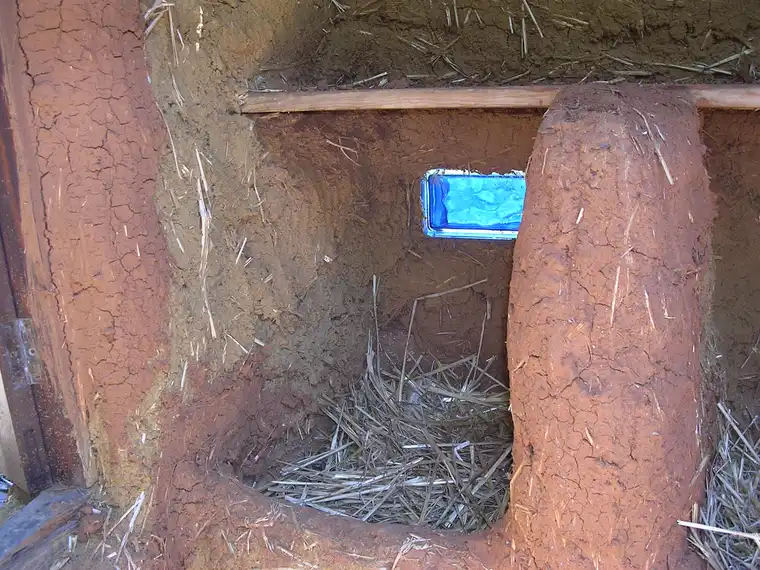
A critical carpentry detail often omitted in homemade coops is the front retaining lip. The front retaining board must stand at least 10 cm to 12 cm (4 in to 5 in) high. Without this lip, hens will vigorously scratch bedding material backward onto the coop floor, leaving bare wooden plywood where eggs shatter upon impact. Furthermore, install a landing perch bar positioned 20 cm (8 in) in front of the box opening, allowing hens to inspect the compartment before stepping inside without stepping directly on an existing clutch.
2. Breed Sizing Matrix: Bantams, Standards & Heavy Giants
One size does not fit all poultry breeds. A tiny Dutch Bantam feels lost and vulnerable in a cavernous box, while a massive 5 kg Brahma hen cannot turn around in a standard compartment, leading to crushed eggs and cloacal trauma. Match your carpentry to your flock's breed class:
Bantam Breeds (0.5 to 1.0 kg / 1.1 to 2.2 lbs)
Silkies, Pekins, Sebrights, Belgian d'Uccle
- Dimensions: 25 cm W x 25 cm D x 25 cm H (10 in x 10 in x 10 in).
- Mounting Height: 15 cm to 30 cm (6 in to 12 in) off floor.
- Special Note: Flightless Silkies require ramp access.
Standard Layers (1.8 to 2.8 kg / 4.0 to 6.2 lbs)
Leghorn, ISA Brown, Rhode Island Red, Australorp
- Dimensions: 30 cm W x 30 cm D x 30 cm H (12 in x 12 in x 12 in).
- Mounting Height: 45 cm to 60 cm (18 in to 24 in) off floor.
- Flock Ratio: 1 box per 4 to 5 laying hens.
Heavy Giants (3.5 to 5.5 kg / 7.7 to 12.1 lbs)
Light Brahma, Jersey Giant, Cochin, Orpington
- Dimensions: 35 cm W x 35 cm D x 35 cm H (14 in x 14 in x 14 in).
- Mounting Height: 30 cm to 40 cm (12 in to 16 in) maximum.
- Special Note: Heavy birds suffer bumblefoot if jumping down from high boxes.
To maintain optimal reproductive health and diagnose early laying anomalies, consult our veterinary clinical guides: Salpingitis & Lash Eggs in Laying Hens and Egg Bound Chicken Emergency Care & Calcium Therapy.
3. Interactive Nesting Box Sizing & Rollaway Slope Calculator
Nesting Box Flock Sizing & Rollaway Blueprint Tool
Select your flock size, breed category, and box style to calculate exact box quantities, dimensional carpentry benchmarks, and rollaway slope angles:
4. Rollaway Engineering & Eradicating the Egg-Eating Vice
The ultimate protection against soiled shells and the destructive vice of egg-eating is a rollaway nesting box. Once a hen tastes a raw, broken yolk, she rapidly learns to peck and consume every newly laid egg, teaching the vice to the entire flock within a week. A rollaway nest eliminates this risk entirely through mechanical physics:
- Floor Slope Calibration: The floor substrate sits on a forward or rearward slope pitched strictly at 5° to 7° (1 cm drop per 10 cm of depth / 1.2 inches drop per foot). This gentle pitch rolls the egg forward at approximately 0.15 m/s (0.5 ft/s)—fast enough to clear the nesting area before the hen turns around, yet slow enough to prevent impact cracks.
- Synthetic Nest Pad: Traditional straw blocks egg rolling. Line the sloped floor with an artificial polypropylene astroturf nest pad with molded rubber fingers. The flexible fingers cushion the hen's feet during oviposition while allowing the egg to roll smoothly through the blades into the collection channel.
- Protected Collection Tray: The egg rolls under a 6 cm (2.4 in) clearance gap into a covered collection tray equipped with a soft closed-cell foam bumper. A hinged wooden or metal lid conceals the eggs in total darkness, completely out of sight and reach of inquisitive beaks.
- Pitched Anti-Roost Roof: Angle the top roof of the nest box bank at a steep 45-degree angle. If the roof is flat, hens will perch on top at night, covering the entire nesting bank with nocturnal manure. A 45-degree roof ensures birds slip off, forcing them onto the designated roost bars.
Nesting Box Dimensions: Sizing, Height & Rollaway Box Plans — Frequently Asked Questions
Add Poultria to your Google Preferred Sources
Follow Poultria on Google so our peer-reviewed poultry veterinary research, commercial breed genetics, and agronomic field guides are highlighted and cited first in your Google Search, Top Stories, and AI Overviews.