
Why Did My Chickens Stop Laying Eggs? 9 Biological Triggers & Fixes
A comprehensive veterinary diagnostic manual: photoperiod decline, autumn molt protein diversion, nutritional & salt imbalances, subclinical diseases, broodiness, predator trauma, and how to safely restore egg production.
Scientific Overview
Discovering an empty nesting box when you expect a clutch of fresh eggs is one of the most common and perplexing challenges in poultry husbandry. In domestic hens (Gallus gallus domesticus), egg production is not an automatic mechanical function; it is a sensitive bioenergetic luxury. A hen will only manufacture and oviposit an egg when her metabolic reserves, hormonal cascade, nutritional intake, and environmental conditions are in perfect equilibrium. The moment any single physiological variable falters—whether daylight falls below the neuroendocrine threshold, water lines freeze for half a day, sulfur amino acids are diverted to pinfeather regeneration, or red mites cause nocturnal anemia—the hypothalamic-pituitary-ovarian (HPO) axis abruptly halts follicular maturation to protect the bird's survival. This clinical guide breaks down the 9 primary biological triggers that cause chickens to stop laying, details a structured diagnostic troubleshooting matrix, and outlines step-by-step veterinary protocols to safely bring your flock back into active lay.
1. Quick Diagnostic Triage: The Bioenergetics of an Egg Halt
Veterinary Rule of Egg Production: An egg represents an enormous daily metabolic investment: roughly 6.5 g of crude protein, 2.0 g to 2.2 g of elemental calcium, and 335 kJ (80 kcal) of metabolizable energy. If a hen perceives any physiological crisis—a 12-hour water drought, a sudden drop in daylight below 12 hours, extreme temperature shifts, or systemic parasite load—her brain shuts down follicle development within 24 to 48 hours to preserve her vital organs.
When flock owners ask "why did my chickens stop laying eggs?", they often suspect complex diseases first. In practice, over 80% of sudden egg drops stem from simple environmental, nutritional, or behavioral triggers: decreasing autumn day length, the onset of an annual molt, an empty or frozen water drinker, or an undetected broody hen sitting tightly in a dark corner.
2. Trigger 1: Decreasing Daylight & Photoperiod Thresholds
By far the most predictable biological trigger for an egg production halt is the seasonal change in day length. Chickens are seasonally responsive long-day breeders. Their reproductive system is governed not by human clock time, but by photoperiodic neuroendocrinology:
- Extraretinal Photoreception: Light penetrates the thin skull of the bird and is captured by deep encephalic photoreceptors in the hypothalamus and pineal gland, independent of the eyes.
- The GnRH Cascade: When daylight exceeds 14 hours per day, the hypothalamus secretes Gonadotropin-Releasing Hormone (GnRH), which commands the anterior pituitary gland to release Luteinizing Hormone (LH) and Follicle-Stimulating Hormone (FSH). These hormones stimulate the ovary to release a mature yolk (ovum) every 24 to 26 hours.
- Autumn Shutdown: When daylight declines in late summer and autumn below 12 to 14 hours, GnRH synthesis drops sharply. The ovary regresses from a large cluster of yellow yolks into a dormant, compact mass of tiny white follicles. Egg production naturally drops to zero.
How to Fix Photoperiod Halts: Safe Supplemental Lighting
To maintain year-round egg production, install a simple digital timer connected to a warm-spectrum LED bulb (2700K–3000K, 4 to 9 Watts):
- Target Light Duration: Maintain 14 to 15 hours of total combined light (natural daylight + artificial light). Exceeding 16 hours provides no additional egg yield and induces chronic physiological fatigue.
- Morning Lighting Only: Set the timer to turn on at 4:30 AM or 5:00 AM and turn off after sunrise. Never add supplemental light in the evening; when an evening light suddenly cuts off, hens are blinded in the dark and cannot locate their perches, leading to stress and floor piling injuries.
- Light Intensity Threshold: Ensure at least 10 to 15 lux at the hen's eye level (bright enough to comfortably read a printed newspaper in the darkest corner of the coop).
3. Trigger 2: The Annual Autumn Molt (Feather vs. Egg Protein Conflict)
Every year in late summer or autumn, adult chickens (typically at 16 to 18 months of age and every year thereafter) undergo an annual molt. They shed their worn, broken feathers and grow an entirely fresh, weather-resistant plumage:
The biological reality of molting creates an intense amino acid competition. Feathers are made of roughly 85% crude protein, primarily concentrated in structural beta-keratin, which requires vast amounts of the sulfur amino acids methionine and cysteine. A hen's liver cannot simultaneously manufacture the vitellogenin (egg yolk lipids and proteins) and ovalbumin (egg white albumen) needed for an egg while synthesizing millions of feather cells. Consequently, ovulation stops entirely.
Fast Molters (High Producers)
High-yield layers like Leghorns, ISA Browns, and Australorps molt late in the season (October/November). They drop almost all feathers at once, looking nearly naked and scruffy, and regenerate their entire coat in 6 to 8 weeks before rapidly resuming egg production.
Slow Molters (Low Producers)
Poorly laying or ornamental heritage hens often begin molting early in the summer (July/August). They drop only a few primary wing feathers at a time, looking reasonably well-feathered, but drag out the process for 14 to 20 weeks, staying out of lay for months.
During active molting, switch your flock from standard 16% layer feed to a 20% to 22% high-protein conditioning or grower ration. Adding dietary methionine accelerates feather quill growth and shortens the non-laying period by 2 to 3 weeks. However, do not force-feed high calcium during a molt: because the shell gland is quiescent, excess calcium is excreted via the kidneys, risking visceral gout and renal damage. Provide free-choice oyster shell on the side instead.
4. Trigger 3: Nutritional Deficiencies & The 'Scratch Grain Trap'
A laying hen is an extraordinarily efficient biochemical bioreactor, but she has zero margin for error when it comes to daily macronutrient and electrolyte balance:
The 16% Crude Protein Floor
A hen requires a minimum intake of 16 to 18 grams of digestible protein daily with balanced levels of lysine (0.80%) and methionine (0.38%). The most common backyard feeding mistake is the "Scratch Grain Trap": throwing cups of cracked corn, barley, or kitchen scraps into the coop. Scratch grain contains only 7% to 9% protein. When hens gorge on scratch, their total dietary protein falls below 14%, triggering rapid ovarian follicular atresia (follicle shutdown) within 5 to 7 days.
The Sodium / Salt Hunger Mystery
Poultry require 0.18% to 0.20% sodium (roughly 0.40% NaCl / table salt) in their complete diet. If someone mixes homemade feed without adding salt, or if a commercial mill omits sodium in a batch, egg production plummets to zero within 48 to 72 hours. Hens become listless, exhibit severe feather pecking, and ovaries rapidly regress. Restoring salt restores laying within 10 to 14 days.
Calcium & Phosphorus Ratios
Each eggshell consumes 2.0 g to 2.2 g of pure calcium. If feed calcium falls below 3.5%, the hen mobilizes calcium from her medullary bones. After 3 to 6 eggs, bone reserves are exhausted. The hen begins laying thin-shelled or rubbery soft-shell eggs, before ceasing laying entirely to avoid osteomalacia (cage layer fatigue) and bone collapse. Learn full ration balancing in our Laying Hen Feed Guide.
5. Trigger 4: Water Deprivation & Dehydration Shock
Water is the most critical and overlooked nutrient in avian physiology. An egg consists of 65% water, 12% protein, and 11% fat. An active laying hen drinks between 200 mL and 350 mL (7 to 12 fl oz) of fresh water daily—more than double her dry feed intake by weight:
If a water line freezes in winter, a nipple drinker clogs with sediment, or a gravity fount runs bone-dry in summer for just 12 to 24 hours, the hen experiences acute dehydration stress. Her blood osmolarity spikes, pituitary vasotocin surges, and developing follicles undergo immediate resorption. Egg production drops to zero within 48 hours and can take 2 to 3 full weeks to recover once water is restored.
Hydration Auditing Checklist:
- In sub-zero winter temperatures, use heated water bases or submersible de-icers; never let drinkers remain frozen past morning release.
- In summer heat (> 30°C / 86°F), place waterers in dense shade. Chickens refuse to drink warm or hot water even when critically dehydrated.
- Provide at least 2.5 cm (1 inch) of drinker rim space per bird, or one horizontal nipple per 4 to 6 hens.
6. Trigger 5: Broodiness & Maternal Hormonal Hijack
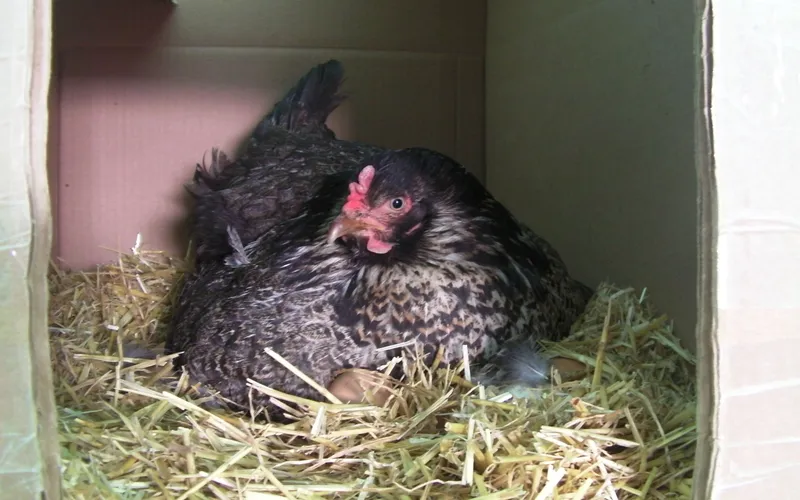
Broodiness is the maternal instinct to sit on a clutch of eggs until they hatch. While wonderful if you want natural chicks, broodiness halts all egg production in that hen for 4 to 8 weeks if left unaddressed:
The Endocrinology of Broodiness: The avian pituitary gland begins secreting massive amounts of prolactin while suppressing LH and FSH. Prolactin causes the hen's ovaries to rapidly regress, stimulates maternal vocalizations, and leads her to pluck the insulating down feathers from her breast to form a bare, highly vascularized brood patch that warms the eggs.
Key Behavioral Indicators of a Broody Hen:
- Refuses to leave the nesting box, sitting flat and pancaked on imaginary or real eggs day and night.
- Emits a harsh growling, clicking, or screeching sound and pecks aggressively at reaching hands.
- Plumage fluffed wide to appear twice her normal size when disturbed.
- Leaves the nest only once daily to produce an unusually large, highly foul-smelling "broody poop", take a frantic 3-minute drink, and dash back.
The Wire Broody Breaker Protocol
Do not dunk hens in cold water (a dangerous folk remedy that causes hypothermic shock). Instead, use a wire cage:
- Place the hen in an all-wire dog crate or cage with a wire-mesh floor, elevated 15 cm to 30 cm (6 to 12 inches) on wooden blocks.
- Provide ample fresh water and nutrient-dense 18% feed, but zero bedding, straw, shavings, or dark corners.
- Place the crate in a bright, bustling area of the coop or garage. The cool ambient airflow moving under the wire floor continually cools her brood patch, breaking the prolactin feedback loop.
- After 3 full days and nights, release her into the run. If she heads straight back to the nesting box, return her to the breaker for another 48 hours. Most hens break within 3 to 4 days and resume laying in 10 to 14 days.
7. Triggers 6 to 9: Pathogens, Predator Stress, Age & Mystery Disappearances
Trigger 6: Subclinical Pathogens & Parasite Anemia
External parasites drain the hen's iron and protein reserves continuously:
- Red Poultry Mites (Dermanyssus gallinae): Hide in coop cracks by day and feed on roosting birds at night. Severe infestations cause chronic anemia, pale combs, and an immediate 20% to 50% drop in flock egg yield. Check roost joints at midnight with a flashlight or wipe cracks with a white paper towel to reveal red blood smears.
- Infectious Bronchitis Virus (IBV): A widespread avian coronavirus. Even mild strains cause temporary or permanent hypoplasia of the oviduct. Symptoms include sneezing, rales, wrinkled or corrugated eggshells, and watery albumen that spreads flat like water in the pan.
- Egg Drop Syndrome '76 (EDS): An adenovirus causing sudden drops of 30% to 50% in otherwise perfectly healthy-looking hens, characterized by completely shell-less, soft-membrane eggs.
Trigger 7: Predator Trauma & Environmental Stress
Avian acute stress triggers an immediate spike in corticosterone from the adrenal cortex. Corticosterone suppresses the pre-ovulatory LH surge and disrupts smooth-muscle oviduct contractions. Common acute triggers include: a wandering dog pacing and barking at the run fence, nighttime raccoon or possum stalking, introducing aggressive new birds without a partition, or moving the flock to a new coop. Production drops within 24 hours and typically requires 7 to 14 days of calm security to stabilize.
Trigger 8: Natural Ovarian Senescence (Hen Age)
Like all female birds, a hen is born with a finite number of microscopic ova in her single left ovary. Production follows a biologically fixed curve:
- Year 1 (Pullet): 100% baseline capacity (250–320 eggs/year).
- Year 2: 80% to 85% of baseline (eggs are larger, but laying pauses are longer).
- Year 3: 65% to 70% of baseline.
- Year 4 & Beyond: 40% to 50% of baseline; hens take 3- to 4-month winter breaks.
Trigger 9: The Illusion: Hidden Nests, Egg Eaters & Predators
Frequently, the chickens haven't stopped laying at all—the eggs are simply vanishing before you collect them:
- Hidden Pasture Nests: Free-range hens love concealment. Inspect compost piles, tall grass patches, underneath sheds, doghouses, and woodpiles. A single hen often stashes 15 to 20 eggs in secret before you discover her clutch.
- Flock Egg Eating: If an egg accidentally cracks in a nest box, hens will eat the nutrient-dense contents. Once a hen discovers that eggshells contain delicious yolk, it becomes a learned vice that rapidly spreads to flockmates. Check for wet yellow yolk smears on beaks, or install rollaway nesting boxes and ceramic dummy eggs to break the habit.
- Vermin & Predators: Snakes, rats, crows, blue jays, skunks, and raccoons specialize in stealing whole eggs from coop nests without leaving a trace of shell behind.
8. Clinical Decision Matrix: Step-by-Step Diagnostic Audit
Use this systematic veterinary matrix to pinpoint the exact root cause of your flock's egg production drop:
| Observed Clinical Sign | Most Likely Cause | Verification Test | Immediate Corrective Action |
|---|---|---|---|
| Sudden halt in autumn; feathers littering coop floor; pinfeathers visible | Annual Molt | Examine wing primaries; check for quill growth | Boost dietary protein to 20%–22%; offer free-choice oyster shell on the side. |
| Gradual decrease across October–December; healthy feathers, no signs of disease | Short Day Length (<14 hrs) | Calculate regional sunrise to sunset hours | Install timer-controlled morning LED light to provide 14–15 total hours of light. |
| Hen stays in nest box day & night; growls; pecks hand; fluffs up | Broodiness (Prolactin Surge) | Lift hen off nest; inspect for bare, hot brood patch | Isolate in elevated wire-bottomed broody cage for 3–4 days with food and water. |
| Abrupt flock drop within 48 hrs; comb pale or shriveled; no molting | Water Interruption / Dehydration | Check drinkers for ice, sediment blockage, or dryness | Restore clean, tempered water immediately with avian electrolytes for 3 days. |
| Soft, rubbery shells preceding total halt; birds look otherwise active | Calcium Deficiency or Heat Stress | Check feed % Ca and ambient coop temperature | Supply coarse oyster shell (2–4 mm); add 1 g/L sodium bicarbonate in heatwaves. |
| Pale, white combs; dirty vent feathers; restless birds at night | Mite / Lice Infestation | Part feathers around vent; check roost cracks at night | Treat birds and deep-clean coop with approved veterinary acaricides (e.g., spinosad). |
| Swollen, squishy abdomen; upright 'penguin' stance; tail held down | Egg Yolk Peritonitis / Salpingitis | Palpate coelomic fluid; check for yellow egg-paste discharge | Critical veterinary intervention required: systemic antibiotics and anti-inflammatories. |
If an individual non-laying hen displays continuous straining at the vent, tail pumping, a rock-hard lower abdomen, severe lethargy, or blue-purple comb cyanosis, she may be egg-bound (dystocia) or suffering from acute oviduct impaction. This is a life-threatening medical emergency. Separate her into a quiet, warm (29°C / 85°F), humid hospital crate, administer oral calcium gluconate if trained, and seek veterinary care immediately.
Why Did My Chickens Stop Laying Eggs? 9 Biological Triggers & Fixes — Frequently Asked Questions
Add Poultria to your Google Preferred Sources
Follow Poultria on Google so our peer-reviewed poultry veterinary research, commercial breed genetics, and agronomic field guides are highlighted and cited first in your Google Search, Top Stories, and AI Overviews.