
Hubbard Flex Broilers: Efficient Commercial Meat Strain Guide
Complete management manual on Hubbard genetics, feed cost optimization, eviscerated yield, and housing.
Scientific Overview
Developed by Hubbard (a premier subsidiary of Aviagen), the Hubbard Flex is a globally deployed commercial broiler strain engineered with a specific economic directive: achieving the lowest total live production cost per pound of chicken meat. Renowned across Europe, the Americas, and Asia for superior broiler breeder female reproductive output (producing high numbers of hatching eggs per hen housed) coupled with exceptional broiler feed conversion, the Hubbard Flex delivers a balanced, cost-efficient carcass with high boneless breast meat yield. The strain is specifically noted for strong skeletal integrity, excellent walking ability, high livability, and low maintenance energy overhead. This guide details Hubbard Flex growth trajectories, brooding parameters, nutritional formulation, and environmental housing standards.
1. Breeding Heritage, Conformation & Total Cost Genetics
Founded in Walpole, New Hampshire, in 1921 by Oliver Hubbard, the Hubbard breeding enterprise revolutionized commercial meat poultry by selecting for balanced multi-trait excellence. The modern Hubbard Flex is engineered to optimize the complete supply chain: breeder hen egg volume, hatchery hatchability, and broiler turn profitability.
| Flock Age (Days) | Live Weight (lbs / kg) | Daily Feed Intake (g) | Cumulative FCR | Commercial Carcass Trait |
|---|---|---|---|---|
| Day 7 | 0.41 lbs (185 g) | 30 g/day | 0.94 | Target brooding benchmark: 4.4x hatch weight |
| Day 21 | 2.10 lbs (950 g) | 100 g/day | 1.25 | Strong skeletal leg bone mineralization |
| Day 35 | 4.65 lbs (2,110 g) | 170 g/day | 1.48 | Optimal whole-bird retail packaging weight |
| Day 42 | 6.05 lbs (2,745 g) | 202 g/day | 1.60 | Eviscerated Yield: 73.8%; Breast Meat: 22.8% |
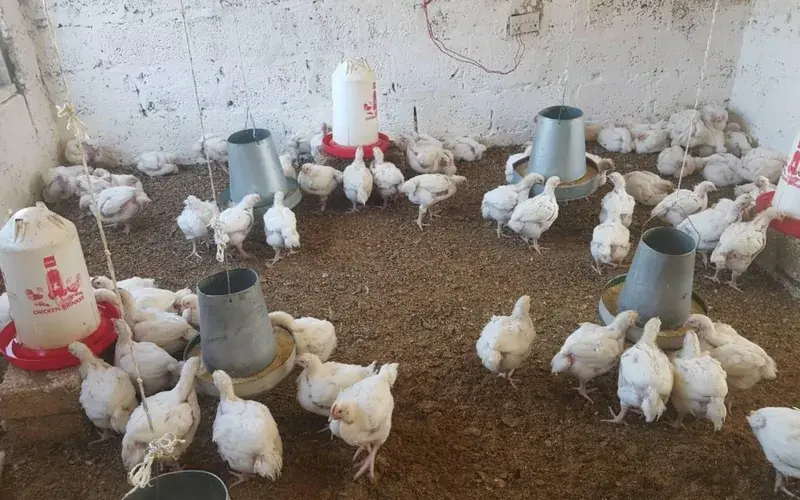
Birds display clean white plumage, yellow skin, and unfeathered yellow legs. The Hubbard Flex exhibits a balanced body center-of-gravity that preserves leg strength and active walking ability throughout the entire growing turn.
2. Economic Performance & Feed Conversion Efficiency
The Hubbard Flex is celebrated for delivering exceptional Feed Conversion Ratios (FCR), routinely achieving 1.46 to 1.52 at standard 35-day processing weights. Calculate your flock's live feed efficiency with the Feed Conversion Ratio (FCR) Calculator.
Evaluate overall broiler flock profitability using our Broiler Turn ROI Simulator and benchmark your technical efficiency against international standards using the European Production Efficiency Factor (EPEF) Calculator.
3. Nutrition & 3-Phase Feeding Programs
Hubbard Flex broilers respond well to disciplined feeding phases formulated for lean muscle synthesis:
- Starter Phase (Day 0 to 10): 22.5% crude protein, 3,000 kcal/kg ME, 1.38% digestible lysine. Formulate rations with the Feed Formulation Tool.
- Grower Phase (Day 11 to 24): 21.0% crude protein, 3,100 kcal/kg ME, 1.20% digestible lysine. Provide as uniform 2.5 mm pellets.
- Finisher Phase (Day 25 to Harvest): 19.0% crude protein, 3,200 kcal/kg ME, 1.02% digestible lysine.
4. Housing Setup, Ventilation & Brooding Climate
Ensuring optimal environmental control during the critical first 14 days lays the foundation for flock livability:
- Brooding Temperature: Maintain 90°F to 92°F (32°C–33°C) at chick litter level during Day 1 to 3, lowering gradually to 68°F (20°C) by Day 28. Plan climate with the Brooding Climate Calculator.
- Air Exchange: Calculate minimum ventilation fan rates using the Ventilation Fan Calculator. Keep carbon dioxide below 3,000 ppm and ammonia below 10 ppm.
5. Health Maintenance & Skeletal Soundness
Key biosecurity and veterinary priorities include:
Hubbard geneticists place heavy selection weight on leg health and gait scores. Flocks show low rates of tibial dyschondroplasia and valgus/varus leg deformities, ensuring high welfare standards and low processing trim losses.
Maintain dry litter beneath nipple drinkers to harvest premium Grade-A chicken paws for export markets.
6. Summary: The Balanced Total Cost Broiler
The Hubbard Flex represents the ideal combination of breeder female reproductive volume, broiler feed conversion efficiency, and rugged skeletal soundness, delivering exceptional return on investment across global poultry operations.
6. Practical Flock Decision Guide & Yield Optimization Matrix
Achieving top economic returns with the Hubbard Flex requires aligning hatchery management, farm brooding, and processing plant specs. Commercial integrators should observe three core guidelines:
Check crop fill on 100 chicks at 8 hours and 24 hours post-placement. At 8 hours, at least 85% of chicks must have soft, pliable, full crops containing both feed and water; by 24 hours, this must reach 95% or higher. Chicks with empty or hard crops indicate inadequate feeder tray coverage or water line airlocks.
Under normal thermal conditions (68°F to 72°F / 20°C–22°C), Hubbard Flex broilers consume 1.7 to 1.9 times more water by weight than dry feed. Any sudden drop in water consumption is the earliest warning sign of enteric disease, feed palatability failure, or water sanitization line faults.
Manage feed withdrawal strictly between 8 and 12 hours prior to processing. Shorter withdrawal times leave un-digested feed in the gastrointestinal tract, causing carcass contamination risk during automated evisceration; withdrawal times exceeding 12 hours cause live weight shrink and bile staining on liver and breast meat.
 zoom_in Click to Enlarge
Related Calculators
Scientific Literature
- Hubbard Breeders. (2023). Hubbard Flex Broiler Management Manual.
- Aviagen Group. (2022). Broiler Performance Benchmarks and Breed Specifications.
- Leeson, S., & Summers, J. D. (2008). Commercial Poultry Nutrition (3rd ed.). University Books.