
Ross 308 Broilers: Performance, Growth Curves & FCR Standards
A scientific guide to Ross 308 growth benchmarks, feed conversion ratios, carcass yields, and brooding environment.
Scientific Overview
The Ross 308 is the world's benchmark commercial broiler strain developed by Aviagen. Engineered for rapid growth velocity, exceptional feed conversion efficiency (cumulative FCR 1.45–1.52 to 2.2 kg), and high breast meat proportion (22.5–24.0%), achieving its full genetic potential requires precise brooding temperature management and phase-feeding nutritional programs.
1. Ross 308 Genetic Lineage, Breeding History & Global Monopoly
Ross 308 Definition: The Ross 308 is the flagship fast-feathering commercial broiler cross developed by Aviagen (originally Ross Breeders, Scotland). Selected through quantitative genomic pedigree lines for balanced biological efficiency, high juvenile livability (>96.5%), rapid early skeletal development, and high breast meat yield (22.5–24.0%), the Ross 308 represents approximately 45% to 50% of the world's commercial poultry meat production.
Commercial poultry integrations select the Ross 308 because it provides an optimized economic balance between parent stock reproductive output (producing 175 to 185 hatching eggs per hen housed to 64 weeks) and broiler progeny performance. The strain is engineered to thrive across diverse geographical regions, functioning effectively in fully automated closed-environment tunnel-ventilated houses as well as naturally ventilated open-curtain houses in subtropical zones.
The biological strength of the Ross 308 lies in its intense early metabolic velocity. Unlike slower-growing strains, the Ross 308 possesses an aggressive feeding drive during the first 14 days of life, which establishes an expansive gastrointestinal surface area and accelerates satellite muscle cell hypertrophy in the pectoralis major and minor muscles.
2. Day-by-Day Performance Objectives: Weight, Gain, Feed & FCR Targets
Achieving the genetic potential of a Ross 308 flock requires daily benchmarking against official Aviagen mixed-sex performance objectives. The table below provides standard commercial growth curves under good management practices with pelleted diets:
| Age (Days) | Live Weight (g) | Daily Gain (g/day) | Daily Feed (g/bird) | Cumulative Feed (g) | Cumulative FCR |
|---|---|---|---|---|---|
| Day 1 (Hatch) | 42 g | — | 12 g | 12 g | 0.80 |
| Day 7 | 195 g | 32 g | 33 g | 165 g | 0.85 |
| Day 14 | 485 g | 54 g | 64 g | 510 g | 1.05 |
| Day 21 | 1,010 g | 85 g | 110 g | 1,180 g | 1.17 |
| Day 28 | 1,675 g | 102 g | 158 g | 2,120 g | 1.27 |
| Day 35 (Retail Market) | 2,240 g (2.24 kg) | 108 g | 195 g | 3,315 g | 1.48 |
| Day 42 (Heavy Debone) | 2,950 g (2.95 kg) | 112 g | 225 g | 4,870 g | 1.65 |
The 7-Day Weight Multiplier Rule: Modern poultry science establishes that a day-old chick must multiply its hatch weight by at least 4.6 to 4.8 times by Day 7 (e.g., a 42 g hatchling must exceed 190–195 g at 7 days). Every 10 grams of deficit at Day 7 translates to a 60–80 gram deficit at Day 35 harvest age.
3. Early Brooding Physiology: The Critical First 7 Days & Crop Fill Targets
Day-old broiler chicks are poikilothermic—they cannot regulate their internal body temperature until 10 to 12 days of age. If the litter or concrete floor is cold, chicks lose core thermal energy through conductive heat transfer, causing gut mucosal hypoperfusion, delayed residual yolk sac absorption, and immunosuppression.
The Crop Fill Assessment Protocol:
To verify that chicks have discovered water lines and feed trays, palpate the crops of 100 randomly sampled chicks across the brooding zone at regular intervals:
- 2 Hours Post-Placement: Minimum 75% of crops must be soft, warm, and full of feed and water.
- 8 Hours Post-Placement: Minimum 85% crop fill target.
- 24 Hours Post-Placement: >95% crop fill target. Any flock falling below 90% crop fill at 24 hours will suffer elevated mortality and wide flock weight variation at slaughter.
Chick Internal Vent Temperature Standards:
Measure the cloacal vent temperature of 15–20 chicks using a digital clinical thermometer. The ideal chick internal body temperature is 39.4°C to 40.5°C (103°F to 105°F). If vent temperature drops below 39.0°C (102°F), chicks huddle, stop feeding, and vocalize distress; if vent temperature exceeds 41.0°C (106°F), chicks pant and rapidly dehydrate.
4. Brooding Environment & Step-Down Climate Profile (°C & °F)
Pre-heating the poultry house 24 to 36 hours prior to chick placement is essential to ensure the concrete floor reaches 32°C (90°F) with fresh dry litter (5–8 cm depth). The table below outlines the official Aviagen temperature and relative humidity schedule:
| Age Period | Chick-Level Air Temp (°C) | Chick-Level Air Temp (°F) | Floor Concrete Temp (°C) | Target Relative Humidity (%) |
|---|---|---|---|---|
| Pre-Placement (24h prior) | 32°C | 90°F | 32°C (90°F) | 60% – 70% |
| Day 1 to 3 | 30°C | 86°F | 30°C (86°F) | 60% – 70% |
| Day 4 to 7 | 28°C | 82°F | 28°C (82°F) | 60% – 65% |
| Day 8 to 14 | 26°C | 79°F | 26°C (79°F) | 55% – 65% |
| Day 15 to 21 | 24°C | 75°F | 24°C (75°F) | 50% – 60% |
| Day 22 to 28 | 22°C | 72°F | 22°C (72°F) | 50% – 60% |
| Day 29+ to Harvest | 20°C | 68°F | 20°C (68°F) | 50% – 60% |
5. Lighting Chronobiology: Photoperiod Programs to Prevent Metabolic Disorders
Rapid early growth in Ross 308 broilers can place intense physiological demands on the cardiovascular and skeletal systems. Providing a continuous 24-hour light regime causes excessive feed consumption, increasing the incidence of ascites (pulmonary hypertension syndrome), sudden death syndrome (flip-over), and tibial dyschondroplasia.
Standard Lighting Schedule for Ross 308:
- Day 0 to 7: 23 hours of light, 1 hour of darkness (23L:1D) at 30 to 40 lux intensity to encourage water and feed discovery.
- Day 8 to 32: Step down to 18 hours of light, 6 hours of darkness (18L:6D) or 20L:4D at 5 to 10 lux. Darkness allows melatonin release, promotes immune organ development, stabilizes bone mineralization, and lowers metabolic heat production.
- Final 3 Days Pre-Harvest: Increase photoperiod back to 23L:1D at 10 lux to facilitate continuous feed intake before pre-slaughter feed withdrawal.
6. 4-Phase Dietary Formulations & Digestible Amino Acid Targets
Ross 308 nutritional programs must transition across four distinct dietary phases to track the bird’s shifting biological priorities from muscle frame development to adipose deposition:
| Nutrient Specification | Pre-Starter (0–10d) | Starter (11–24d) | Grower (25–35d) | Finisher (36+d) |
|---|---|---|---|---|
| Metabolizable Energy (ME kcal/kg) | 3,025 kcal | 3,100 kcal | 3,175 kcal | 3,225 kcal |
| Crude Protein (CP %) | 23.0% | 21.5% | 19.5% | 18.0% |
| Digestible Lysine (%) | 1.44% | 1.29% | 1.16% | 1.02% |
| Dig. Methionine + Cysteine (%) | 1.08% | 0.99% | 0.91% | 0.83% |
| Calcium (%) | 0.96% | 0.88% | 0.80% | 0.76% |
| Available Phosphorus (%) | 0.48% | 0.44% | 0.40% | 0.38% |
Pellet Physical Quality (PDI): Diets should be supplied as sieved micro-crumbs (1.5–2.0 mm) from Day 0 to 10, transitioning to 3.0 mm short pellets in the grower phase and 3.5 mm pellets in the finisher phase. Maintaining a Pellet Durability Index (PDI) >95% with fines (<1 mm) under 10% improves daily feed consumption and prevents feed wastage.
7. Water Consumption Standards & Drinker Line Engineering
Water is the most critical nutrient for Ross 308 broilers. Under standard thermo-neutral house temperatures (21°C), Ross 308 broilers consume approximately 1.6 to 1.8 times the mass of feed consumed. When house temperature exceeds 30°C (86°F), water intake jumps to 2.5–3.0 times feed mass.
Drinker Line Management Rules:
- Nipple Height: Adjust drinker lines daily so that birds stretch their necks at a 45° angle to the nipple pin at Day 1, gradually raising to a 60° angle by Day 21. If nipples are set too low, birds bump drinker pins causing water spillage and wet litter.
- Nipple Flow Rate: 20–30 ml/min for day-old chicks, increasing to 70–90 ml/min by Day 35.
- Water Sanitization: Maintain free residual chlorine between 2.0 and 4.0 ppm at the furthest nipple drinker from the pump, with an Oxidation-Reduction Potential (ORP) >650 mV to eliminate bacterial biofilms (E. coli, Pseudomonas).
8. Minimum & Tunnel Ventilation Requirements (Air Exchange Rates)
Because Ross 308 broilers generate significant metabolic heat, effective environmental control requires distinguishing between minimum ventilation (moisture and gas removal) and tunnel ventilation (heat removal via wind-chill convective cooling).
- Minimum Ventilation: Operates on a 5-minute timer cycle (e.g., 60 seconds on, 240 seconds off) to extract carbon dioxide (<2,500 ppm), ammonia (<10 ppm), and moisture without dropping house temperatures. Minimum ventilation rate begins at 0.10 m³/hr/bird (0.06 CFM/bird) at Day 1 and increases to 1.50 m³/hr/bird by Day 35.
- Tunnel Ventilation: When house temperature exceeds the target setpoint by >2°C, exhaust fans pull air through evaporative cooling pads at a velocity of 2.5 to 3.2 m/s (500–600 ft/min). This creates a wind-chill cooling effect of 5°C to 7°C across the feathered birds.
Calculate Your Farm Ventilation Airflow
Input your house dimensions and flock age into our specialized ventilation tool.
Launch Ventilation Calculator →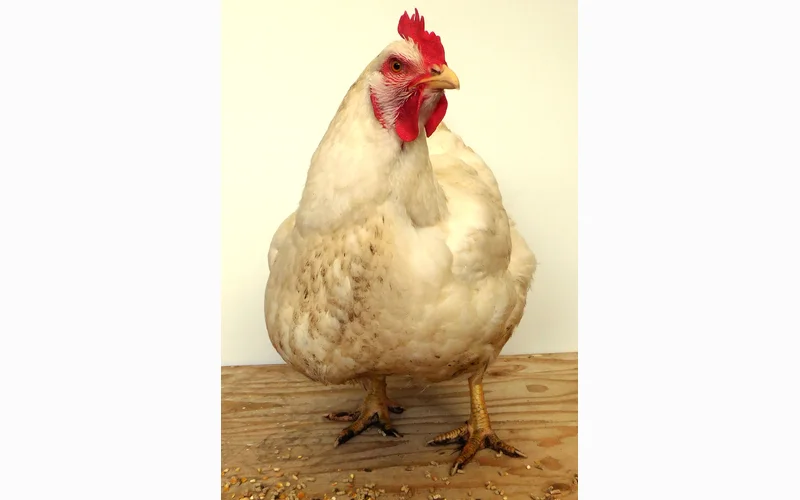 zoom_in Click to Enlarge
Related Calculators
Scientific Literature
- Ross 308 Broiler Performance Objectives (Aviagen, 2021).
- Commercial Broiler Management Handbook (Aviagen Group).
- Nutrient Requirements of Poultry (National Research Council).