
Plymouth Rock Chickens: Barred Rock Heritage Guide & Care
Complete husbandry guide on egg yield curves, barred plumage genetics, cold hardiness, and coop setup.
Scientific Overview
Originating in Massachusetts in the mid-19th century, the Plymouth Rock—most famously recognized in its Barred Rock variety—is one of America's oldest and most beloved dual-purpose heritage breeds. Developed by crossbreeding Dominique, Black Java, and Cochin fowl, the Plymouth Rock was created to give American homesteaders a docile, cold-hardy bird that lay dependable brown eggs through freezing northeastern winters while offering a plump, well-marbled carcass for Sunday dinner. Recognized by the APA in 1874, the breed became the cornerstone of the early commercial broiler industry before modern specialized hybrids were developed. This guide provides actionable husbandry guidance covering sex-linked barring genetics, feed-to-egg economics, coop space parameters, and routine health practices for backyard and pastured flocks.
1. Historical Roots, Varieties & Barred Feather Genetics
The Plymouth Rock belongs to the American Class of poultry. While the Barred variety is the most famous, the APA Standard recognizes seven distinct varieties: Barred, White, Buff, Silver Penciled, Partridge, Columbian, and Blue.
The striking striped appearance of the Barred Rock is controlled by the sex-linked barring gene (B), located on the Z sex chromosome. Because male chickens carry two Z chromosomes (ZZ) and females carry only one (ZW):
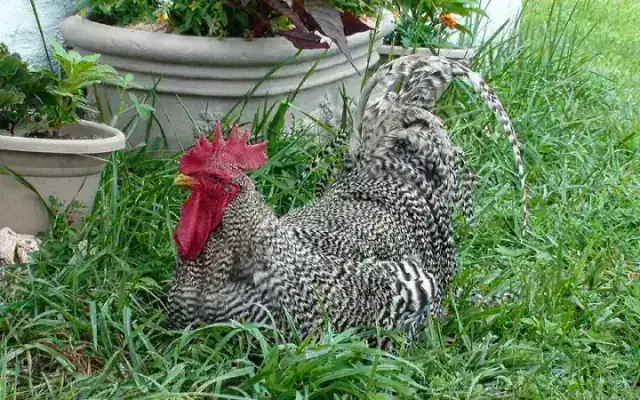
- Double-Barred Males (B/B): Carry two doses of the barring gene, resulting in clean, crisp white bars that are equal in width to the black bars. This gives roosters an overall lighter, silver-gray appearance.
- Single-Barred Females (B/-): Carry only one barring allele, resulting in black bars that are wider than the white bars. This makes hens noticeably darker in color than roosters.
- Chick Down Autosexing: At hatch, Barred Rock chicks are black with a creamy white spot on the head. Male chicks display a larger, irregular, diffused white patch and lighter yellow-tinted shanks, while female chicks have a smaller, tight, well-defined head spot with dark grayish shading down the front of the shanks.
| Standard Weight | Pounds (lbs) | Kilograms (kg) | Body Conformation |
|---|---|---|---|
| Cock | 9.5 lbs | 4.3 kg | Deep, broad breast with full curved carriage |
| Hen | 7.5 lbs | 3.4 kg | Long, broad back with moderately deep abdomen |
| Cockerel (Young Male) | 8.0 lbs | 3.6 kg | Upright balance with firm muscling |
| Pullet (Young Female) | 6.0 lbs | 2.7 kg | Symmetrical frame with tight feather set |
2. Egg Production, Shell Quality & Table Meat Yields
Plymouth Rocks are celebrated for dependable, steady egg production that holds up well during autumn and winter when day lengths shorten. A healthy Barred Rock hen lays between 200 and 280 large brown eggs annually, averaging 4 to 5 eggs per week.
Pullets generally drop their first egg between 20 and 22 weeks of age. Eggs average 2.1 to 2.4 oz (60–68 grams), with strong pinkish-brown to rich brown shells that resist cracking. In their second laying year, hens maintain approximately 80% of their pullet volume, making them highly economical for multi-year backyard flocks.
Calculate your flock's efficiency and egg income using our Hen-Day Egg Production Calculator alongside the Backyard Egg Profit Estimator.
Dual-Purpose Meat Performance
Unlike commercial broilers that reach butcher weight at 6 weeks, heritage Barred Rock cockerels grow at a steady, natural pace. They yield an excellent roasting carcass of 4.5 to 5.5 lbs (2.0–2.5 kg) at 16 to 20 weeks of age. The meat offers deep, traditional chicken flavor and firm texture suited for slow roasting, braising, and rich stocks.
3. Temperament, Family Friendliness & Foraging Habits
The Plymouth Rock is widely regarded by backyard poultry enthusiasts as one of the most docile and friendly breeds available. They are calm, curious birds that rarely start disputes in the coop and quickly adapt to human companionship.
- Child & Family Friendly: Hens enjoy human interaction, often allowing gentle handling and eating directly from hands. Roosters are typically calm and far less aggressive than Mediterranean or fighting game breeds.
- Excellent Foragers: Barred Rocks love free-ranging in fenced yards, hunting grasshoppers, crickets, slugs, and garden weeds. Their active foraging reduces feed costs while enriching yolk coloration with natural beta-carotenes.
- Low Flightiness: Due to their heavy weight and compact wings, adult Plymouth Rocks cannot fly over standard 4-foot (1.2-meter) fences, making containment easy.
- Coop Noise Level: Very quiet birds. Outside of occasional soft clucking and post-lay cackles, they are well-suited for urban and suburban neighborhoods with noise restrictions.
4. Housing Specifications, Roosts & Winter Management
Setting up your coop correctly ensures long-term flock health and prevents foot and feather damage:
- Floor Space: Allow at least 4 sq ft (0.37 sq m) of indoor space per bird, and 10 sq ft (0.93 sq m) in an outdoor predator-proof run. Determine your coop dimensions with the Coop Space Calculator.
- Roost Design: Heavy 7- to 9-lb birds require sturdy wooden roosts. Use 2x4 lumber positioned flat (wide side up) so the foot rests flat without cramping the toes. Keep perches no higher than 24 inches (60 cm) from the floor to avoid bumblefoot upon landing.
- Nesting Boxes: Provide one 12x12-inch (30x30 cm) nesting box for every 4 hens, bedded with clean pine shavings or sweet meadow hay. Dark, secluded nesting areas discourage egg eating.
- Cold Weather Performance: With dense down feathering and medium single combs, Plymouth Rocks thrive in snow and freezing temperatures. Ensure coop ventilation allows moisture to vent out near the roof while keeping roost level free from drafts.
5. Health Maintenance & Common Vulnerabilities
Plymouth Rocks are robust birds with few genetic weaknesses. Keeping them healthy requires simple, consistent management practices:
Because they have hearty appetites, Plymouth Rocks confined to small coops can become overweight if overfed corn or scratch grains. Excess abdominal fat lowers egg production and increases the risk of prolapsed vent. Limit treats to less than 10% of total diet and supply a balanced 16% protein layer pellet. Check feed intake guidelines using the Layer Feed Intake Calculator.
Their dense feathering makes routine checks for northern fowl mites and poultry lice essential. Provide a covered dry dust bath filled with fine sand, peat moss, and food-grade diatomaceous earth to allow natural preening parasite control.
Male Barred Rocks have tall single combs that can freeze during sustained sub-zero cold snaps if humidity builds up inside the coop. Ensure high-level ventilation is open to exhaust bird breath, and apply protective salves when temperatures drop below 0°F (-18°C).
6. Summary & Flock Fit: Should You Choose Plymouth Rocks?
The Plymouth Rock remains one of the safest and most satisfying choices for beginners and veteran homesteaders alike. They combine high brown egg production with docile manners, low flightiness, and rugged hardiness through winter chills. If you want a dependable, friendly flock bird that thrives on backyard forage and produces eggs year after year, the Barred Rock is difficult to beat.
 zoom_in Click to Enlarge
Related Calculators
Scientific Literature
- American Poultry Association. (2023). The American Standard of Perfection. Burgettstown, PA.
- Robinson, J. H. (1924). Principles and Practice of Poultry Culture. Ginn and Company.
- University of Wisconsin-Madison Extension. (2019). Dual-Purpose Heritage Chicken Breeds for Small Farms.