
Rhode Island Red Chickens: Heritage Breed Guide & Care
Complete flock guide on egg production curves, feed intake, coop requirements, and dual-purpose genetics.
Scientific Overview
Developed in the coastal towns of Little Compton and Adamsville, Rhode Island, during the late 19th century, the Rhode Island Red stands as America's foundational dual-purpose farm bird. Early agricultural homesteaders bred local Malay, Java, and black-breasted Red Leghorn fowl with Cochin stock to create a rugged chicken capable of producing steady brown eggs through bitter New England winters while yielding a full-bodied table bird at the end of its laying career. Today, flock owners distinguish between two separate strains: traditional APA heritage lines with deep mahogany plumage and blocky bodies, and high-production commercial Red hybrids bred strictly for maximum egg output. This guide details the physical standards, feeding curves, yard temperament, and seasonal health management required to raise healthy, productive Rhode Island Reds.
1. Lineage, Color Genetics & Physical Standards
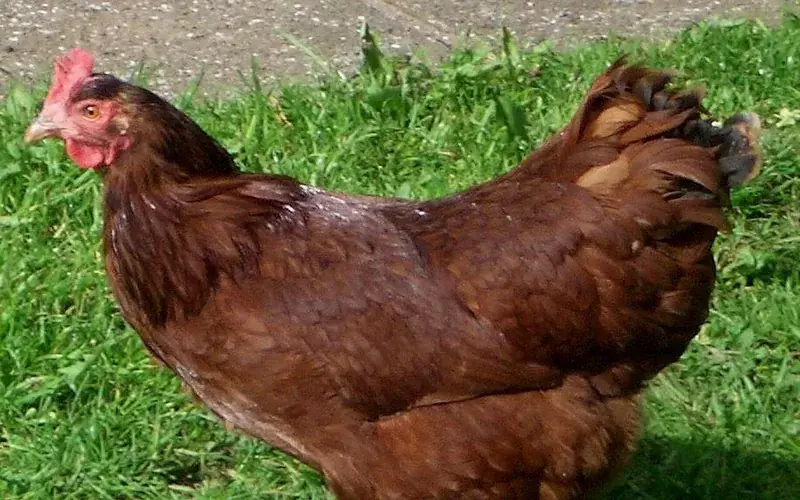
The Rhode Island Red was admitted to the American Poultry Association (APA) Standard of Perfection in 1904 for the single comb variety and in 1905 for the rose comb variety. The breed is classified under the American Class and features a distinctive rectangular, brick-shaped body carried horizontally on sturdy yellow legs.
| Physical Attribute | APA Heritage Standard | Commercial Production Strain |
|---|---|---|
| Mature Cock Weight | 8.5 lbs (3.9 kg) | 5.5–6.5 lbs (2.5–2.9 kg) |
| Mature Hen Weight | 6.5 lbs (2.9 kg) | 4.5–5.0 lbs (2.0–2.3 kg) |
| Plumage Color | Rich dark mahogany red with black main tail feathers | Lighter rust-red, occasional white underdown flecks |
| Comb & Wattles | Medium single comb (5 well-defined points) or rose comb | Large single comb with thin blade |
| Shanks & Toes | Rich yellow with reddish horn line running down sides | Pale yellow, often bleached out during heavy lay |
The plumage of true heritage birds shows a lustrous greenish-black sheen on the tail feathers, with wings displaying black markings in the lower web of the primaries. The skin and carcass fat carry a natural yellow tone driven by dietary carotenoids. The eyes are a sharp reddish-bay color, and earlobes are bright red, indicating the hen lays brown-shelled eggs.
2. Egg Laying Capacity & Growth Curves
Rhode Island Reds are workhorses in the laying pen. Heritage hens begin laying between 20 and 24 weeks of age, hitting peak production around 30 to 34 weeks. While commercial strains reach point-of-lay earlier (18 to 20 weeks) and produce up to 280 to 300 eggs per year, traditional heritage lines average 220 to 260 large brown eggs annually with thicker shells and persistent multi-year output.
Flock keepers can track actual lay rates using the Hen-Day Egg Production (HDEP) Calculator. In their second laying year, heritage Reds retain 80% to 85% of their pullet-year volume, outperforming light hybrid layers that drop sharply after 14 months of lay.
For homesteaders calculating flock operating margins, use our Backyard Egg Profitability Calculator to balance feed costs against daily carton sales.
3. Yard Temperament, Social Rank & Noise Levels
Rhode Island Reds are confident, curious, and assertive birds. In mixed-breed backyard flocks, Red hens almost always claim the upper spots on the roosting pecking order. They are active and alert, spending hours scratching through leaf litter, pasture grass, and garden beds to hunt for beetles, grubs, and weed seeds.
Rooster Behavioral Management
While hens are friendly, approachable, and often learn to run toward their keeper for mealworm treats, Rhode Island Red roosters have a well-documented reputation for territorial drive. During breeding season (spring and early summer), mature cocks actively defend their flock from perceived threats, including yard dogs, small children, and visitors.
Keepers raising Reds in suburban backyards should handle young cockerels calmly and regularly without hand-feeding aggression games, or simply keep a hen-only flock to maintain peaceful yard routines.
In terms of noise, hens are relatively quiet during the day, vocalizing mainly during the 5-minute "egg announcement song" after laying. They tolerate fenced confinement well, provided they receive sufficient floor space and environmental stimulation to prevent feather pecking.
4. Coop Design, Roost Spacing & Winter Care
Because Rhode Island Reds are heavy-bodied birds, coop layout must be designed to protect their joints and feathers:
- Floor Space: Provide a minimum of 4 sq ft (0.37 sq m) per bird inside the enclosed coop, and 8 to 10 sq ft (0.75–0.93 sq m) in the outdoor predator-proof run. Plan your coop dimensions accurately using the Coop Space & Housing Density Tool.
- Roosting Bars: Use 2x4 lumber with the wide 3.5-inch (8.9 cm) side facing upward, corners lightly rounded. This allows heavy Reds to sleep with their feet flat, covering their toes with breast feathers to prevent winter frostbite. Allow 10 to 12 inches (25–30 cm) of roost length per adult bird.
- Roost Height: Position perches no higher than 24 to 30 inches (60–75 cm) off the bedding floor, or provide an intermediate ramp. When heavy 7-lb hens drop down onto hard surfaces, high drops frequently cause foot bruising and bumblefoot lesions.
- Winter Ventilation: Reds tolerate sub-zero temperatures down to -10°F (-23°C) effortlessly if the coop remains draft-free at bird level with open ridge vents near the roofline. Cold dry air is harmless; damp humid air trapped inside causes frostbitten comb points. In severe cold, apply plain petroleum jelly or natural beeswax balm to large single combs.
5. Health Vulnerabilities & Nutritional Management
Rhode Island Reds are exceptionally hardy birds with strong natural disease resistance. However, their high production drive and dense body mass introduce a few specific husbandry considerations:
Because they produce large, dense eggs, pullets coming into lay require steady calcium access. Offer free-choice coarse crushed oyster shell in a separate feeder alongside their 16% layer pellets. Do not rely solely on fine limestone meal mixed into commercial mash, as large hens absorb coarse grit over several hours overnight while forming the eggshell.
Due to their active scratching habits and heavy body weight, check footpads monthly for dark scabs. Ensure coop litter (kiln-dried pine shavings or coarse straw) is kept at least 4 to 6 inches (10–15 cm) deep to cushion landings.
While cold-hardy, dark-feathered heavy birds suffer when temperatures climb above 85°F (29°C). Monitor heat stress indices with our Poultry Heat Stress (THI) Calculator and provide shaded run canopies and chilled water fonts with electrolytes during midsummer heat waves.
6. Practical Decision Guide: Is the Rhode Island Red Right for You?
Choosing the Rhode Island Red depends on your homestead goals and family environment:
- Ideal For: Homesteaders and small-scale egg producers looking for self-reliant, predator-aware birds that lay 4 to 5 large brown eggs weekly while maintaining excellent forage efficiency.
- Not Ideal For: Mixed flocks with very delicate, timid breeds (like Polish or Faverolles) who may be pushed around by assertive Red hens, or families with small children seeking an overly docile lap chicken (consider Buff Orpingtons or Australorps instead).
When purchasing chicks, confirm whether the hatchery offers APA Standard Heritage stock (best for multi-year longevity and true breed conservation) or Production Red hybrids (best for maximum first-year egg numbers).
 zoom_in Click to Enlarge
Related Calculators
Scientific Literature
- American Poultry Association. (2023). The American Standard of Perfection. Burgettstown, PA.
- Damerow, G. (2015). The Chicken Health Handbook (2nd ed.). Storey Publishing.
- Savage, T. F. (2010). Heritage Breeds and Genetic Selection in Farm Poultry. Oregon State University Extension.