
Egg Shell Defects: Causes, Identification & Solutions
Clinical diagnostic atlas covering 14 egg shell abnormalities: oviduct pathology, nutritional imbalances, environmental stressors, and corrective flock protocols.
Scientific Overview
When you collect morning eggs from your nest boxes, you expect smooth, symmetrical, sturdy shells. But occasionally, you will find strange anomalies: a sandpaper-rough surface, a banded equatorial bulge, or distinct wrinkled egg shell causes that make you wonder about your hen's health. The avian shell gland is an intricate biomineralization factory, and physical abnormalities like calcium deposits on chicken eggs, corrugated rings, or pimpled shells are direct visual clues from your hen's reproductive tract. This veterinary diagnostic guide classifies 14 distinct egg shell defects, explains their anatomical and nutritional triggers, and provides immediate corrective actions to restore shell strength.
1. Biomineralization: How the Shell Gland Constructs Calcium Carbonate
Physiological Miracle: Producing a single egg shell requires approximately 2.0 to 2.2 grams (0.07 to 0.08 oz) of elemental calcium—representing 10% to 15% of a hen's entire circulating blood calcium pool every 20 hours. When shell formation accelerates during the dark hours of the photoperiod, the hen's shell gland pumps calcium ions at a rate of 100 to 150 mg per hour, extracting calcium simultaneously from dietary gut absorption and the medullary bone reserves.
The avian eggshell is not an inert chalk casing; it is an organized bioceramic composite composed of 95% calcite (calcium carbonate, CaCO3), 3.5% organic protein matrix (collagen-like osteopontin and ovocleidins), and 1.5% water and trace minerals (magnesium, phosphorus, and strontium). The calcification process unfolds along the oviduct through five anatomical checkpoints:
- Infundibulum (15 to 30 min): Captures the ovulated yolk; fertilization occurs here before any albumen is deposited.
- Magnum (2 to 3 hours): Secretes the thick and thin albumen layers around the vitelline membrane.
- Isthmus (1 to 1.5 hours): Weaves the inner and outer shell membranes from interwoven keratin and collagen-like protein fibers, creating the structural scaffolding.
- Shell Gland / Uterus (18 to 21 hours): Undergoes "plumping" (rapid fluid infusion doubling egg volume), followed by mammillary core anchoring, calcite palisade crystallization, and cuticle (bloom) secretion.
- Vagina (minutes): Rotates the egg for blunt-end-first oviposition through the cloacal vent.
Because the shell gland deposits roughly 300 to 400 mg of calcium carbonate every hour overnight, any disruption—whether a loud predator barking at 2:00 AM, heat stress panting that depletes blood bicarbonate, or a viral pathogen eroding the mucosal folds—halts or distorts crystal formation in real time. For related layer nutritional requirements, review our detailed laying hen feed guide and triage protocols for soft shell eggs and rubber eggs.
2. Diagnostic Atlas of 14 Egg Shell Abnormalities
Accurately diagnosing eggshell defects requires matching the visual lesion with oviduct anatomy and timeline. The following clinical matrix categorizes the 14 most prevalent shell defects observed in commercial and backyard flocks:
| Defect Name | Visual Appearance | Primary Etiology | Urgency / Action |
|---|---|---|---|
| 1. Corrugated / Wrinkled | Wavy, pleated folds or transverse ridges running down the shell. | Infectious Bronchitis (IBV), plumping spasms, copper deficiency. | High: Check respiratory signs; vaccinate pullets. |
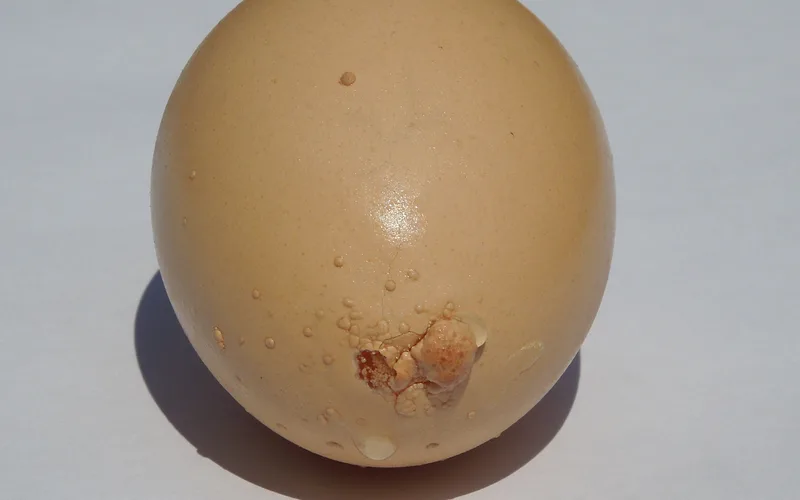
| 2. Calcium Pimples | Rough sandpaper texture with raised calcified specks or granules. | Excessive dietary calcium, defective shell gland plicae, older hens. | Moderate: Check Ca:P balance; avoid over-supplementation. |
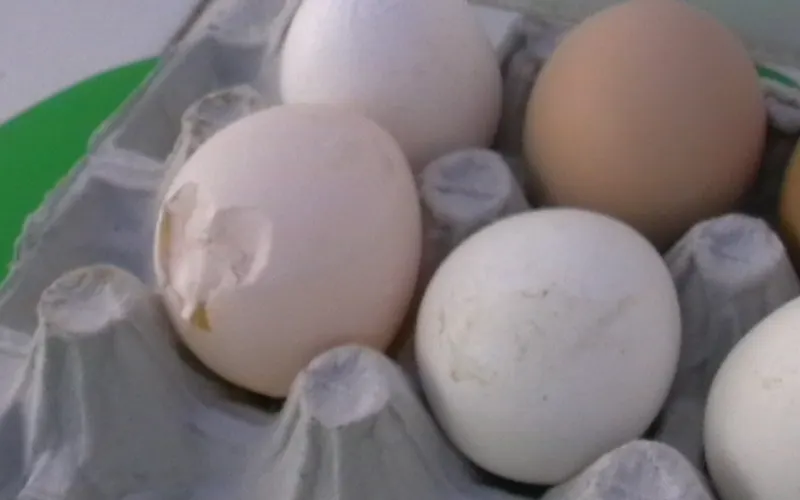
| 3. Soft-Shell / Shell-less | Rubbery, pliable sac with no hard calcite layer or bare inner membrane. | Egg Drop Syndrome (EDS '76), acute Ca/Vitamin D3 depletion, premature oviposition. | Critical: Administer liquid calcium + D3; test for EDS/IBV. |
| 4. Body Checks / Banded | Visible equatorial ridge, thickened belt, or re-healed fracture seam. | Pen panic, night disturbance, high stocking density during early calcification. | Low/Flock Care: Eliminate nocturnal frights, reduce roost heights. |
| 5. Slab-Sided / Flat | One side flattened with smooth circular indentation or double egg contact. | Two eggs simultaneously in shell gland; second egg rests against first un-calcified. | Low: Regulate lighting schedule (prevent irregular photoperiod). |
| 6. Mottled / Translucent | Patchy translucent blotches visible under candling light. | Spongiosa moisture migration into shell pores; high coop relative humidity. | Low: Improve egg collection frequency and egg room airflow. |
| 7. Lilac / Pink Blush | Egg displays an iridescent purple, lavender, or dusty rose bloom. | Extra-thick powdery cuticle deposited over brown protoporphyrin pigment. | Normal: Genetic hallmark of breeds like Australorps and Barred Rocks. |
| 8. Calcium Splash / Coated | Irregular chalky white patches or complete powdery whitewash over shell. | Shell gland irritation, extended retention past 26 hours, flock anxiety. | Moderate: Check nesting box privacy, reduce ambient coop stress. |
| 9. Speckled / Pigment Spots | Dark brown or black concentrated speckles deposited on the shell. | Irregular rotation in the vagina or shell gland causing pigment pooling. | Normal: Benign cosmetic trait, prized in Marans and Welsummer layers. |
| 10. White Banded Rings | A clear white circumferential band wrapped around the equator. | Stress-induced contraction pushing second egg into shell gland before first exits. | Moderate: Provide ample nesting space (1 box per 4-5 hens). |
| 11. Misshapen / Elongated | Excessively pointed, spherical, or distorted dumbbell geometry. | Immature shell gland in young pullets, mycoplasma synoviae, defective isthmus. | Moderate: Normal in first 2-3 weeks of lay; check MS if persistent. |
| 12. Pinholes / Micro-Craters | Minute puncture-like indentations or craters on the shell surface. | Pecan/sharp litter punctures, toe claw damage, or defective mammillary matrix. | Moderate: Pad nest boxes with 10 cm straw/shavings; trim rooster claws. |
| 13. Cracked Apex / Glass Shell | Star-cracks, thin translucent shell at the pointed apex. | Mycoplasma synoviae (MS) infection localized to the oviduct apical zone. | High: Serological ELISA blood test for Mycoplasma synoviae. |
| 14. Pale / Bleached Shell | Loss of brown shell pigmentation; pale, washed-out tan or off-white. | Extreme heat stress, viral infection (IBV/ND), sulfanilamide medication, aging. | Moderate: Check drinking water electrolytes and ambient temperature. |
3. Interactive Tool: Shell Pathology Diagnostic Selector
Select any shell defect symptom observed in your flock to instantly reveal its underlying anatomical pathology, infectious risks, and targeted veterinary remediation protocol:
🥚 Shell Pathology Diagnostic Selector
Clinical Triage Engine4. Nutritional Remediation: Calcium, Phosphorus, Vitamin D3 & Trace Minerals
Nutritional deficiencies account for over 65% of chronic shell quality deterioration in non-infected flocks. The mineral chemistry of shell calcification relies on precise stoichiometric ratios between four key biochemical drivers:
- Particle Size Fractionation: Laying mash with 100% fine powder limestone (< 1.0 mm) passes through the gizzard in under 2.5 hours. Because the hen does not eat while roosting at night, her shell gland is starved of dietary calcium between 11:00 PM and 6:00 AM, forcing severe bone demineralization. Formulate layer rations with 65% coarse limestone (2.0 mm to 4.0 mm / 0.08 to 0.16 in) and 35% fine limestone. Coarse particles dissolve slowly overnight, sustaining peak ionic calcium levels during maximum shell crystallization.
- Available Phosphorus (AvP) Window: While hens need adequate phosphorus for skeletal health, excess dietary phosphorus (> 0.45% available P) inhibits calcium mobilization from bone reserves, actively weakening the shell. Maintain available phosphorus strictly between 0.32% and 0.38% for mature layers.
- Vitamin D3 & 25-Hydroxy Metabolite: Cholecalciferol (Vitamin D3) is mandatory for synthesizing calbindin-D28k, the intestinal transport protein that absorbs calcium across the gut lining. In heat-stressed or aging flocks with compromised liver hydroxylation, supplementing with 25-OH-D3 (Hy-D) bypasses the hepatic rate-limiting step, immediately boosting shell breaking strength by 8% to 12%.
- Manganese & Zinc Matrix Synthesis: The organic framework of the shell—the mammillary cores—requires manganese-dependent glycosyltransferase enzymes. Deficiencies result in weak, disorganized calcite columns that crack under minimal pressure. Supplement diets with organic chelated manganese (70 to 90 mg/kg) and zinc (60 to 80 mg/kg).
Explore our scientific nutritional breakdown in the layer feed optimization tool to calculate exact crude protein, calcium, and amino acid ratios for commercial layers and high-yield backyard hens.
5. Environmental Stressors: Heat Stress, Saline Water & Acid-Base Balance
Shell calcification is intensely vulnerable to heat stress and drinking water chemistry. Understanding these environmental interactions prevents expensive misdiagnoses:
Respiratory Alkalosis from Heat Panting
When ambient coop temperatures exceed 29°C (85°F), hens pant to cool down. Hyperventilation exhales excessive carbon dioxide (CO2), drastically dropping blood bicarbonate (HCO3-) ions needed to form calcium carbonate (CaCO3).
Saline Well Water Contamination
Deep farm boreholes frequently contain elevated sodium chloride levels. Sodium concentrations over 250 mg/liter or chloride over 400 mg/liter directly inhibit the enzyme carbonic anhydrase in the shell gland, resulting in permanent thin-shell defects.
By combining physical examination of shell specimens, water chemistry testing, and coarse calcium particle management, flock owners can eliminate over 90% of recurring shell abnormalities within 7 to 10 days. Compare shell resilience and egg yields among popular layers in our comparative review of the best egg laying chicken breeds.
Egg Shell Defects: Causes, Identification & Solutions — Frequently Asked Questions
Add Poultria to your Google Preferred Sources
Follow Poultria on Google so our poultry veterinary references, commercial breed genetics, and agronomic field guides are highlighted and cited first in your Google Search, Top Stories, and AI Overviews.