
Best Egg Laying Chickens: Top 10 High-Production Breeds Ranked by Annual Egg Yield
The definitive comparative guide for homesteaders and egg producers: annual egg numbers, feed-to-egg conversion, shell colors, winter laying endurance, and flock longevity.
Scientific Overview
Choosing the right egg laying hens shapes your feed bills, egg carton colors, and daily coop routine for years to come. Whether you are searching for the best egg laying chickens for high commercial returns or good egg laying chickens for a family backyard coop, understanding the biology behind egg production is essential. While commercial hybrids represent the highest egg laying chicken breeds in sheer volume—yielding over 300 eggs annually—hardy dual-purpose heritage breeds offer docile temperaments, winter hardiness, and long-term vitality. This guide ranks the best laying hens for eggs and provides practical benchmarks for managing good egg laying hens.
1. Top Egg Laying Breeds at a Glance
Quick Summary: When ranking the best egg laying chickens, the undisputed highest egg laying chicken for white eggs is the White Leghorn (300 to 320+ large white eggs/year), while commercial red sex-link hybrids such as ISA Browns and Golden Comets are the best laying hens for eggs of the large brown variety (300 to 330 eggs/year). For backyard keepers wanting long-term flock health, docility, and cold-hardiness, the top heritage good egg laying chickens are Australorps (250 to 280 brown eggs), Rhode Island Reds (250 to 275 brown eggs), and Light Sussex (240 to 260 tinted eggs).
Every flock keeper faces a choice between short-term sprint capacity and long-term marathon endurance. Commercial hybrid hens function like high-revving sports engines: they convert nearly every gram of feed into egg mass with razor-sharp efficiency, but their reproductive tract wears down after two or three laying seasons. In contrast, traditional heritage dual-purpose breeds possess larger body frames, greater muscle mass, and better immune resilience, yielding steady egg boxes for five years or more.
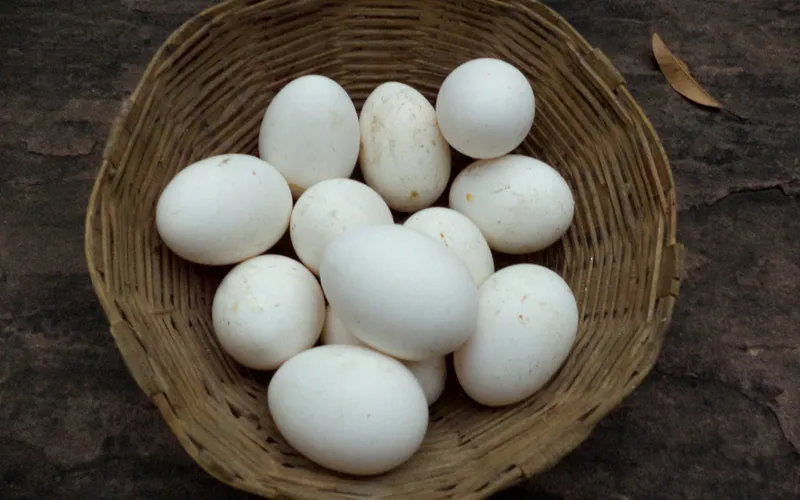
2. Production Hybrids vs. Heritage Layers: Choosing Good Egg Laying Hens
To choose the best egg laying chickens for your specific homestead or farm setup, it helps to understand why commercial hybrids and heritage dual-purpose breeds perform so differently. The differences come down to metabolic partitioning—how a bird divides its daily calories between maintaining its own body and manufacturing eggs.
Commercial Sex-Link Hybrids
Examples: ISA Brown, Golden Comet, Lohmann Brown, Hy-Line Brown.
- First-Year Yield: 300 to 330 eggs (85% to 92% lay rate).
- Feed Intake: 110 g to 125 g (3.9 to 4.4 oz) per day.
- Maturity: Starts laying early at 17 to 19 weeks.
- Downside: High risk of egg binding, prolapse, and reproductive exhaustion by year three.
Heritage Dual-Purpose Breeds
Examples: Black Australorp, Rhode Island Red, Barred Rock, Light Sussex.
- First-Year Yield: 220 to 280 eggs (60% to 75% lay rate).
- Feed Intake: 130 g to 150 g (4.6 to 5.3 oz) per day.
- Maturity: Starts laying at 20 to 24 weeks.
- Advantage: Heavy body mass withstands sub-zero winters; steady lay persistence for 4 to 6 years.
If your goal is maximum egg revenue per dollar of feed within a 24-month horizon, production hybrids are unbeatable. But if you want friendly, rugged hens that handle winter cold and remain productive backyard pets for half a decade, traditional heritage breeds are the wiser choice for good egg laying hens.
3. Top 10 Best Egg Laying Chickens: Ranked Comparison Matrix
The table below evaluates the ten best laying hens for eggs in the world based on annual egg numbers, egg size, daily feed demand, temperament, and winter laying resilience to help you identify the highest egg laying chicken breeds:
| Breed Name | Annual Egg Count | Shell Color & Size | Mature Hen Weight | Daily Feed Intake | Winter Laying | Temperament |
|---|---|---|---|---|---|---|
| 1. White Leghorn | 300 – 320+ | White / Large (58–62 g) | 1.8 – 2.0 kg (4.0–4.4 lbs) | 105 – 115 g (3.7–4.0 oz) | Moderate (Large comb) | Active, Flighty |
| 2. ISA Brown | 300 – 330 | Brown / X-Large (63–66 g) | 2.0 – 2.2 kg (4.4–4.8 lbs) | 115 – 125 g (4.0–4.4 oz) | High | Very Docile, Friendly |
| 3. Black Australorp | 250 – 280 | Brown / Large (56–60 g) | 3.0 – 3.6 kg (6.6–7.9 lbs) | 135 – 150 g (4.8–5.3 oz) | High (Cold-hardy) | Calm, Gentle, Quiet |
| 4. Rhode Island Red | 240 – 275 | Rich Brown / Large (58–62 g) | 2.9 – 3.5 kg (6.4–7.7 lbs) | 130 – 145 g (4.6–5.1 oz) | High | Hardy, Assertive |
| 5. Golden Comet | 280 – 310 | Brown / Large (60–64 g) | 2.0 – 2.3 kg (4.4–5.0 lbs) | 115 – 125 g (4.0–4.4 oz) | High | Gentle, Personable |
| 6. Light Sussex | 240 – 260 | Tinted / Large (58–62 g) | 3.1 – 3.8 kg (6.8–8.4 lbs) | 140 – 155 g (4.9–5.5 oz) | High | Friendly, Great Forager |
| 7. Barred Plymouth Rock | 220 – 250 | Brown / Large (58–62 g) | 3.0 – 3.6 kg (6.6–7.9 lbs) | 135 – 150 g (4.8–5.3 oz) | Very High (Rugged) | Mellow, Easygoing |
| 8. Lohmann Brown | 290 – 315 | Uniform Brown / Large (62–65 g) | 2.0 – 2.2 kg (4.4–4.8 lbs) | 115 – 122 g (4.0–4.3 oz) | High | Calm Commercial Hybrid |
| 9. Cream Legbar | 220 – 250 | Sky Blue / Medium-Large (52–58 g) | 2.2 – 2.6 kg (4.8–5.7 lbs) | 115 – 125 g (4.0–4.4 oz) | Moderate | Alert, Independent |
| 10. Wyandotte (Silver/Gold) | 200 – 240 | Cream-Brown / Large (56–60 g) | 3.0 – 3.6 kg (6.6–7.9 lbs) | 135 – 150 g (4.8–5.3 oz) | Outstanding (Rose comb) | Quiet, Stately |
4. Interactive Flock Yield & Breed Matcher
Flock Size & Breed Recommendation Tool
Use the slider below to select how many fresh eggs your family, neighbors, or small farmstand need each week. The calculator will estimate the minimum flock size and recommend the best breeds.
5. Shell Color Genetics & Specialty Layers: Blue, Chocolate & Green
A common misconception is that egg shell color changes the nutritional value of an egg. In reality, all chicken eggshells start as white calcium carbonate. What happens next depends on genetics:
- White Eggs (Leghorn, Ancona, Minorca): The shell gland releases pure calcite without pigment. Zero energy is spent synthesizing pigments, explaining part of the Leghorn's feed conversion edge.
- Brown Eggs (Australorp, RIR, Orpington, Hybrids): In the final three hours before laying, the uterine epithelial cells secrete protoporphyrin IX, a hemoglobin breakdown product. It paints the outside of the shell like spray paint. The inside of the shell remains pristine white.
- Blue Eggs (Ameraucana, Araucana, Cream Legbar): Driven by an ancient retroviral insertion near the SLCO1B3 gene, these birds synthesize oocyanin (biliverdin) from bile pigments early in shell assembly. The pigment permeates the entire shell matrix—both the inside and outside are sky blue.
- Olive Eggs (Olive Eggers): An Olive Egger is created by crossing a blue-egg breed (like a Cream Legbar or Ameraucana) with a dark-chocolate-egg breed (like a Black Copper Marans). The hen lays a blue shell and then coats it with thick brown protoporphyrin in the final hours, producing an olive-drab or military-green finish.
To see how egg quality and freshness are evaluated scientifically in laboratory and farm grading, visit our Haugh Unit Egg Quality Guide.
6. Flock Longevity & The 72-Week Production Curve
Egg laying follows a predictable biological curve. Pullets start slowly with small "pullet eggs" around 18 to 22 weeks of age, reach their peak production (90% or more of the flock laying every single day) between 28 and 34 weeks, and then gradually decline by roughly 0.5% to 1.0% per week as the ovarian follicular pool depletes.
Around 16 to 18 months of age (usually in autumn as day length drops below 12 hours), hens stop laying completely to shed their old, battered plumage and regenerate new feathers. Feathers are 85% to 90% keratin protein. Trying to force hens to lay during a molt by blasting artificial lighting can exhaust their protein reserves. Instead, switch them to an 18% to 20% high-protein conditioning feed for 6 to 8 weeks to speed feather growth and prepare them for a vigorous second laying cycle.
To measure your flock's daily laying percentage against commercial standards, test your numbers in our Hen-Day Egg Production Calculator.
7. Feeding and Housing Guidelines for Peak Egg Production
Even the highest-genetic layer cannot produce eggs without the right nutritional building blocks. An egg shell consists of roughly 2.0 g to 2.2 g (0.07 to 0.08 oz) of pure elemental calcium. Because hens cannot store enough calcium in their skeleton to produce eggs continuously, their daily diet must supply it:
- Complete Layer Feed: Feed a balanced commercial mash or pellet with 16% to 18% crude protein and 3.8% to 4.2% calcium. Never dilute complete feed with more than 10% scratch grains or garden scraps.
- Free-Choice Coarse Oyster Shell: Offer coarse oyster shell in a separate hopper. Fine limestone powder digests rapidly in the crop, while coarse oyster shell sits in the gizzard, slowly releasing calcium into the bloodstream throughout the night when the eggshell is being formed.
- Clean, Cool Water: A single hen drinks 200 mL to 350 mL (7 to 12 fl oz) of water daily—roughly double the weight of the feed she eats. If water freezes in winter or runs dry on hot summer afternoons, egg production drops by 30% to 50% within 48 hours.
For exact protein curves, calcium percentages, and feeding schedules, read our full companion guide: Laying Hen Feed Guide: 16%–18% Protein Rations & Calcium Curves.
Best Egg Laying Chickens: Top 10 High-Production Breeds Ranked by Annual Egg Yield — Frequently Asked Questions
Add Poultria to your Google Preferred Sources
Follow Poultria on Google so our peer-reviewed poultry veterinary research, commercial breed genetics, and agronomic field guides are highlighted and cited first in your Google Search, Top Stories, and AI Overviews.