
Heating a Chicken Coop Safely: Radiant Panels vs Heat Lamps
Engineering guide to winter poultry thermodynamics: down feather insulation, combustion fire hazards, safe flat-panel radiant heaters, and draft-free ventilation.
Scientific Overview
Every winter, hundreds of chicken coops burn to the ground, killing entire backyard flocks and threatening human residences because well-meaning keepers install dangerous 250-watt glass clamp heat lamps. From a veterinary physiology standpoint, healthy adult chickens do not need their coop heated like a living room. An adult hen is wrapped in an extraordinary natural insulation jacket consisting of thousands of interlocking contour feathers and plumulaceous down that effortlessly trap body heat at 40.5°C to 41.7°C (105°F to 107°F). Furthermore, artificial coop overheating prevents birds from acclimating to winter temperatures, making them fatally vulnerable to sudden hypothermic shock if an ice storm knocks out electrical power. When supplemental heating is legitimately required—such as during sub-arctic polar vortexes below -20°C (-4°F) or for large-combed Mediterranean breeds prone to severe frostbite—it must be deployed using zero-combustion radiant flat panels and zero-draft ventilation balance. This manual details the physics of coop winterization, analyzes fire-safe heating equipment, and provides an interactive winter heating requirement calculator.
1. Avian Thermoregulation: Down Feathers & Metabolic Thermogenesis
Physiological Thermogenesis: A mature hen maintains a core body temperature between 40.5°C and 41.7°C (105°F and 107°F). Under cold stress, chickens do not sweat or huddle helpless; they puff out their contour feathers to trap a 2 cm dead-air boundary layer with an effective insulation value of R-10, tuck their head and unfeathered beak under their wing hackles, and tuck their shanks firmly into their ventral down feathers on a wide wooden roost.
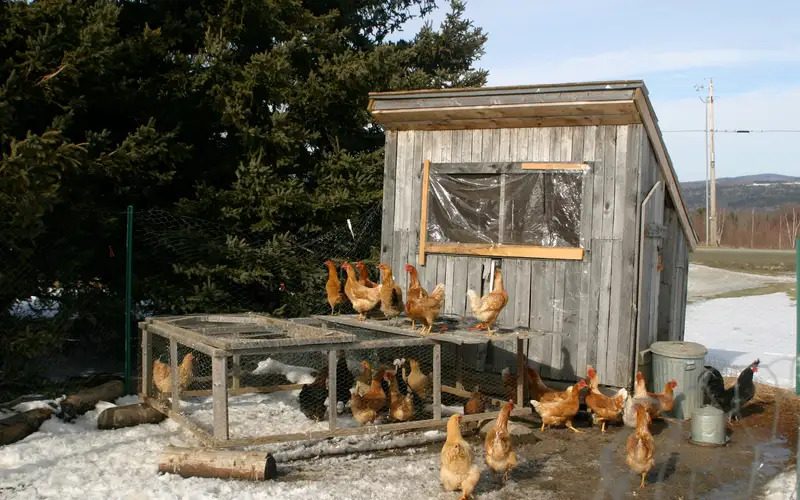
Chickens generate massive internal heat through metabolic feed digestion. Fermenting coarse grains and high-protein feed in the crop and gizzard acts like a miniature internal furnace. Feeding your flock a handful of cracked corn or whole oats immediately before evening lockup fuels active microbial digestion throughout the night, boosting internal metabolic heat by 15% to 20% during the coldest pre-dawn hours. Hardy heritage dual-purpose breeds like the Plymouth Rock, Rhode Island Red, and Australorp thrive in sub-zero winters with zero artificial heating.
2. The Heat Lamp Menace vs. Radiant Flat Panels
The conventional agricultural heat lamp is the single most destructive appliance in backyard poultry keeping. Understanding the engineering differences between convective heat lamps and safe radiant panels is a matter of life and death:
Clamp-On Glass Heat Lamps (PROHIBITED)
- Power: 250 Watts convective drawing 2.1 Amps continuous.
- Bulb Surface Temp: Exceeds 260°C (500°F).
- Failure Mode: Spring clamps slip; wing dust settles on hot glass; birds panic and collide with cord.
- Thermal Shock Risk: Creates an artificial 15°C (60°F) bubble. When a winter power blackout strikes, unacclimated birds freeze to death within 4 hours.
Radiant Flat Panels (VETERINARY APPROVED)
- Power: 100 to 200 Watts radiant heat only.
- Surface Temp: Thermostatically capped at 65°C to 75°C (150°F to 167°F).
- Safety Profile: Zero glowing filaments or exposed glass; will not ignite dry pine shavings even on direct physical contact.
- Targeted Warmth: Warms hens standing next to the panel like sunshine without heating the ambient air mass or ruining winter acclimatization.
For coop structural engineering standards and predator-proof hardware cloth specifications, review our comprehensive build manuals: Predator-Proof Chicken Coop: Hardware Cloth, Aprons & Locks and Chicken Coop Plans & Dimensions: Floor Space & Roost Calculator.
3. Interactive Winter Heating & Frostbite Risk Calculator
Coop Winter Heating & Frostbite Risk Diagnostic Tool
Input your expected winter low temperatures, flock breed anatomy, and coop insulation to determine if supplemental radiant heat is clinically required:
At -12°C (10.4°F), medium single-comb hens maintain robust core body temperatures through normal feather down insulation and huddling. Supplemental heat is contraindicated.
• Ventilation: Maintain 0.1 m² (1 sq ft) of high-ridge soffit opening to vent humid breath.
• Roost Bars: Ensure roosts are 2x4s with the wide 8.9 cm (3.5 in) face turned flat up so breast feathers cover feet.
• Water Heating: Use an electric submersible poultry water de-icer base (40W) to keep water liquid without heating air.
4. Moisture Physics: Why Ventilation Beats Insulation for Frostbite Prevention
Backyard keepers often wrap their coop in airtight plastic sheeting or seal every seam to 'keep the warmth in.' This is the single most common cause of severe comb frostbite and winter respiratory illness. The biophysics of winter humidity explain why:
- Respiratory Exhalation Volume: A flock of 10 laying hens respires approximately 1.0 to 1.5 liters (0.26 to 0.40 gallons) of water vapor into the coop air every single night through breath and moist cecal droppings.
- Dew Point Condensation: Warm air holds more moisture than cold air. When moisture-laden breath rises toward an unventilated ceiling, it contacts cold wall surfaces, condensing into ice droplets that settle onto the protruding, unfeathered comb tips and wattles of sleeping hens.
- Ischemic Necrosis: Liquid condensation destroys the insulating air boundary around delicate comb tissue. At -5°C (23°F), damp comb tissue rapidly freezes solid, bursting cellular capillaries and turning the serrated tips black within 6 hours. In contrast, bone-dry comb tissue routinely tolerates -15°C (5°F) with zero damage.
- The High-Ridge Rule: Keep vents situated high above the roost line (at least 30 cm / 12 in above the highest roosting bar) covered with 6 mm (0.25 in) hardware cloth. This creates a thermal chimney: warm, wet air naturally exits through the apex, while the sleeping hens remain sheltered in a completely draft-free lower zone.
Heating a Chicken Coop Safely: Radiant Panels vs Heat Lamps — Frequently Asked Questions
Add Poultria to your Google Preferred Sources
Follow Poultria on Google so our peer-reviewed poultry veterinary research, commercial breed genetics, and agronomic field guides are highlighted and cited first in your Google Search, Top Stories, and AI Overviews.